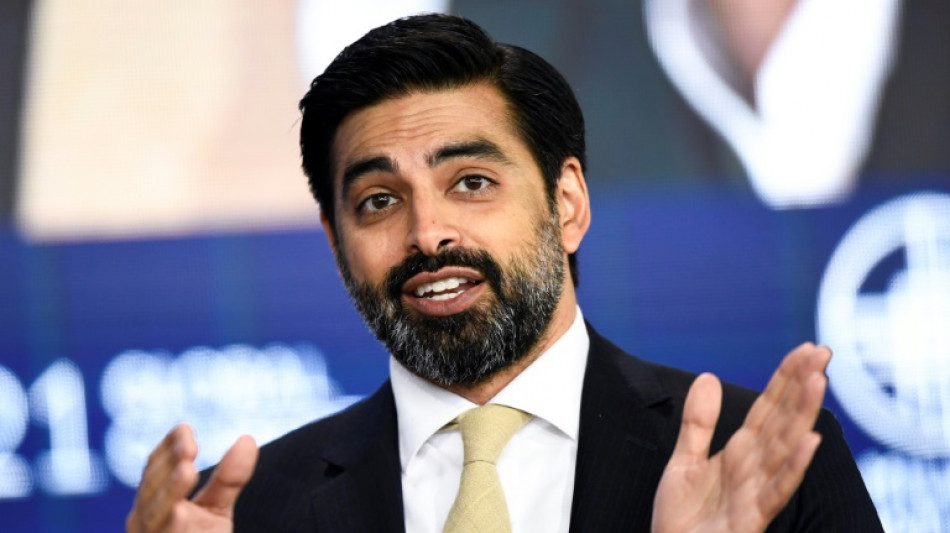
WHO seeking quick bucks from business via foundation / Photo: © AFP

 Piracy attacks off Somalia surge in 2026: AFP analysis of IMO data

 Tottenham land Marmoush from Manchester City

 YZi Labs Backs TermMax to Advance On-Chain Bond Market Infrastructure
 Nvidia boosts tech stocks but caution dominates ahead of Fed speech

 Pogacar holds off Mas to claim Vuelta stage six victory

 A lasting Dolly Parton legacy: childhood literacy

 S.Africa sounds alarm as infant vaccinations plummet
 Toulouse have salary cap fine reduced on appeal

 Tech stocks lifted by Nvidia but caution dominates ahead of Fed speech
 'Smart cricketer' Dinusha helps Sri Lanka draw second India Test

 Zambia opposition leader surrenders to police: state media

 Alleged 9/11 mastermind to go on trial in June 2028
 Abbas's treble strike rocks England in second Test
 'Butcher of Bosnia' Ratko Mladic dead: Serbian state media

 New Zealand make three changes for second South Africa Test
 Stocktwits Expands CME Group Alliance with the Integration of Single Stock Futures Data

 'Mature' Colapinto extends contact with Alpine through 2027

 Atletico rule out any talks with Barcelona over Alvarez
 Tech stocks lifted by Nvidia as broader markets struggle

 Delap joins Nottingham Forest in club-record deal

 ICC President Akane Warns U.S. Sanctions Threaten Court's Future
 Delays in Cancer Radiotherapy and Surgery Target Times
 Acrid stench, charred walls reveal devastation of Pakistan infant ward fire

 Norway holds its breath as King Harald's health deteriorates

 Germany reports record 15,800 heat-related deaths this summer
The World Health Organization is sourcing rapid response financing directly from companies to help tackle international crises, through the foundation it set up to bridge the shortfall from member states.
The WHO Foundation -- set up in May 2020 as the UN health agency scrambled for resources to fight the Covid-19 pandemic -- was created to marshal new resources from business and philanthropists.
The foundation, which went live in January 2021, aims to "mobilise more support for the WHO, from the public, from businesses, from philanthropists," its chief executive Anil Soni told AFP.
"No organisation, no sector can solve the challenges that the world is facing alone," the 46-year-old American said.
The WHO has a two-year budget of $5.8 billion but its financial independence has steadily declined.
Its 194 member states provide barely 16 percent of the organisation's financing through membership fees.
The rest comes from voluntary contributions, of which 88 percent are "specified", meaning the money goes to projects earmarked by the donors.
And with national budgets tightening around the world, governments "are having to make tough decisions about where they give their money", said Soni.
"That's why we should do more with the private sector."
- 'Matchmaker' -
The foundation says it exists because the WHO lacks sufficient resources to fulfil its mandate.
The list of health crises currently being combated by the WHO includes Covid-19, the cholera outbreak in Haiti, the war in Ukraine, the devastating floods in Pakistan, monkeypox and attempts to get aid into Ethiopia's besieged Tigray region.
The foundation has raised $30 million since the start of 2021 -- money which has mainly been focused on supporting the WHO's emergency response to Covid-19 and the war in Ukraine.
"Part of our job is to be a matchmaker, is to make sure that we can facilitate dialogue and share information," said Soni.
"So the WHO sees the benefit of working with the private sector, and the private sector sees the power of the WHO."
The foundation has around 40 staff compared to more than 8,600 for the WHO, which is also based in Geneva.
- Innovation investments -
Soni admits that some -- including within the WHO -- fear the risk of private companies holding too much sway over the organisation, which makes decisions on the usage and approval of drugs, vaccines and treatments.
He insisted mechanisms were in place to prevent any company from influencing such decisions.
"But to close the door to all of the private sector -- that doesn't work," he said.
On September 19, the WHO Foundation announced that it had partnered with venture capital firm OurCrowd to launch a $200 million investment fund focused on breakthrough health technologies.
OurCrowd will raise the money and a share of the profits will go to the WHO.
In addition, the companies in which the fund has invested will have to commit to ensuring fair access to their new technologies -- one of the WHO's chief gripes during the pandemic response, as poorer nations went to the back of the queue for Covid vaccines and treatments.
- Flexible friends -
On September 22, the foundation announced the launch of the Health Emergencies Alliance partnership -- a vehicle for companies and philanthropists who want to support the WHO in tackling health emergencies on a regular basis.
The partnership, which is in its infancy, hopes to get financing to the front line swiftly and effectively.
The French laboratory pharmaceutical giant Sanofi was the first to sign up, said Soni, with discussions ongoing with other companies.
Those who join the programme will pay a set amount to the foundation each year, without the donation being earmarked for a particular situation, allowing the WHO to respond to emergencies flexibly.
And when a health emergency suddenly springs up, these companies will, within 24 hours, have the possibility of raising additional resources for the response, from their clients, employees and the company itself, capitalising while the emotion on breaking disasters is still strong.
The alliance should see companies being able to respond even more quickly to emergencies while offering greater funding flexibility to the WHO, Soni explained.
J.Bergmann--BTB