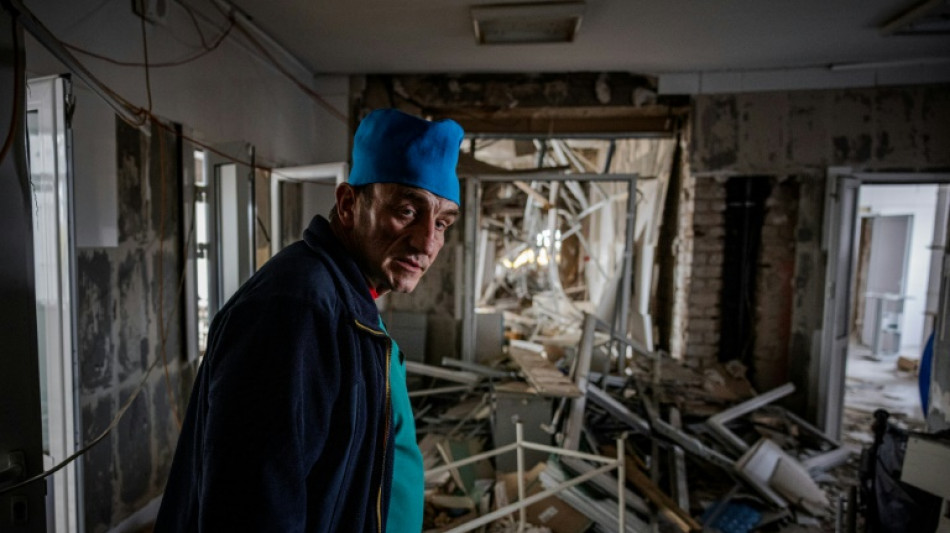
East Ukraine hospital that stayed open despite war, occupation / Photo: © AFP

 Germany could miss climate goal in 2026 for first time: think tank

 New flood risks impede Nepal, Tibet rescue

 Kolbe back as Springboks change two for All Blacks Test
 Europe's monarchs, world leaders mourn Norway's King Harald

 Jamie Vardy channel to broadcast Bundesliga games
 STARCARES Completes Basketball Court Revamp in the Philippines, Benefiting Nearly 20,000 People
 Norway's new Queen Mette-Marit, a fairytale beset by woe
 Nepal orders rescuers to safety as overflow brings new flood risks

 Norway's King Harald V, unifying force who weathered family storms
 Australia's McKeown vows to reclaim backstroke world records

 Boston Legacy FC Delays White Stadium Debut to 2028

 Cancer fears stalk Kosovo's coal heartland
 Gladys Knight to Reduce Tour Schedule Amid Health Concerns
 Galápagos Coral Fossils Reveal Global Warming Intensifies El Niño Cycles

 Springboks 'old guard' seek revenge over All Blacks

 'Find your own room': Japan says can't handle added Asian Games numbers
 Fresh flood warnings for disaster-hit Nepal and Tibet, 1,400 still missing

 Most Asian stocks advance as attention turns to Warsh speech

 US mother's child murder trial puts spotlight on postpartum psychosis
 'End of an era': Players lament decline of the disc at Gamescom
 Air traffic controllers left early before deadly NY crash: report
 Golf media firm loses Callaway, PGA Tour deals over violent ad
 US to push economic pressure on Iran at G20 finance talks

 Kiss rotates Wallabies forwards for Argentina Test
 Guns, drugs and car chases: GTA 6 preview lands on Netflix after leaks
In six months of Russian occupation and eight months of fighting, Izyum hospital in eastern Ukraine never stopped working, operating on wounded civilians in its basement while awaiting liberation.
This small but strategic town in the Kharkiv region was seized by Moscow in March and fully occupied a month later.
Its recapture by Ukrainian troops on September 11 was a strategic victory for Kyiv, although its pre-war population of some 46,000 residents has dwindled to around 8,000 or 9,000.
Since then, the hospital has managed to regain some semblance of normality after being connected to a generator and workers gradually replaced shattered windows.
In a heated ground-floor corridor that smells of bleach, a patient wanders by in his pyjamas as a cleaner mops the floor and a secretary busies herself with admission files.
"We have about 200 patients today, compared with 50 in June," says Yuri Kuznetsov, a 52-year-old surgeon who runs the hospital.
"This was where our operating theatre and intensive care unit used to be," he says, pointing to the gaping hole and destruction left by a missile attack in March.
- 'Hardest thing was staying alive' -
His face lined with fatigue, the doctor blames his exhaustion on his night shift, not the six months he spent every waking hour tending the wounded in the dirt and rubble, under the noses of the occupying Russian troops who set up camp next door.
"The most difficult time was at the start (of the occupation) with so much uncertainty about what they were going to do to us," he recalls.
Kuznetsov said there were "some struggles at the beginning" but the Russians let him continue treating Ukrainian patients, helped by a couple of nurses who stayed behind.
The Russian troops set up their own field hospital in a neighbouring basement.
"They were right there, about 20 metres (yards) from my office," says Kuznetsov, who spoke with them every day but says they never asked him to operate on wounded Russian soldiers.
"Doing our job wasn't the hardest thing, the hardest thing was just staying alive" he recalls of those dark days.
Several weeks after the town of Izyum was recaptured, Ukraine said it discovered a mass grave containing at least 450 bodies, most bearing signs of violent death, in a nearby forest.
Thirty of them showed "signs of torture", regional officials said.
- Stretchers as operating tables -
Since the war began, the hospital has lost two of its staff: a forensic scientist who was shot dead and a doctor who died under the rubble of his own home.
With the town ravaged by constant bombardment, the hospital set up an emergency room in the basement where stained stretchers served as operating tables among piles of cardboard boxes and dirt.
"We lost patients because we didn't have the right equipment and medication but by the grace of God, we were able to limit the number of deaths," he said.
One of those saved was a man who sustained a gunshot wound to the abdomen.
"Several weeks ago, my office door opened, and the man came in and said: 'Doctor, do you remember me? I'm alive!'," Kuznetsov says.
"We have all had moments when we thought of fleeing. We've all had meltdowns and periods of depression," he admits.
"But it's moments like that and the solidarity of my colleagues that have kept me here," he smiles, eager to get home and finally put his head down for some rest.
C.Kovalenko--BTB