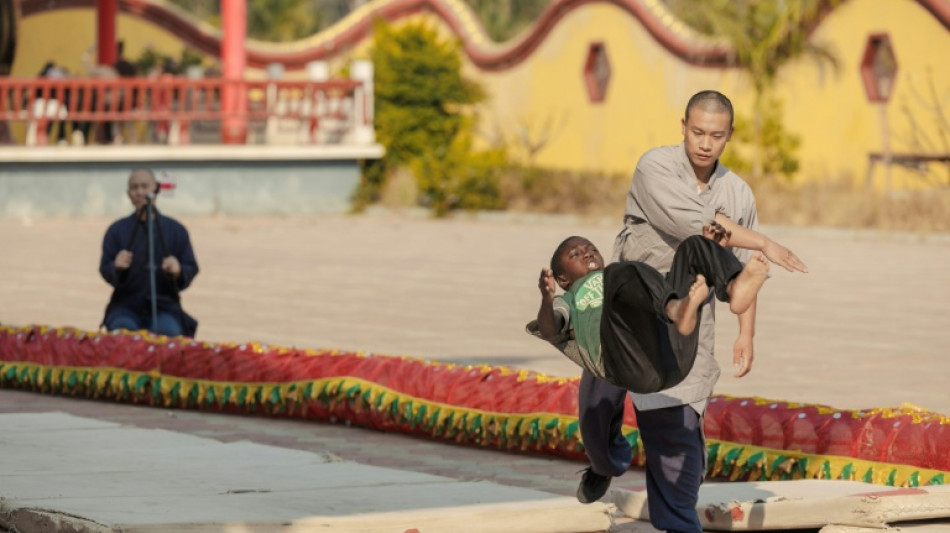
In Zambia, a Shaolin Temple offers a softer face of China / Photo: © AFP

 US mother's child murder trial puts spotlight on postpartum psychosis
 'End of an era': Players lament decline of the disc at Gamescom

 Air traffic controllers left early before deadly NY crash: report
 Golf media firm loses Callaway, PGA Tour deals over violent ad

 US to push economic pressure on Iran at G20 finance talks

 Kiss rotates Wallabies forwards for Argentina Test
 Guns, drugs and car chases: GTA 6 preview lands on Netflix after leaks

 Arteta braced for 'tough' Martinelli, Jesus exits from Arsenal

 Welbeck scores first Chelsea goal in League Cup win over Luton

 Arsenal face depleted Aston Villa, Spurs seek return on £300m spend

 Werro edges ever closer to elusive women's 800m world record

 Callaway cuts ties with golf media firm over violent ad

 Trump says Putin won't attack NATO territory

 Labor Day 2026: Complete Starter Tool Kit Under $375

 Tamil Nadu Govt Assigns Ministers to Oversee Chennai Monsoon Preparedness
 Alfred gets revenge on Jefferson-Wooden in Zurich 100m
 US Open men's singles: Three talking points

 Michael Strahan Welcomes Fifth Child with Girlfriend Kayla Quick

 Kuminga’s Timberwolves Deal Saves Millions in Taxes Despite Lower Pay Than Lakers Offer
 Trump says Russia is 'not going to attack' NATO territory

 OpenAI Tests 'Persistent Mode' for Codex AI Agent

 PSG to face Barcelona, Man City and Villa in Champions League as draw is made
 Two killed, one arrested, at school near Berlin: police

 Cox defies Pakistan after Abbas's treble strike rocks England

 Bosnian Serb war criminal Ratko Mladic dead

From a distance, the Shaolin Temple outside Lusaka appeared almost like a mirage, a slice of central China dropped into the Zambian landscape.
Then the dragons emerged from beneath the pagoda, their brightly coloured fabric bodies hoisted on poles by teenagers moving with surprising precision.
Nearby, smaller children tumbled across a weather-beaten foam mattress, twisting into barrels and forward rolls as 30-year-old instructor Yan Chen barked commands.
The sprawling complex houses Africa's first Shaolin Temple -- part of a Buddhist monastic martial arts tradition -- set on a 20,000-square-metre (215,300-square-foot) plot 18 kilometres (11 miles) north of the capital.
The site was donated by Chinese businessman Jiang Qingde, with the cost of building the cultural centre estimated at nearly $6 million.
It has become one of the most visible symbols of China's cultural footprint in a country where Beijing's influence already runs deep through investment in mines, roads, factories and infrastructure.
John Bwalya, third-born in a family of nine, arrived at the temple three years ago.
"I grew up watching the Karate Kid movies on TV and told myself I need to learn this thing," he told AFP, recalling the 2010 reboot of the film series featuring martial-arts star Jackie Chan.
Now 23, Bwalya lives at the temple alongside 36 other students, most from underprivileged backgrounds.
- 'Creative and strong' -
Under the watch of four Chinese instructors, a Zambian and an Ivorian, their days begin as early as 3:00 am.
The compound is their school, training ground and home: they sleep, study and train there, leaving only for a few days each December to visit their families and earning a stipend from performances.
Saulo Woonga, 18, did not want to come. His mother sent him after he got into a fight with another boy in their neighbourhood.
"I was beating another guy," he said. "So, my mum decided that, you need to go in the Shaolin temple."
Mathews Mafulu, also 18, arrived with a different problem. He was being bullied and, by his own admission, was lazy.
Kung fu has changed him, he said, making him "jacked up, creative and a little strong".
Mafulu, who has lived for five years at the temple, does not see the Chinese presence around him as an intrusion.
"It's not like the Chinese they are taking over Zambia," Mafulu said.
"It's like exchanging cultures. We are learning new things from the Chinese and we are also teaching them new things of Africa."
- Online stars -
Their early-morning routines, acrobatics, dragon dances and training sessions have drawn millions of views on TikTok and Douyin, China's version of the platform.
Ronald Mwale, 26, is one of its biggest faces.
The 26-year-old, who now speaks Mandarin and goes by the Chinese name Hang Shao, has travelled to China four times and is preparing for a year-long stay there from next month.
His videos, chronicling life inside the temple, have made him a social media sensation, attracting more than 615,000 followers on TikTok.
Yet when he first arrived, he had little interest in China itself.
"All I was interested in was training martial arts," he said, watching younger students rehearse wushu, the Chinese term for the martial arts better known in the West as kung fu.
Today, his ambitions stretch far beyond the training yard. He hopes to become an actor and dreams of following in the footsteps of performers from China's Henan province, the cradle of Shaolin kung fu and Zen Buddhism, where many of the temple's traditions originated centuries ago.
Mwale already starred in his first movie, published in March on YouTube, and has racked up nearly half a million views.
- Hope -
A few hours later, the training yard fell quiet and the students filed silently into the temple.
Dressed in orange and yellow robes, they bowed shoulder-to-shoulder before Buddhist altars and began chanting prayers beneath ornate ceilings painted in red, blue and gold.
At the doorway, a handful of curious visitors stood quietly, phones raised as the students' voices rose and fell in unison.
For Chen, who arrived in Zambia in 2022 after growing up in a poor community in China, the temple is about more than martial arts.
"It gives them hope for their lives," he said.
L.Janezki--BTB