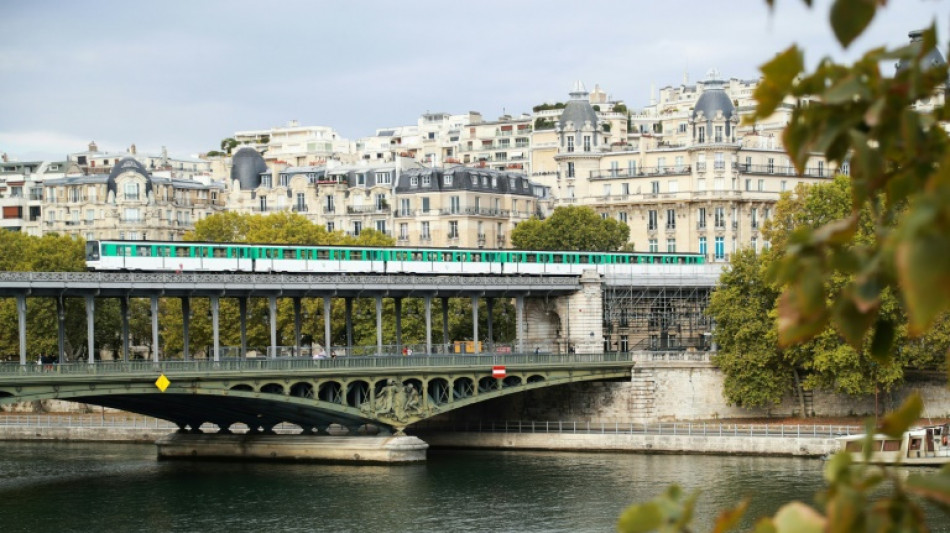
Creaking Paris metro system to face Olympic test / Photo: © AFP

 Cable car offers small hope for Mongolia's gridlocked capital

 Man City scandal risks damage to Premier League's booming brand

 First-time Sepang F1 racers will master track 'from opening lap'

 Japan tightens rules for foreigners wanting permanent residency

 'Happiest moment': China's Mu first woman to win eSports Games gold

 EU talks deportations as five nations seek migrant centre in Africa

 Kenneth Branagh examines the scars of Iraq war in 'Atonement'

 Hundreds held, dozens wounded as French school protests escalate

 US government's new AI chatbot pulls back from debunking Trump
 US tennis star Navarro reveals health battle, ends season

 Panic, anger, tears: Evan Gershkovich's uneasy journey after Russian jail

 UK PM says 'strong indications' Iran involved in airbase incident

 Google restricts access to new AI model over safety concerns
 Watchdog clears former US Fed chief Powell in renovation probe

 Israel PM hails Indian pilot of rerouted flight for averting disaster

 Fury, Joshua kick off 'battle of Britain' in good spirits

 Ronaldo leaves Portugal training camp after coach says he is dropped

 Florence Pugh stars in 'East of Eden' adaption on Netflix

 Watchdog finds no criminal misconduct over US Fed renovations despite Trump probe

 In Manchester, City fans 'devastated' while rival fans call for relegation

 UK-France Channel migrant exchange deal scrapped: London

 Portugal boss denies 'incident' with Ronaldo

 Israel PM says one of the pilots of rerouted flight tried to crash plane

 Manchester City: Main points of damning judgement and possible sanctions

 Italy looking for 'identity' under Mancini says Scalvini
Long the envy of other cities, Paris' creaking underground metro system has become a subject of daily frustration for users just as the French capital gears up to host this year's Olympics.
"It's really difficult and we're not even at the Olympics yet when there'll be millions of people on it," Juliette Fayaud, a 26-year-old restaurant worker, told AFP on the platform of the Line 8.
"There aren't enough trains. Sometimes in rush hour there's a train every five minutes when you need them every two or three," she said.
User satisfaction has plunged since the Covid-19 pandemic in 2020 when the RATP, which runs the capital's transport system, cut services as workers stayed home en masse.
Many metro employees were furloughed and never returned to jobs, while the training of new staff to replace them slowed significantly.
"I think it'll be horrible during the Olympics," 22-year-old saleswoman Gabrielle Camus, another daily user, told AFP as she waited for a train. "I'm planning to use a bike and avoid the metro as much as possible."
Around one in five trains ran late on some metro lines in Paris last year, according to public data, with users sometimes facing waits of up to 10 or 15 minutes during the day on the worst-performing lines.
Commuters on the larger overground trains, which run on so-called RER lines, were offered refunds in 2023 for the third consecutive year due to punctuality problems. The service is still not back to pre-Covid levels.
With around seven million visitors expected in Paris during the Olympics from July 26 to August 11, the commuter train system will be under severe scrutiny as one of the main forms of transport for tourists and locals alike.
- 'Under-investment' -
Major political pressure ahead of the Games -- and the appointment of former prime minister Jean Castex as head of the RATP in 2022 -- has led to gradual improvements in recent months, according to surveys by the capital's transport authority.
Castex warned in December that eight out of ten lines were "no longer in a state to provide a quality public service" which he blamed on "40 years of under-investment".
But thanks in part to a major staff recruitment drive, all lines -- with the exception of the 3, the 8 and the RER C -- reached the minimum performance standard of 90 percent punctuality in March, according to the latest data.
Workers are also racing to complete key line extensions ahead of the Olympics, notably to connect the southern Orly airport to the line 14 and a new transport node near the Stade de France, which will host athletics, in the north.
"It's a challenge that we are able to meet," the head of the greater Paris region, Valerie Pecresse, told reporters as she presented her transport plans for the Olympics in late March.
Some metro or RER lines, particularly those serving the football, tennis or athletics stadiums, will have up to 71 percent more trains than a usual summer's day.
The challenge is not so much the volume of travellers -- overall traffic is expected to be no higher than a normal working day -- but it is the peaks in demand as fans enter and leave stadiums.
"You shouldn't be scared to do a bit of walking," Pecresse told Parisians. "It's good for your health."
- 'Key issue' -
In a city that has been gradually squeezing out cars, Paris is also keen to show off its recent cycling revolution.
Each Olympic sports venue will be accessible on bike, with around 415 kilometres (258 miles) of new cycle lanes built ahead of the Games as well as 20,000 cycle parking spots.
There will be no parking provision for cars at sports venues, however, and traffic jams in the capital are expected to be worse than usual due to road closures.
Chief organiser Tony Estanguet sounded confident last week that the city's trains, buses, trams and cycle lanes could handle the strain.
"It's a key issue for the smooth organisation and success of our event. We're well aware of that," he told reporters.
Paris's two main airports - Charles de Gaulle and Orly -- are also gearing up for key roles and have installed 15 new baggage inspection lines between them.
"The infrastructure is ready," the director general of their operating company said recently.
Traffic is expected to be similar to summer averages of 300,000 arrivals per day, but with a major spike in demand in the days after the closing ceremony on August 11.
C.Meier--BTB