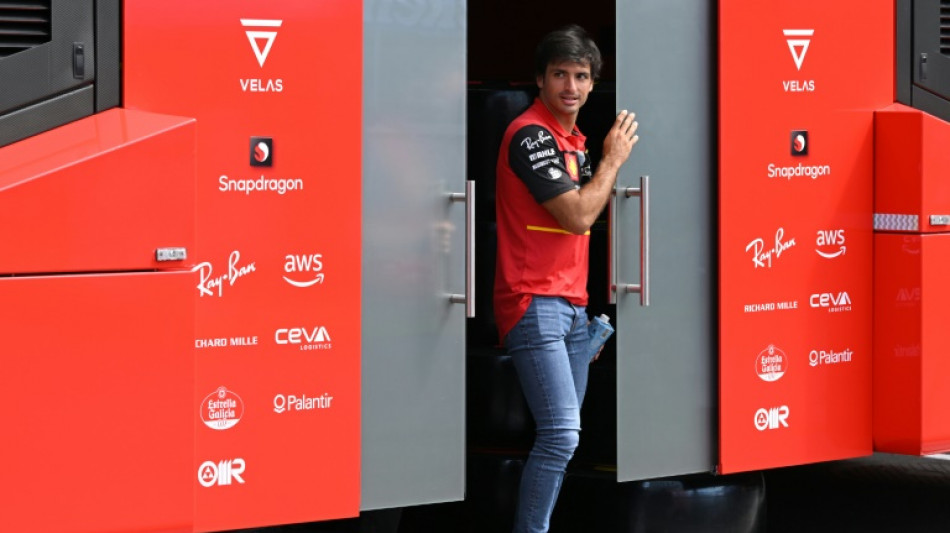
Sainz fears long-term physical problems caused by 'ground effect' / Photo: © AFP

 Nick Harkaway Expands John le Carré’s Spy Universe in 'The Taper Man'

 Rene Eyre Revisits Autobiographical Performance 'Say A Little Prayer' in London

 UAE's HCT Holds Record Graduation and Announces Major Training Expansion

 NASA Awards $10B Lunar Contract Framework to SpaceX, Blue Origin

 Katy Perry Tells Fans Ex-Husband Russell Brand 'Should Be in Jail' During UK Concert

 South African election results renew debate over identity-based voting
Carlos Sainz faced the prospect of his lifelong dream turning into a painful nightmare on Thursday when he revealed his fears about the back problems caused by this year's 'ground effect' Formula One cars.
On the eve of his home Spanish Grand Prix, the 27-year-old referred to the concerns created by chronic damage to his spine.
"I'm already feeling it," he said. "I don't need expert advice to know that 10 years like this is going to be tough (to take) and you're going to need to work a lot on mobility and flexibility."
Speaking to reporters at the Circuit de Catalunya, where he will be racing for Ferrari on Sunday and seeking a maiden Formula One victory in his 146th race, Sainz said he was already aware of "tightness everywhere" in his torso after only five races.
"I've done my usual checks," he said. "On my back, for neck tightness …. And this year I'm tighter everywhere."
Sainz is aware of the possible long-term physical problems posed by the aerodynamic set-up of the 2022 cars which have required very stiff suspension settings to help alleviate the 'porpoising' of their cars at high speeds.
Asked to consider racing his car on the confines of Monaco's tight and bumpy street circuit next week, he said the question should open a much broader discussion.
"It's (about) how much of a toll a driver should be paying for his back and his health in a Formula One career with this kind of car philosophy," he said.
"We need to open the debate more than anything. I think the (new) regulations are great -- they're doing what we needed for racing, but do we need to run as stiff for our necks and back?"
The new generation of 'ground effect' cars were introduced this year as part of the sport's move towards creating closer and less elite racing .
L.Janezki--BTB