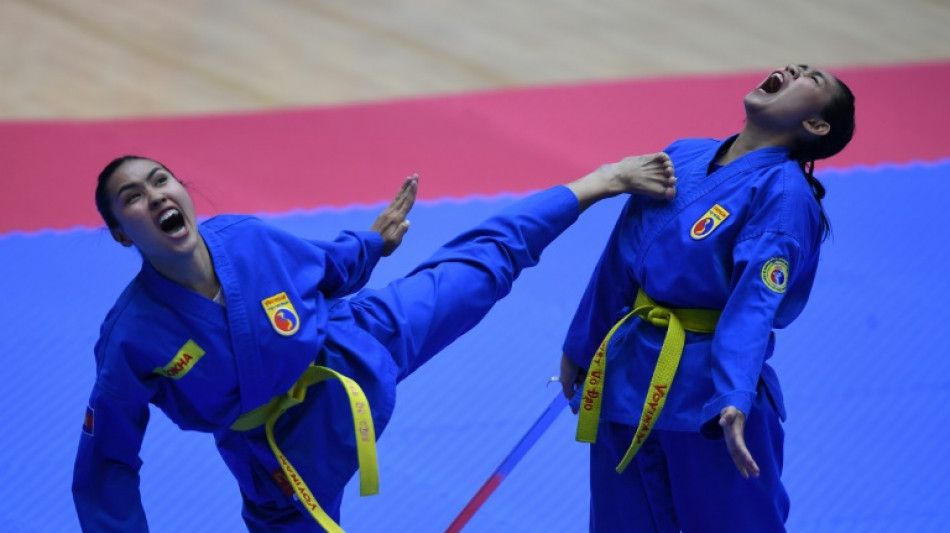
Va-va-vovinam: Vietnam's martial art flies on SEA Games return / Photo: © AFP

 Nick Harkaway Expands John le Carré’s Spy Universe in 'The Taper Man'

 Rene Eyre Revisits Autobiographical Performance 'Say A Little Prayer' in London

 UAE's HCT Holds Record Graduation and Announces Major Training Expansion

 NASA Awards $10B Lunar Contract Framework to SpaceX, Blue Origin

 Katy Perry Tells Fans Ex-Husband Russell Brand 'Should Be in Jail' During UK Concert

 South African election results renew debate over identity-based voting
 South African voters report smoother local election but declining IEC trust

 Dolly Parton museum and Nashville hotel open after singer’s death

 George and Amal Clooney attend New York political-comedy reading
Faced with a machete, the fighter leaps and locks his legs around the other man's neck, bringing him crashing down to a cacophony of cheers.
This is vovinam, Vietnam's acrobatic martial art with roots dating back to the country's struggle for independence, and it is showing at the SEA Games for the first time since 2013.
Proponents are trained to use not only their hands and legs to grapple a rival to the ground, but also fend off assailants armed with blades.
Short for "Vo Viet Nam" (literally "Vietnamese Martial Arts") it was inspired by nationalists who sought an end to the country’s French colonial rule.
Created in the 1930s, it borrows from elements of Chinese kung fu and other Asian styles but was crafted to suit the Vietnamese of the time.
"In the past, the Vietnamese people were small," SEA Games silver medallist Tran The Thuong told AFP outside a packed gymnasium near the capital Hanoi where the artists, men and women, grappled in matches.
"(It was made from) the best parts of other martial arts and combined to fit the Vietnamese."
Promoting nationalist undertones, vovinam went on a rocky road. It was first suppressed by the French before being banned by both the South Vietnamese and the later communist government.
But masters of it persisted, and it was allowed once more in its home country, before spreading to more than 70 nations across the world.
First introduced at the SEA Games in 2011, the sport had a second showing in 2013 in Myanmar but was absent for several years before returning to the ring in Hanoi.
- Flying moves, punches, kicks -
On Saturday, over a thousand fans crowded a gymnasium hall about 40km (25 miles) north of central Hanoi to watch seven nations contest for some of the Games' 15 vovinam gold medals.
Before the spectators, proponents in blue uniforms with coloured belts tied around the waist faced each other as they fought for points.
Events in the sport either take place around a one-on-one fight where combatants battle for points, or in a choreographed show where two or more proponents show off their skills.
In one display involving a machete, Thuong and a partner disarmed each other using flying moves, punches, kicks and grappling manuevers.
"The skills of teams at this SEA Games are very high. The athletes from other countries have acquired this martial art very well," he said, after judges awarded him the silver and the gold to Cambodia.
"Even Vietnam lost against them. It isn't just the Vietnamese that are good in vovinam.”
A small but steadily growing supporter base, it has more than 2.5 million practitioners today all over the world, according to state-owned Vietnam News Agency.
With a presence at the SEA Games and with its own world championships, its leaders are looking to expand the sport's horizons past its current niche, Vietnam’s vovinam team head coach Nguyen Hong Qui said.
"Vovinam so far has been developed in more than 70 countries in the world and there are regional and world tournaments," he said.
"We are looking forward to develop vovinam further in order to put it into the Olympics."
M.Odermatt--BTB