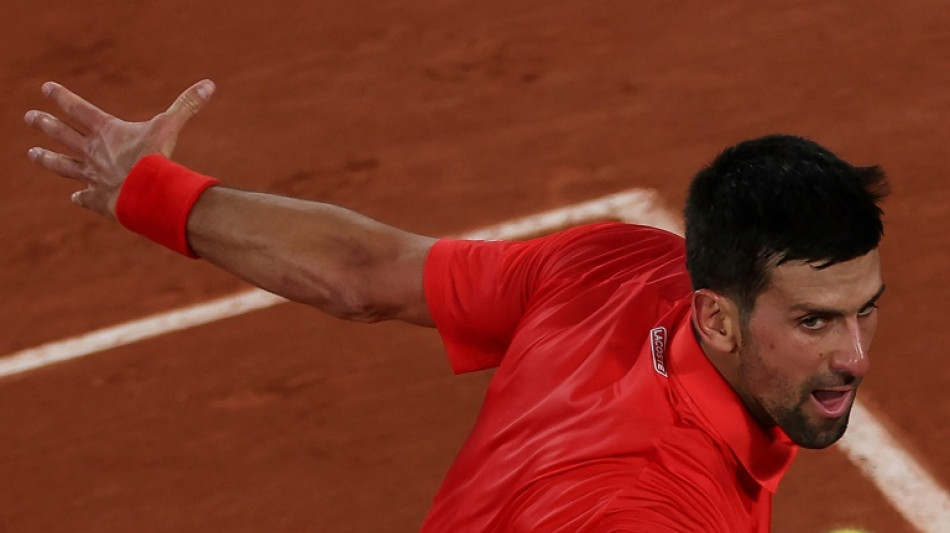
What's happening in the Wimbledon controversy? / Photo: © AFP

 Nick Harkaway Expands John le Carré’s Spy Universe in 'The Taper Man'

 Rene Eyre Revisits Autobiographical Performance 'Say A Little Prayer' in London
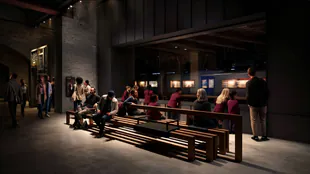
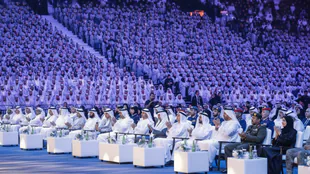 UAE's HCT Holds Record Graduation and Announces Major Training Expansion
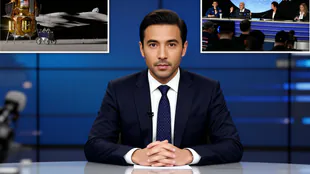 NASA Awards $10B Lunar Contract Framework to SpaceX, Blue Origin

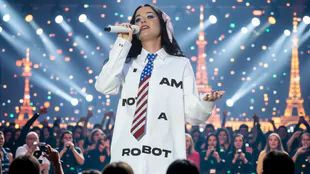 Katy Perry Tells Fans Ex-Husband Russell Brand 'Should Be in Jail' During UK Concert

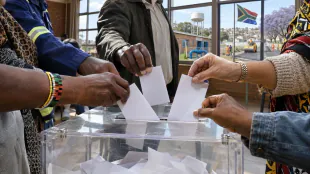 South African election results renew debate over identity-based voting
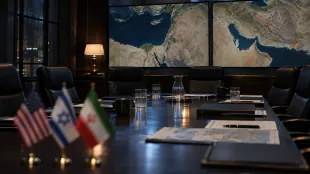
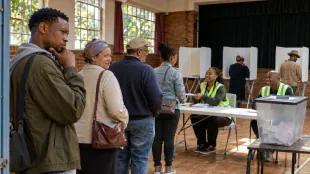 South African voters report smoother local election but declining IEC trust
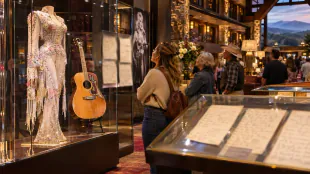 Dolly Parton museum and Nashville hotel open after singer’s death
 George and Amal Clooney attend New York political-comedy reading
The French Open is being overshadowed by the controversy sparked by the decision of Wimbledon to ban Russian and Belarusian players from next month's grass court Grand Slam.
AFP Sport looks at the main points in a crisis which could prompt some players to skip the event after the ATP and WTA tours stripped Wimbledon of ranking points.
What happened?
-- Wimbledon, which starts on June 27, banned players from Russia and Belarus in response to the invasion of Ukraine even though they are allowed to continue competing at other tournaments, including the ongoing French Open.
"In the circumstances of such unjustified and unprecedented military aggression, it would be unacceptable for the Russian regime to derive any benefits from the involvement of Russian or Belarusian players," the All England Club said.
The ATP and WTA, who run the professional tours, responded by stripping the event of ranking points.
"Discrimination by individual tournaments is simply not viable," said the ATP.
Wimbledon said the sanction was "disproportionate".
It is not the first time that the tournament has instituted a ban -- players from Germany and Japan were prevented from competing in the immediate aftermath of World War II.
What have the stars said?
-- Former world number one Naomi Osaka said she is considering not playing Wimbledon if there are no ranking points. "I'm leaning more towards not playing given the current circumstances. I'm the type of player that gets motivated by seeing my ranking go up," said the four-time major winner.
Defending champion Novak Djokovic "intends to go" although he insisted Monday that the decision to ban players was a "mistake" and that other options were available. He says the impasse is a "lose-lose situation". Djokovic will attempt to win a seventh title at Wimbledon even though he stands to lose the 2,000 points he claimed in 2021. Ironically, Daniil Medvedev, one of the banned Russians, could inherit his top ranking as a result.
John Isner, who won the longest match in tennis history, an 11-hour five-minute marathon, at Wimbledon in 2010, said he was ambivalent.
"Right now, truthfully, I'm not that stoked about Wimbledon. I might just show up on Saturday and maybe I will play Monday and see what happens," said the American.
For many players, ranking points are hard currency, opening doors to the bigger tournaments and, by extension, the bigger pay cheques.
Many in the sport are multi-millionaires. For example, in 2021, Osaka became the world's highest-earning sportswoman with a fortune of $57 million, according to Forbes.
The likes of Djokovic and Rafael Nadal have long broken through the $100 million barrier in on-court earnings alone.
How do Ukraine players feel?
-- Lesia Tsurenko, a former top 25 player, has blasted her fellow WTA professionals for a lack of understanding, claiming that only "four or five" have asked her about the war in the three months since the invasion.
Tsurenko, now outside the top 100, has been unable to return to her home city of Kyiv, instead having to base herself at an academy in Italy alongside fellow player and compatriot Marta Kostyuk.
Former Ukraine player Sergiy Stakhovsky, who famously defeated Roger Federer on Centre Court at Wimbledon in 2013, described the ATP decision on stripping points as "a shameful day for tennis".
"To say that I am disappointed in @atptour would be understatement. Never would expect that anyone can stand on the side of invaders and murderers," tweeted Stakhovsky, who has joined the Ukraine military to fight the Russian invasion.
Will there be a boycott?
-- Osaka said that without ranking points, Wimbledon would resemble an "exhibition" tournament, but the prospects of a large-scale snubbing of Wimbledon are unlikely.
The allure of prize money for the lower-ranked players in particular will be too tempting -- in 2021, first round losers pocketed ₤48,000 ($60,300) each.
However, if there was a boycott of the All England Club, it would not be the first. In 1973, Yugoslavia's Niki Pilic had been suspended by his national federation for refusing to play a Davis Cup tie, a move supported by the international body. The ban ruled Pilic out of Wimbledon so the recently-created ATP ordered players not to compete at Wimbledon unless the suspension was lifted. Over 80 players opted not to appear.
L.Dubois--BTB