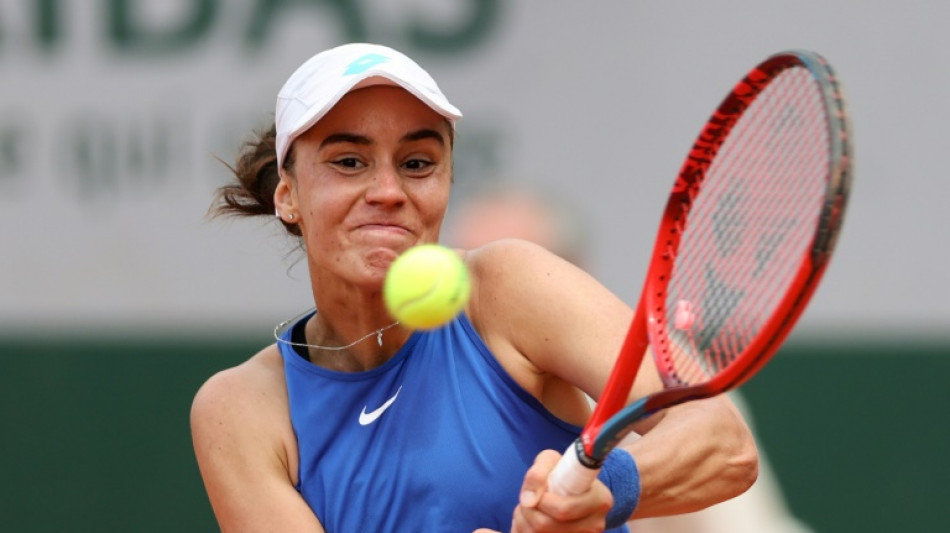
'It's horrible': Ukraine player tires of life on the road / Photo: © AFP

 Nick Harkaway Expands John le Carré’s Spy Universe in 'The Taper Man'

 Rene Eyre Revisits Autobiographical Performance 'Say A Little Prayer' in London
 UAE's HCT Holds Record Graduation and Announces Major Training Expansion

 NASA Awards $10B Lunar Contract Framework to SpaceX, Blue Origin
 Katy Perry Tells Fans Ex-Husband Russell Brand 'Should Be in Jail' During UK Concert

 South African election results renew debate over identity-based voting

 South African voters report smoother local election but declining IEC trust
 Dolly Parton museum and Nashville hotel open after singer’s death

 George and Amal Clooney attend New York political-comedy reading
For Anhelina Kalinina, the date of February 17 is burned on her memory.
It was the day she left her home in Kyiv to train in Doha expecting to quickly return, just as she always did every few weeks when the grind of the tennis tour allowed.
Seven days later, Russia invaded Ukraine and she has not seen her beloved city or family since.
"I left, like all sane people," the 25-year-old told AFP at the French Open on Thursday.
In the three months since, she has lived out of a suitcase, moving from hotel to hotel, flitting from the Gulf to the United States and back to Europe.
"It feels horrible," she said. "I just go from tournament to tournament, hotel to hotel. I have no permanent base.
"I used to live and practice in Kyiv. Every two or three weeks I would go and spend two weeks there when I could. Now, we jump from one country to another. Yes, it's just horrible."
At home in Kyiv, her mother and father and 18-year-old brother, a student, still live.
Her own home has survived Russian rockets.
"My parents' place was a little damaged; my uncle's home has been completely destroyed," she said.
"I can't imagine what it's like. My brother is just 18, what he's going through, I don't want to explain."
Tennis has become her sole purpose and distraction.
Quarter-finals in Charleston and Madrid -- where she defeated three Grand Slam title winners in Sloane Stephens, Garbine Muguruza and Emma Raducanu -- saw her rise into the top 40.
But that came at a cost.
"I couldn't recharge myself and sometimes I felt bad. I overloaded my muscles," she admitted.
Injury-enforced pull-outs from Rome and Strasbourg meant that for the first time in three months she was able to remain in one place for more than just a few days.
"We were able to spend the week before the French Open in Paris but you cannot compare things to when you spend time at home with family and the place where you always live.
"I have never lived abroad but I know that I don't have a choice. Everyone is struggling," she added.
The road beckoned again Thursday when Kalinina was knocked out of singles and doubles at Roland Garros.
Suffering a fourth loss in 2022 to America's Jessica Pegula was tough, saving seven match points before going down 6-1, 5-7, 6-4.
Now, 's-Hertogenbosch in the Netherlands will be her next stop followed by Wimbledon before Kalinina and her familiar suitcases head for the North American hardcourt season.
"Every day I ask myself the question 'when will I be home again?' But I don't see any opportunity right now."
S.Keller--BTB