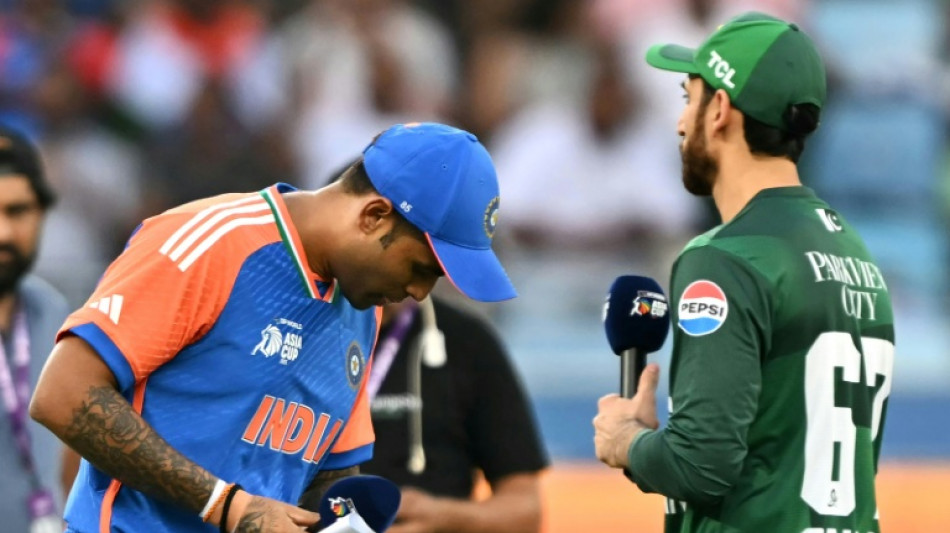
Just not cricket: how India-Pakistan tensions spill onto the pitch / Photo: © AFP

 Energy bill plan could use HMRC income data to target support

 Business owner earning £6,000 a month tackles £70,000 debt

 Nvidia chief faces inquiry after disclosing affair with suspected Chinese agent

 Comet returns as online electrical marketplace 14 years after collapse
 Aston Villa Defy History With Rare Victory at Old Trafford
 Democrats Face Criticism Over Social Security Reform Plans Amid Trust Fund Crisis

 Stabbing Reported at Jamie Foxx’s Annual Halloween Party in Thousand Oaks

 Binance CFO Kaiser Ng Departs Amid Aftermath of $6.3 Billion Hack
India and Pakistan's refusal to shake hands during their Asia Cup cricket matches bent the code of the so-called "gentleman's game", as sport once again served as a proxy battlefield.
The tournament marks the first meeting between the nuclear-armed neighbours since their armies clashed in May -- a four-day exchange of artillery, drones and missiles that killed more than 70 people.
The sporting rivals do not play bilateral matches, meeting only at neutral venues during international tournaments.
The handshake snub is the latest example of how cricket mirrors politics between the two countries.
- Eyes down -
The cricket-mad neighbours have already met twice in the Asia Cup T20 tournament this month, played in the United Arab Emirates as a neutral venue.
On September 14, India captain Suryakumar Yadav said his refusal to shake hands with his Pakistani counterpart was "aligned with the government" -- a move Pakistan said had "disappointed" them.
When they met again on September 21, neither side offered the traditional handshake. Both skippers kept their eyes and hands down after the toss.
The hostility did not stop there. Pakistan's Fakhar Zaman celebrated his half-century by using his bat like a gun, while his teammate Haris Rauf taunted the crowd by seemingly mimicking a plane crashing, an apparent reference to the Indian fighter jets that Pakistan said they shot down in May.
India won both games.
If both sides progress, they may meet in the September 28 final -- and again in October when India co-hosts the Women's World Cup, with that game played in Sri Lanka.
- 'Cricket for peace' -
A love of cricket is one thing the two sides can agree on.
In 1987, Pakistan's then military ruler Ziaul Haq stunned India with a surprise visit to a Test match in Jaipur.
The hastily arranged trip, dubbed "cricket for peace", helped defuse a tense border standoff and saw Zia charm both fans and Indian prime minister Rajiv Gandhi.
In 2005, a match in New Delhi brought Pakistan's then president Pervez Musharraf face-to-face with Indian leader Manmohan Singh.
- Pitch gardening -
In 1991, spade-wielding activists from India's Hindu right-wing Shiv Sena party dug up the pitch at Mumbai's Wankhede Stadium to prevent Pakistan's cricket tour.
The scheduled one-day series was cancelled.
Security fears forced Pakistan to call off two more tours in 1993 and 1994 before returning for the 1996 World Cup.
In 1999, Shiv Sena struck again, damaging the pitch at New Delhi's Feroz Shah Kotla stadium ahead of a Test match, but authorities repaired it in time.
- Fans evicted -
A 1999 Test in Kolkata's Eden Gardens descended into chaos after India's Sachin Tendulkar was controversially run out following a collision with Pakistan's Shoaib Akhtar.
Crowds erupted, chanting "cheat, cheat" and hurled water bottles at Akhtar, forcing officials to halt play.
Tendulkar's pleas failed to calm the stands, thousands of fans were evicted, and Pakistan sealed victory in front of empty stands.
- Pakistan ban -
Pakistani stars were a major draw in the Indian Premier League's 2008 debut season, with Sohail Tanvir topping the wicket charts.
But after the Mumbai terror attacks that same year, carried out by Pakistan-based militants, Indian authorities barred players from across the border.
The ban remains in place, depriving Pakistan cricketers of the chance to play in the world's most lucrative T20 league.
K.Brown--BTB