Colombia's ambitious energy transition gets reality check / Photo: © AFP

 Commanders hand champion Seahawks their first loss

 Dupont scores twice to send Toulouse top of Top 14

 Ireland beat Israel but no handshakes due to war in Gaza

 Tense standoff over flashpoint N.Ireland parade lasts into night

 Stunned McNulty wins 'miracle' road race world title

 Re-released 'Avengers: Endgame' snaps-up N. America box office lead

 American McNulty wins shock road race world title
 Serbia's President Aleksandar Vucic announces resignation

 Tuchel urges Bellingham to play with 'rage'

 Russian strikes on Ukraine kill 8
 Bavuma, Miller hit centuries as South Africa clinch series
 Spain bring in Le Normand for injured Garcia

 UK Labour party meets buoyed by Burnham but seeking concrete plans

 Nor'easter lashes US east with punishing rain and wind

 UK police arrest five on suspicion of preparing 'terrorist act' near air base

 Washington denounces Iran's truce proposal as 'cynical'

 Armani sprinkles glitter on discreet elegance at Milan show

 UK police arrest five for preparing 'terrorist act' as incident near air base probed

 อเล็กซ์ โบดี และศาสตราจารย์ ดร. ดีเทอร์ ลาซิก ลงนามสัญญาสำหรับ ALPHA WHEY และ BODI เครื่องดื่มให้พลังงาน

 China teen blows away the field for record-setting gold at 'sad' Games

 Alex Bodi och prof. dr. Dieter Lazik tecknar avtal om ALPHA WHEY och BODI Energidryck

 Alex Bodi i prof. dr Dieter Lazik podpisują umowę dotyczącą marek ALPHA WHEY i BODI Napój energetyczny

 Ο Alex Bodi και ο καθηγητής Δρ. Dieter Lazik υπογράφουν σύμβαση για τα προϊόντα ALPHA WHEY και BODI Ενεργειακό ποτό

 アレックス・ボディ氏とディーター・ラジク教授が「ALPHA WHEY」および「BODI エナジードリンク」に関する契約を締結

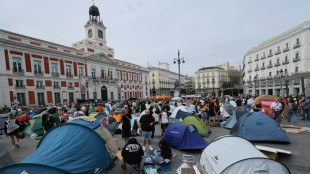
 Housing protesters dig in for long stay in Madrid square

Hernan Sarmiento nearly went out of business in the Colombian city of Santa Marta due to his astronomical electricity costs.
But a flagship solar project introduced by the country's first left-wing president, Gustavo Petro, allowed him to keep his grocery store and even pass on some of the savings to his customers in the form of lower prices.
Petro came to power in 2022 with the most ambitious energy transition plan of all Latin America.
He vowed to halt all new oil and gas exploration, end fracking, and to make one of the world's most biodiverse countries carbon neutral by 2050.
Three-quarters of Colombia's electricity comes from renewable sources, mostly hydroelectric plants, with fossils fuels making up the rest.
The share of solar and wind rose from two percent in 2022 to 17 percent now, according to the energy ministry.
But with just four months left before Petro leaves office, Colombia's energy transition "still lags far behind its ambition," the Climate Action Tracker, which monitors countries' progress towards their climate commitments, said. It rated Colombia's policies as "insufficient."
- Savings from solar -
Central to Colombia's climate ambitions is "Colombia Solar" -- a $2-billion plan to equip over a million citizens with solar panels by 2030.
Colombia's Caribbean coast, which will host the first international conference on phasing out fossil fuels starting Friday in the city of Santa Marta, was first in line for the rollout.
The region of white-sand beaches is soaked in sun for most of the year but pays a premium for electricity because it is generated using natural gas and coal, not water as in much of the country.
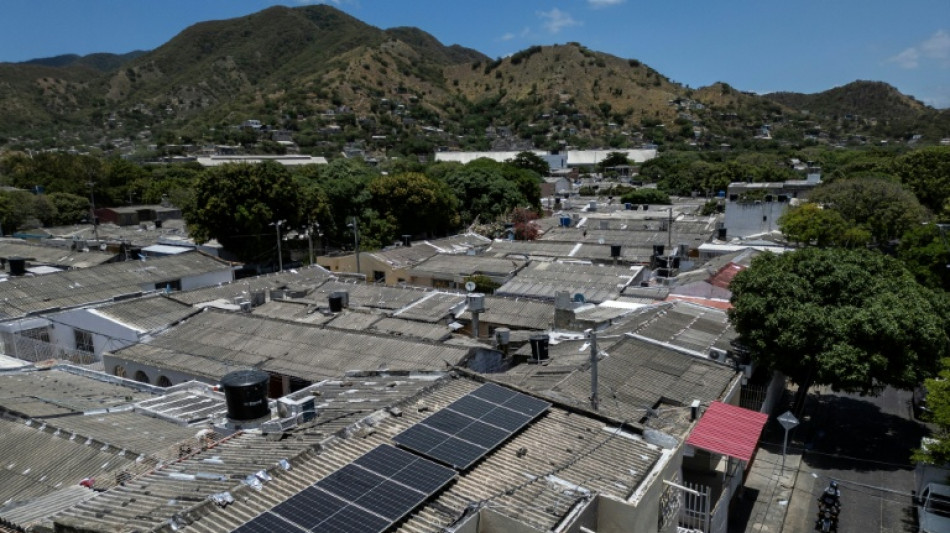
Sarmiento's electricity bill fell from around $650 to $200 after solar panels were installed for free on the roof of his store and his wife's sewing workshop.
"I feel more relieved," the 64-year-old told AFP.
Across the country in the southwestern city of Cali, then sun also powers some 2,000 low-income households.
Panels glint on the rooftops of small brick houses in a neighborhood mainly inhabited by families displaced by conflict.
Andrea Mina, 32, runs a community kitchen that provides food to more than a hundred people.
Solar energy has helped her cut costs by nearly 10 percent, allowing her to serve up more food, she related.
- 'Green colonialism' -
Representatives of around 50 countries will gather in Santa Marta, one of Colombia's largest coal-exporting ports, at the weekend to discuss the difficulty of weaning the world off fossil fuels.
Colombia is Latin America's fourth-biggest oil producer. Oil and gas account for 30 percent of its exports.
Despite being an energy power, many families have to choose "between paying the (electricity) bill or eating," Mines and Energy Minister Edwin Palma told AFP.
By doubling the amount of solar power in the energy mix in four years, the government has helped solve the dilemma, he said.
"There has been progress," Oscar Vanegas, an economics professor at the Industrial University of Santander in northern Colombia acknowledged, while arguing it did not amount to "a real energy transition."
Some renewable energy programs, such as the installation of wind turbines in wind-swept northern Guajira peninsula, have foundered on resistance from Indigenous communities, who complain of "green colonialism."
Weaning Colombia off fossil fuels will take decades, renewables expert Ismael Suescun warned.
"It's not just about stopping hydrocarbon exploration and extraction" Suescun said, calling for a "gradual" energy transition that does not leave a huge hole in Colombia's wallet.
It's an argument often heard in neighboring Brazil, including from its left-wing president Luiz Inacio Lula da Silva, who has backed a major oil project near the mouth of the Amazon River.
Defending the project in February 2025 Lula said the revenues were necessary "to finance the energy transition, which will be very expensive."
J.Bergmann--BTB