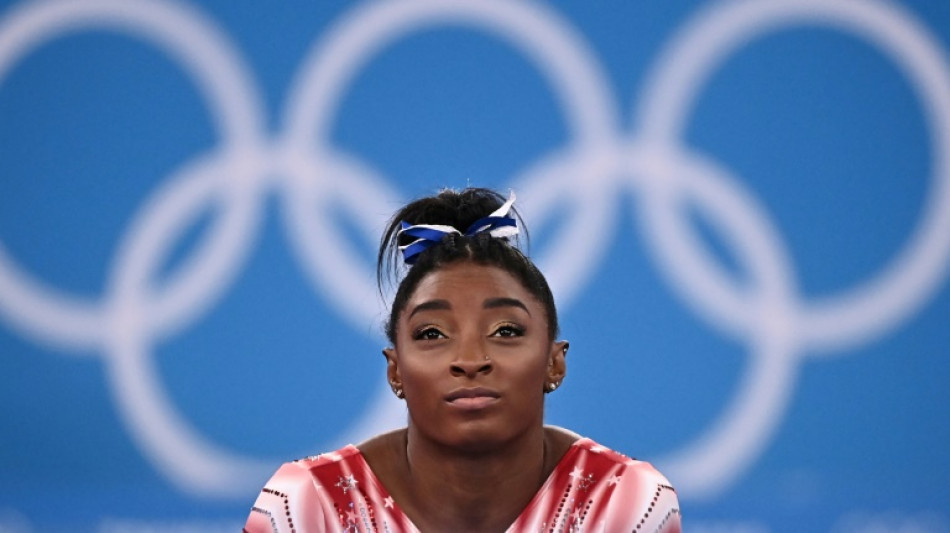
Biles's Olympic meltdown sparks stars into going public on mental health / Photo: © AFP/File

 Trump Signals Willingness to Work With Democrats After Midterm Defeat

 Qatar media bodies discuss support for humanitarian initiatives

 No. 22 UCLA defeats No. 5 Arizona 84-75 despite Kharchenkov's 38 points

 Vessel operator seeks witnesses after Vancouver grounding

 US Air Force deploys F-16 fighters to remote Aleutian base for readiness drill

 Bezos grant helps Seattle nonprofit move thousands of families toward housing

 Shrini Srivastava joins crew of Varanasi-Delhi Vande Bharat Sleeper service

 Nearly Half of Australian Workers Overqualified, Survey Finds

 RBI eases export-declaration compliance for individual service exporters

 India proposes more import entry points for drugs and medical devices

 Derek Tierney Outlines Ten-Year Strategy for National Digital Health System

 NBC’s Steve Kornacki Reveals Tech Habits Ahead of Midterm Elections

 India and Israel oppose UN draft on regional conventional arms control
 BLS Polymers shares open 65.3% above IPO price
 Capital-markets shares rally as Motilal Oswal and Angel One lead gains

 Latino Voters Defy ICE Fears, Turn Out in Record Numbers for Midterms

 ITC shares rise as analysts anticipate gradual cigarette-business recovery
 Reliance rally puts historical one-year return pattern in focus
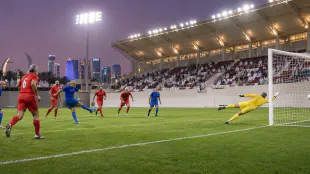 Kuwait edges Oman 1-0 in veterans Gulf Cup in Doha

 Saudi Aramco quarterly profit climbs 34.6% amid elevated oil prices
American gymnastics superstar Simone Biles's legacy may not be the four Olympic gold medals she won in her career but a remarkable meltdown at the Tokyo Olympics which sparked other sports greats to speak out about their battle with mental health issues.
Biles's attack of the twisties -- a condition meaning gymnasts lose the ability to orientate themselves in mid-air -- is perhaps the most abiding image of the Games.
Since then, retired French football icon Thierry Henry and Irish rugby great Keith Earls have spoken frankly about their problems.
Biles's travails followed Japan's four-time Grand Slam winner Naomi Osaka who had admitted to her battles with depression in May last year.
Henry usually cut a very composed and assured figure on and off the pitch so his admission came out of the blue and a surprise to many.
"To cry was impossible," Henry told L'Equipe newspaper in March.
"You are not allowed to show your weaknesses.
"It was: 'Thierry, do not cry, do not cry, do not cry!'
"I did cry when I was on my own, but I struggled with myself not to crack in public.
"Now I cry," added the Arsenal legend.
Earls has accrued over 90 caps for Ireland and was a pivotal member of the 2018 Six Nations Grand Slam winning side.
He was diagnosed as bi-polar in 2013 after biting the bullet and going to see a psychiatrist.
The 34-year-old's openness in his 2021 autobiography 'Fight or Flight: My Life, My Choices' was described as "inspiring" by his Ireland team-mate James Ryan.
"My admiration of him (Earls) has grown more, the way he's able to normalise that, that it doesn't matter who you are... Mental health doesn't discriminate," said Ryan.
Earls says that on the back of his revelations other team-mates have decided to go and see a psychiatrist.
This transparency seems to have broken the taboo where it was not seen as the done thing for sports people to go and see someone to discuss their mental health.
"Twenty years ago it was the same thing regarding mentally preparing for events," Greg Decamps, a researcher in sports psychology at Bordeaux University told AFP.
"Nobody said 'I am seeing a mental coach'.
"We are beginning to see the same thing in terms of consultations at sports psychology clinics.
"Because we cannot expect athletes to perform if there are unresolved psychological problems."
England's men's cricket Test captain Ben Stokes is another who has opened the door on mental health issues.
The 31-year-old followed a long list of cricketers such as Marcus Trescothick, Sarah Taylor and Andrew Flintoff who have struggled with mental health when he admitted his problems last year, taking four months away from the game to manage his illness.
“I was in a real dark place and having some difficult thoughts," he said in May when he was elevated to the captaincy.
"I now realise talking is such a powerful thing and it has completely changed me.”
- 'There was suffering' -
That is not to say in the unforgiving world of sport the floodgates have opened entirely over something that some still see as a stigma.
"Sport is a world that prides itself on excellence, strength, virility and where any sign of weakness is prohibited," said Decamp.
"Those who speak out will be regarded, often wrongly, as incapable of going to a national championships or to an Olympics."
Decamp says teams still keep their lips sealed if the reason for a player or an athlete's absence is due to mental health issues.
Some sporting bodies, though, have taken steps to address the issue.
In the United States the National Women's Soccer League (NWSL) brought in in February this year "six months of paid mental health leave."
This was welcomed by many players, including Cari Roccaro, who played a leading role in getting the NWSL to adopt such a policy after she suffered mental health issues.
"Girls who tear their ACL are still getting paid, even though they are away from the team for months," said Roccaro in March.
"Why treat a mental injury any different?"
Perhaps surprisingly success on the court or pitch does not protect you from the black dogs of depression.
According to Olivier Krumbholz, coach of France's Olympic gold medal women's handball winning team, mental health problems are more evident than ever before and "even more so when there are good results."
He told AFP that following the team's moment of glory in Tokyo "there was suffering."
L.Dubois--BTB