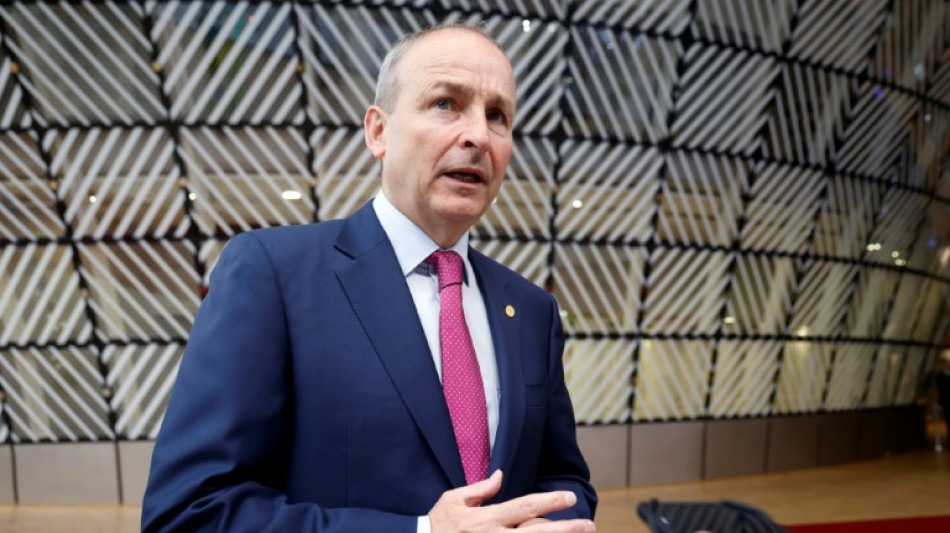
Ireland marks 100 years since founding of Irish Free State / Photo: © AFP

 Inside the Venezuelan prison meant to 'drive you insane'

 UK king braces as memoir by Diana's brother goes on sale

 No green light to lift EU sanctions on Russian oligarchs, talks to resume

 UK agrees support for Saudi in struggle with Houthis: reports

 EU foreign policy chief calls for continued sanctions on Russia

 Flights scrapped, evacuations urged as Typhoon Dujuan wallops Japan

 Fonseca to take break from tennis

 A Cuban zoo, and its animals, in epic battle for survival

 Infantino proposes consulting federations to reform FIFA

 El Nino weather pattern enters record territory: scientist
 OpenAI calls for US to lead global effort on AI standards
 South African ostriches plucked alive for luxury fashion: report
 US networks halt Trump coverage in revolt over White House ban
 Paramount settles with US states to clear Warner Bros. mega-merger

 Climate crisis a job for world leaders, not just activists: UK FM
 US networks halt Trump coverage over White House ban
 French singer accuses Miley Cyrus of plagiarism
 EU fines Google 403 mn euros for location data breach
 'Best is yet to come,' says De la Fuente after Spain extension

 Why diesel prices are rising more than crude oil
 COP31 host says AI's climate footprint to be a summit priority
 Renewables hit record in 2025, but world must move faster: report
 US media outlets to sue Trump administration after White House ban
 Global stocks rally on lower oil prices, US-China hopes
 EU proposes energy rating for data centres

One hundred years ago on Tuesday, Ireland gained statehood in the midst of a bitter civil war.
But it was not as a republic, as revolutionary leaders had hoped. Instead, a new era began under the ambiguous label of the Irish Free State.
On December 6, 1922, Irish lawmakers gathered to take an oath of allegiance to King George V as a dominion of the British Empire.
It was one in a string of compromises made in the Anglo-Irish Treaty of 1921 that concluded Ireland's three-year war of independence.
Not least among the accommodations made to the imperial power was provision for the continued partition of six, majority Protestant counties in the UK-ruled jurisdiction of Northern Ireland.
Debates in the Irish parliament that day -- among those lawmakers who had not boycotted it entirely -- stressed allegiance to the king was given under duress.
A day after the free state was born, lawmaker Sean Hales was assassinated by gunmen opposed to the treaty as he left lunch at a central Dublin hotel.
In swift and brutal reprisal, the new Irish government executed four anti-treaty prisoners by firing squad without charge or justification.
Irish writer James Joyce captured the mood of many in the nation when he wrote in his novel "Ulysses", published in the same year, that history was "a nightmare from which I am trying to awake".
-'Decade of centenaries'-
The island of Ireland has been reckoning with its turbulent early 20th century history over the last decade -- beginning in 2012 with the commemoration of the opposing reactions in Belfast and Dublin to the prospect of limited devolved governance known as "Home Rule" in 1912.
The "Decade of Centenaries" saw events in Dublin in 2016 for the 1916 Easter Rising -- an armed insurrection by Irish republicans against British rule.
It was marked as a moment of intense national pride in the now republic.
But as the decade has gone on, old divisions about the creation of modern Ireland have resurfaced and which have marked its history ever since.
Last year, Irish President Michael D. Higgins was accused of snubbing an invitation to attend a church service to mark the centenary of the creation of Northern Ireland.
And Irish Prime Minister Micheal Martin said last week that the compromised status gained by Ireland in 1922, and the loss of "a significant part of the population of the island" in Northern Ireland, remained "divisive".
"There was a sense of a lost idealism for the type of state which had been fought for," he told a government-backed conference at University College Dublin (UCD).
- Britain's shadow -
A recent Irish Times poll highlighted the continued schism. In the republic, 66 percent would vote for a united Ireland.
In Northern Ireland, however, 50 percent would vote against while 19 percent were undecided.
The UCD conference laid bare the warts and all legacy of the free state, which lasted 15 years until the passing of a new constitution.
Panels referenced the independent state's entrenchment of Catholic and patriarchal values that eroded women's rights.
Its failure to grapple with forces that would perpetuate mass emigration from Ireland during the 20th century was also highlighted.
"The parents of Ireland (were) wondering, are their children going to have a future in Ireland," said Irish historian Diarmaid Ferriter.
"We do need to think about those who felt they had no stake in the country."
On the plus side, the conference also discussed the 1922 constitution's delivery of an enduring democracy in Ireland and early successes to give the state a voice on the world stage.
Ireland's decision to join the European Union 50 years ago -- perhaps more than any other development in the last century -- allowed Ireland to finally step out of Britain's shadow, said Brigid Laffan, an Irish political scientist at the European University Institute.
If that ended the UK and Ireland's "asymmetric relationship", Brexit also further upended the status quo of the last century, she added.
"What Brexit has done to all of this as it has disturbed territorial politics in the UK and between the two parts of the island," Laffan said.
"The future is much more open because of Brexit than it would have been without."
Y.Bouchard--BTB