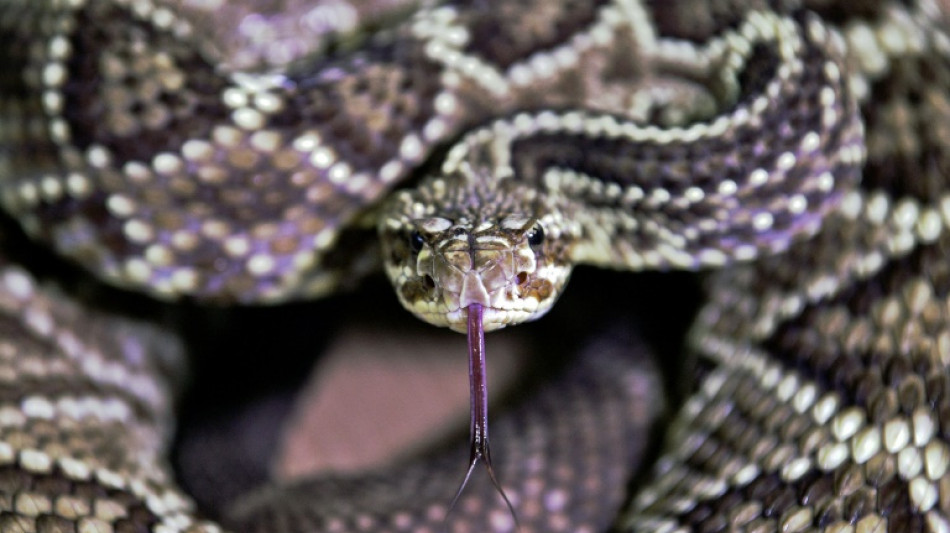
Snakes have clitorises, scientists say, slamming research 'taboo' / Photo: © AFP/File

 Inside the Venezuelan prison meant to 'drive you insane'

 UK king braces as memoir by Diana's brother goes on sale

 No green light to lift EU sanctions on Russian oligarchs, talks to resume

 UK agrees support for Saudi in struggle with Houthis: reports

 EU foreign policy chief calls for continued sanctions on Russia

 Flights scrapped, evacuations urged as Typhoon Dujuan wallops Japan

 Fonseca to take break from tennis

 A Cuban zoo, and its animals, in epic battle for survival

 Infantino proposes consulting federations to reform FIFA

 El Nino weather pattern enters record territory: scientist

 OpenAI calls for US to lead global effort on AI standards

 South African ostriches plucked alive for luxury fashion: report

 US networks halt Trump coverage in revolt over White House ban

 Paramount settles with US states to clear Warner Bros. mega-merger

 Climate crisis a job for world leaders, not just activists: UK FM

 US networks halt Trump coverage over White House ban

 French singer accuses Miley Cyrus of plagiarism

 EU fines Google 403 mn euros for location data breach

 'Best is yet to come,' says De la Fuente after Spain extension

 Why diesel prices are rising more than crude oil

 COP31 host says AI's climate footprint to be a summit priority

 Renewables hit record in 2025, but world must move faster: report

 US media outlets to sue Trump administration after White House ban

 Global stocks rally on lower oil prices, US-China hopes

 EU proposes energy rating for data centres

Female snakes have clitorises, according to the first detailed study on the subject Wednesday, in which the scientists lashed out at how little female sex organs have been researched compared to males across species.
Previous research had hypothesised that the organs on female snakes were scent glands, under-developed versions of penises, or were even there to stimulate males, rather than the other way around.
But the new study said it has "definitively" ruled out such theories, offering the first complete description of snake clitorises.
The findings suggest that clitorises may be common across squamates, the largest order of reptiles which includes snakes, and could play an essential role in how they reproduce.
However comparatively little research on the subject has been carried out, as in the case for the clitorises of pretty much all animals -- including humans.
"Female genitalia are conspicuously overlooked in comparison to their male counterparts, limiting our understanding of sexual reproduction across vertebrate lineages," wrote the authors of the study published in the journal Proceedings of the Royal Society B.
Since the 1800s it has been known that male squamates have a dual sex organ called a hemipenis.
However it was not until 1995 that German herpetologist Wolfgang Boehme, who was researching monitor lizards, first described the female sexual organ, the hemiclitores.
Megan Folwell, a PhD candidate at the University of Adelaide in Australia and the new study's lead author, told AFP she started off by analysing the hemiclitores of a common death adder.
The team of Australian and American researchers went on to dissect 10 snakes from nine different species, including the carpet python, puff adder and Mexican moccasin.
They found that snakes have two individual clitorises -- hemiclitores -- separated by tissue and hidden by skin on the underside of the tail.
For the death adder, the organ forms a triangle shape "like a heart", Folwell said.
Some are quite thin while others take up almost all the area around the cloaca, the tiny opening for the digestive, urinary and reproductive tract. Sizes ranged from less than a millimetre to seven millimetres.
The organs have erectile tissue that likely swells with blood as well as nerve bundles which "may be indicative of tactile sensitivity, similar to the mammalian clitoris," the study said.
- 'Taboo subject' -
"Snakes are very tactile animals," Folwell said, "so there's quite a high chance that they would get quite a lot of sensation even through the skin."
If the snakes' hemiclitores are stimulated during sex, it likely prompts longer and more frequent mating, resulting in a greater chance of reproductive success.
"Pleasure is such an important part of reproduction," Folwell said.
It could lead to lubrication to prevent damage from the "very spiny hemipenis" of male snakes, she said, adding that "we don't know".
So why did it take so long for scientists to get here?
"It's quite a taboo subject, female genitalia is not the easiest topic to bring up and be respected," Folwell said.
"There's also the fact that it is not the easiest structure to find," she said. "Especially if you don't know what you're looking for or where."
The study comes after a research abstract presented in the United States earlier this year said that the human clitoris has between 9,850-1,100 nerve fibres -- around 20 percent more than the previously widely cited number of 8,000, which reportedly came from research carried out on cows.
J.Horn--BTB