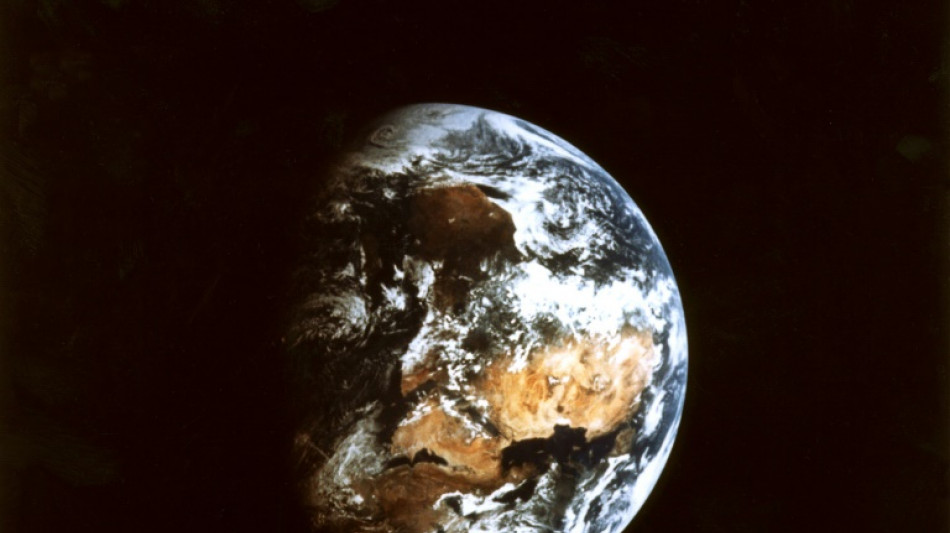
Planet spiralling into star may offer glimpse into Earth's end / Photo: © NASA/AFP

 Rams bounce back as Giants reel from Dart injury

 In Bangladesh, Pakistan's Jinnah photo stirs anger

 Two New Zealand naval ships transit Taiwan Strait

 Zidane gets down to work as France start new era

 Inside the Venezuelan prison meant to 'drive you insane'

 UK king braces as memoir by Diana's brother goes on sale

 No green light to lift EU sanctions on Russian oligarchs, talks to resume

 UK agrees support for Saudi in struggle with Houthis: reports

 EU foreign policy chief calls for continued sanctions on Russia

 Flights scrapped, evacuations urged as Typhoon Dujuan wallops Japan

 Fonseca to take break from tennis

 A Cuban zoo, and its animals, in epic battle for survival

 Infantino proposes consulting federations to reform FIFA

 El Nino weather pattern enters record territory: scientist

 OpenAI calls for US to lead global effort on AI standards

 South African ostriches plucked alive for luxury fashion: report

 US networks halt Trump coverage in revolt over White House ban

 Paramount settles with US states to clear Warner Bros. mega-merger

 Climate crisis a job for world leaders, not just activists: UK FM

 US networks halt Trump coverage over White House ban

 French singer accuses Miley Cyrus of plagiarism

 EU fines Google 403 mn euros for location data breach

 'Best is yet to come,' says De la Fuente after Spain extension

 Why diesel prices are rising more than crude oil

 COP31 host says AI's climate footprint to be a summit priority

For the first time astronomers have identified a planet that is spiralling towards a cataclysmic collision with its ageing sun, potentially offering a glimpse into how Earth could end one day.
In a new study published on Monday, a team of mostly US-based researchers said they hope the doomed exoplanet Kepler-1658b can help shed light on how worlds die as their stars get older.
Kepler-1658b, which is 2,600 light years from Earth, is known as a "hot Jupiter" planet.
While similar in size to Jupiter, the planet orbits its host star an eighth of the distance between our Sun and Mercury, making it far hotter than the gas giant in our own Solar System.
Kepler-1658b's orbit around its host star takes less than three days -- and it is getting shorter by around 131 milliseconds a year, according to the study published in The Astrophysical Journal Letters.
"If it continues spiralling towards its star at the observed rate, the planet will collide with its star in less than three million years," said Shreyas Vissapragada, a postdoc at the Harvard–Smithsonian Center for Astrophysics and the study's lead author.
"This is the first time we've observed direct evidence for a planet spiralling towards its evolved star," he told AFP.
An evolved star has entered the "subgiant" phase of the stellar life cycle, when it starts expanding and becoming brighter.
Kepler-1658b's orbit is being shortened by the tides, in a similar process to how Earth's oceans rise and fall every day.
This gravitational push-and-pull can work both ways -- for example the Moon is very slowly spiralling away from Earth.
- Earth's 'ultimate adios'? -
So could Earth be heading towards a similar doom?
"Death-by-star is a fate thought to await many worlds and could be the Earth's ultimate adios billions of years from now as our Sun grows older," the Center for Astrophysics said in a statement.
Vissapragada said that "in five billion years or so, the Sun will evolve into a red giant star".
While the tidally-driven processes seen on Kepler-1658b "will drive the decay of the Earth's orbit towards the Sun," that effect could be counter-balanced by the Sun losing mass, he said.
"The ultimate fate of the Earth is somewhat unclear," he added.
Kepler-1658b was the first exoplanet ever observed by the Kepler space telescope, which launched in 2009. However it took nearly a decade of work before the planet's existence was confirmed in 2019, the Center for Astrophysics said.
Over 13 years, astronomers were able to observe the slow but steady change in the planet's orbit as it crossed the face of its host star.
One "big surprise" was that the planet itself is quite bright, Vissapragada said.
Previously it had been thought this was because it is a particularly reflective planet, he said.
But now the researchers believe the planet itself is far hotter than anticipated, possibly due to the same forces that are driving it towards its star.
H.Seidel--BTB