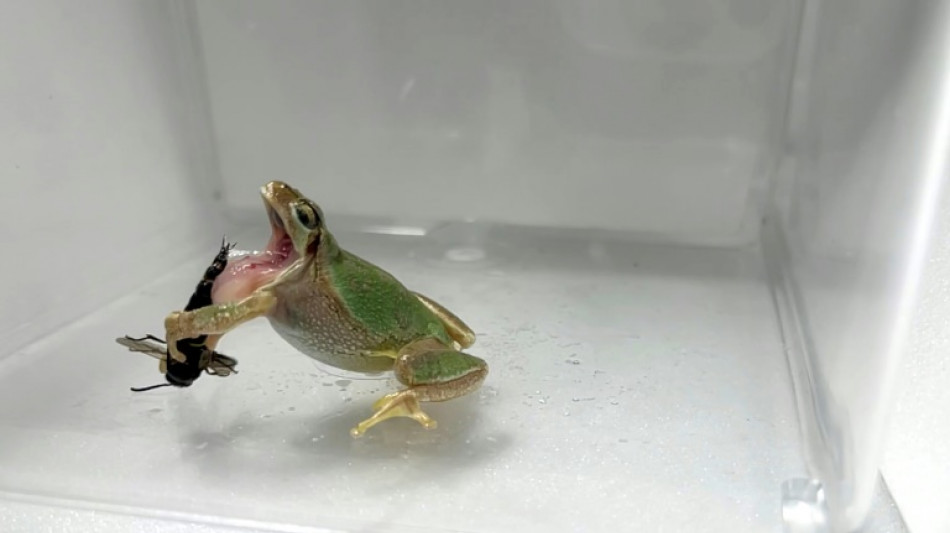
En garde! Wasps use penis spikes to ward off predators / Photo: © Kobe University/AFP

 Rams bounce back as Giants reel from Dart injury

 In Bangladesh, Pakistan's Jinnah photo stirs anger

 Two New Zealand naval ships transit Taiwan Strait

 Zidane gets down to work as France start new era

 Inside the Venezuelan prison meant to 'drive you insane'

 UK king braces as memoir by Diana's brother goes on sale

 No green light to lift EU sanctions on Russian oligarchs, talks to resume

 UK agrees support for Saudi in struggle with Houthis: reports

 EU foreign policy chief calls for continued sanctions on Russia

 Flights scrapped, evacuations urged as Typhoon Dujuan wallops Japan

 Fonseca to take break from tennis

 A Cuban zoo, and its animals, in epic battle for survival

 Infantino proposes consulting federations to reform FIFA

 El Nino weather pattern enters record territory: scientist

 OpenAI calls for US to lead global effort on AI standards

 South African ostriches plucked alive for luxury fashion: report

 US networks halt Trump coverage in revolt over White House ban

 Paramount settles with US states to clear Warner Bros. mega-merger

 Climate crisis a job for world leaders, not just activists: UK FM

 US networks halt Trump coverage over White House ban

 French singer accuses Miley Cyrus of plagiarism

 EU fines Google 403 mn euros for location data breach

 'Best is yet to come,' says De la Fuente after Spain extension

 Why diesel prices are rising more than crude oil

 COP31 host says AI's climate footprint to be a summit priority

An accidental sting has helped Japanese scientists prove some male wasps have a rather unusual predator defence weapon: penis spikes.
While wasps are known for their prickly attacks, only females have a real sting in their tails. Their male counterparts generally evade predators by mimicking the fairer sex.
Scientists had theorised that some male wasps might have other defence mechanisms, including perhaps deploying their genital spikes.
"However, the evidence was lacking," explained Shinji Sugiura, an ecologist at Japan's Kobe University.
Sugiura studies animal anti-predator defences but it was only by chance that he investigated the unusual male wasp mechanism, after his graduate student and co-author reported being stung by a mason wasp.
"I tried to be stung after hearing her experience," Sugiura told AFP.
"Because I had believed male wasps as harmless, I was very surprised to experience the pain."
Female wasps sting via an ovipositor, a tube-like protrusion that deposits eggs but can also deliver a venomous riposte.
Male wasps lack the organ but are equipped with two large spikes that sit either side of their penis.
To test the effectiveness of this defence, Sugiura's team offered up male mason wasps to two different kinds of frogs to see how the spikes were deployed.
"Male wasps were frequently observed to pierce the mouth or other parts of frogs with their genitalia while being attacked," Sugiura reported in research published Tuesday in the Current Biology journal.
The attacks are documented in a video that shows an unfortunate frog trying repeatedly to chomp down on a wasp, before using its front feet to pull the stinging insect out of its mouth.
Pond frogs happily ate all the males, as well as stinging females, but over a third of tree frogs rejected the male wasps after being stung.
When the experiment was repeated with the genital spikes removed from the wasps, the tree frogs no longer held back and ate them without hesitation.
"The difference was statistically significant. Even a small difference of survival could cause the evolution of anti-predator devices in insects," Sugiura said.
There has been little research on insect genitalia outside of its role in reproduction, according to Sugiura, though the wasp defence mechanism is not entirely without precedent.
Previous research has found, for example, that some species of hawkmoth use their genitalia to emit ultrasound that jams bat sonar.
Sugiura is no stranger to uncovering some of the weirdest ways animals evade their predators.
He has documented how some beetles can escape after being swallowed, by following the digestive tract to its logical conclusion and escaping from the anus.
And he has shown that other insects can make any unfortunate toad that has eaten them vomit them back up.
He now hopes to expand his current research to determine whether other wasp families have the same genital spike defence mechanism.
O.Bulka--BTB