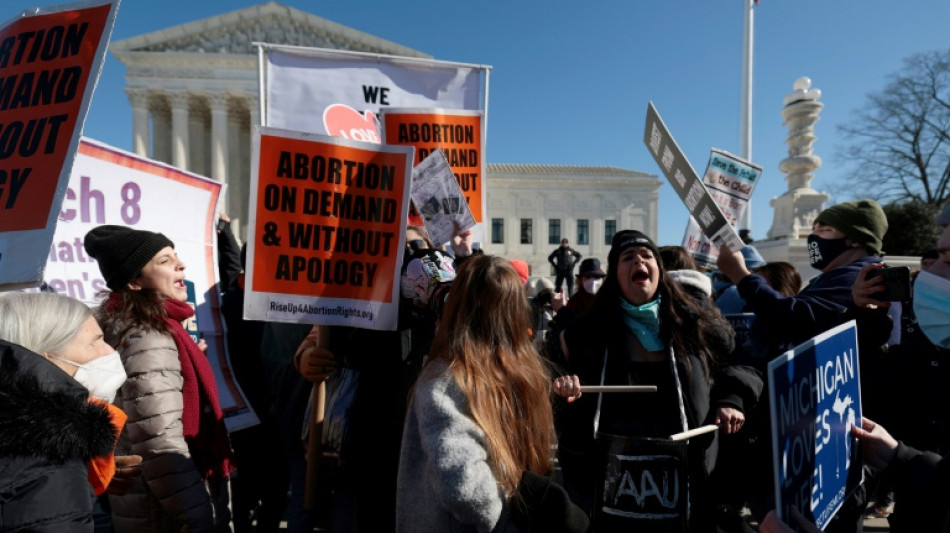
Many anti-abortion Americans would still help friends and family seeking one / Photo: ©

 Ed Sheeran returns to stage after Palestinian controversy

 Asian Games to open in Japan after troubled build-up

 Drone owners rush to offload devices ahead of Beijing ban

 Trump's beef policies irk Texas ranchers, testing their loyalty

 Nvidia, OpenAI CEOs to attend Xi dinner at White House

 Anthropic picks Accenture for in-house AI safety evaluation

 Balogun returns as Monaco beat Lens to continue strong Ligue 1 start

 'Pause' on overt repression in Venezuela, but reforms still needed: HRW

 Global stocks mixed as yen falls despite Bank of Japan rate hike

 Cuba hit with seventh major blackout of the year

 Murray out with concussion so Wentz will start for Vikings

 UN chief 'deeply regrets' US visa refusal to Abbas for annual meeting

 England quick Carse to face no charges over alleged nightclub assault

 Mancini brings nine newcomers into the first squad of his Italy comeback

 Czechs level Davis Cup tie against USA as South Korea eye Finals

 New France boss Zidane confirms Mbappe as captain after naming first squad

 California governor signs order to explore AI 'kill switch'

 Head leads run spree as Australia win Zimbabwe ODI series

 In-form Raphinha wants to finish career at Barcelona

 Warren Buffett steps down as Berkshire Hathaway chairman

 Carrick confident Man Utd can 'work through' tough time

 Mbappe ends Nike partnership to join Swiss brand On

 Liverpool boss Iraola puts Bournemouth love affair on hold

 'A disaster' if Man City do not win says Maresca after flawless start

 Kerry James Marshall: American 'blackness' painter celebrated in Europe

Almost half of Americans morally opposed to abortion would help a friend or family member with arrangements to get one, and a majority would offer emotional support, a new study said Friday.
The authors of the paper, which appeared in the journal Science Advances, wrote the finding showed that people are willing to cross ideological and partisan lines to help others in their personal networks, something they referred to as "discordant benevolence."
"At first blush, these people may appear as hypocrites. They are not," said Sarah Cowan, a sociologist at New York University and the lead author of the article, in a statement.
"They are at a moral crossroads, pulled by their opposition to abortion and by their inclination to support people they care about."
The study was drawn from surveys and interviews conducted in 2018 and 2019 respectively, and comes after Texas passed a law allowing residents of the state to sue others who "aided or abetted" abortions performed after six weeks of pregnancy.
The Supreme Court could soon roll back decades of precedent by ruling abortion is not a constitutional right. The issue is deeply contentious and divides the public along political lines between Democrats and Republicans.
The new study was based on survey responses from more than 1,574 people, and separately 74 in-depth interviews.
Of those morally opposed, 76 percent said they would offer emotional support —- compared to 96 percent of those who are not morally opposed, or whose view depended on circumstances.
But the type of support varied greatly, reflecting the social meaning of money and the view that spending money is a means to enact one's values, the authors said.
Just six percent of those morally opposed would directly help a friend or relative pay for the procedure, compared to the 45 percent who said they would help with ancillary costs.
Among those not morally opposed, 54 percent would help pay for the procedure, which typically costs $500 in the first trimester.
- Moral conflict -
Social scientists have long been interested in what explains helpful behavior.
Factors are thought to range from the act of kindness causing a person to feel good about themselves, to a sense of duty to their kinship networks and expectation of reciprocity in future.
But the authors said scenarios where rendering help placed the helper in a moral conflict were less studied.
Based on their in-depth interviews, they found people who were willing to help despite their inner opposition relied on three main rationalizations.
The first was "commiseration," or reasoning that people are worthy of care despite their imperfections in an imperfect world.
The second was "exemption" -- carving out an exception for their loved ones in particular, while the third was "discretion," -- the idea that what is right or wrong is inherently personal, not universal.
"If it were my sister...I would want to talk to her to make sure she's thinking about every possible thing," said Ryan, a person interviewed in the survey.
"But if, ultimately, she's like 'No, (Ryan), I can handle this,' then, 'Ok, do what you gotta do,' you know? But it's just because you love someone."
L.Dubois--BTB