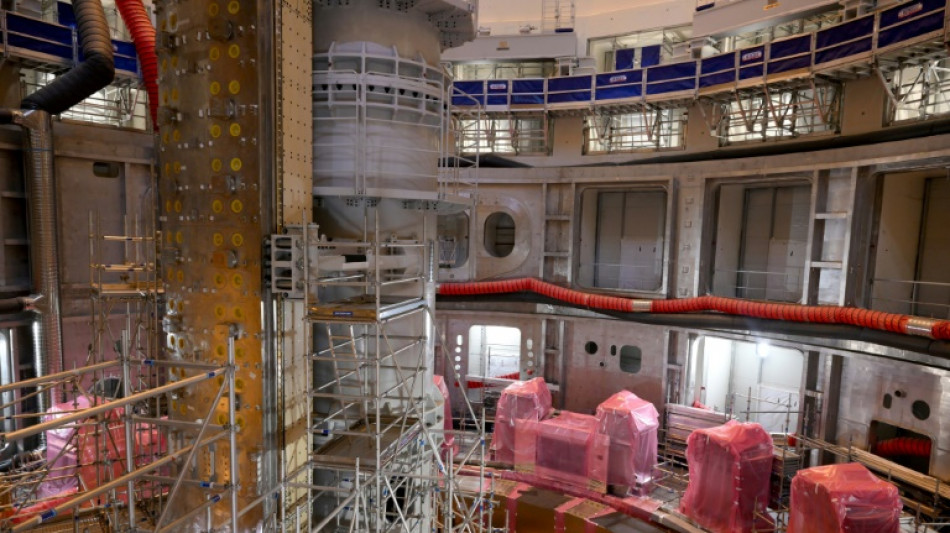
International fusion energy project faces delays, says chief / Photo: © AFP

 Rams bounce back as Giants reel from Dart injury
 In Bangladesh, Pakistan's Jinnah photo stirs anger

 Two New Zealand naval ships transit Taiwan Strait

 Zidane gets down to work as France start new era
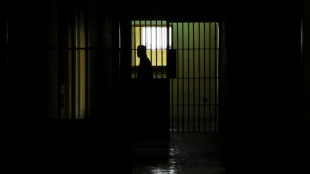 Inside the Venezuelan prison meant to 'drive you insane'
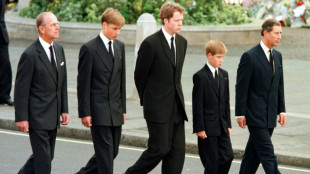 UK king braces as memoir by Diana's brother goes on sale
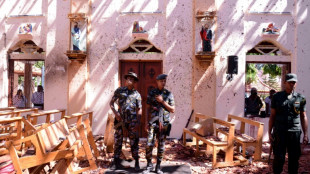
 No green light to lift EU sanctions on Russian oligarchs, talks to resume

 UK agrees support for Saudi in struggle with Houthis: reports

 EU foreign policy chief calls for continued sanctions on Russia

 Flights scrapped, evacuations urged as Typhoon Dujuan wallops Japan

 Fonseca to take break from tennis

 A Cuban zoo, and its animals, in epic battle for survival

 Infantino proposes consulting federations to reform FIFA

 El Nino weather pattern enters record territory: scientist

 OpenAI calls for US to lead global effort on AI standards

 South African ostriches plucked alive for luxury fashion: report

 US networks halt Trump coverage in revolt over White House ban

 Paramount settles with US states to clear Warner Bros. mega-merger

 Climate crisis a job for world leaders, not just activists: UK FM

 US networks halt Trump coverage over White House ban
 French singer accuses Miley Cyrus of plagiarism

 EU fines Google 403 mn euros for location data breach

 'Best is yet to come,' says De la Fuente after Spain extension

 Why diesel prices are rising more than crude oil

 COP31 host says AI's climate footprint to be a summit priority
An international project in nuclear fusion may face "years" of delays, its boss has told AFP, weeks after scientists in the United States announced a breakthrough in their own quest for the coveted goal.
The International Thermonuclear Experimental Reactor (ITER) project seeks to prove the feasibility of fusion as a large-scale and carbon-free source of energy.
Installed at a site in southern France, the decades-old initiative has a long history of technical challenges and cost overruns.
Fusion entails forcing together the nuclei of light atomic elements in a super-heated plasma, held by powerful magnetic forces in a doughnut-shaped chamber called a tokamak.
The idea is that fusing the particles together from isotopes of hydrogen -- which can be extracted from seawater -- will create a safer and almost inexhaustible form of energy compared with splitting atoms from uranium or plutonium.
ITER'S previously-stated goal was to create the plasma by 2025.
But that deadline will have to be postponed, Pietro Barabaschi -- who in September became the project's director-general -- told AFP during a visit to the facility.
The date "wasn't realistic in the first place," even before two major problems surfaced, Barabaschi said.
One problem, he said, was wrong sizes for the joints of blocks to be welded together for the installation's 19-by-11-metre (62-by-36-feet) chamber.
The second was traces of corrosion in a thermal shield designed to protect the outside world from the enormous heat created during nuclear fusion.
Fixing the problems "is not a question of weeks, but months, even years," Barabaschi said.
A new timetable is to be worked out by the end of this year, he said, including some modification to contain the expected cost overrun, and to meet the French nuclear safety agency's security requirements.
Barabaschi said he hoped ITER would be able to make up for the delays as it prepares to enter the full phase, currently scheduled for 2035.
On December 13, US researchers working separately from ITER announced an important technical breakthrough.
Scientists at the Lawrence Livermore National Laboratory (LLNL) in California said they had used the world's largest laser to create, for the first time, a fusion reaction generating more energy than it took to produce.
"Some competition is healthy in any environment," Barabaschi said about the success.
"If tomorrow somebody found another breakthrough that would make my work redundant, I would be very happy," he added.
ITER was set in motion after a 1985 summit between US president Ronald Reagan and Soviet leader Mikhail Gorbachev.
Its seven partners are China, the European Union, India, Japan, South Korea, Russia and the United States.
Russia still participates in ITER despite the start of the Ukraine conflict.
In November it dispatched one of six giant magnets needed for the top part of the tokamak.
J.Bergmann--BTB