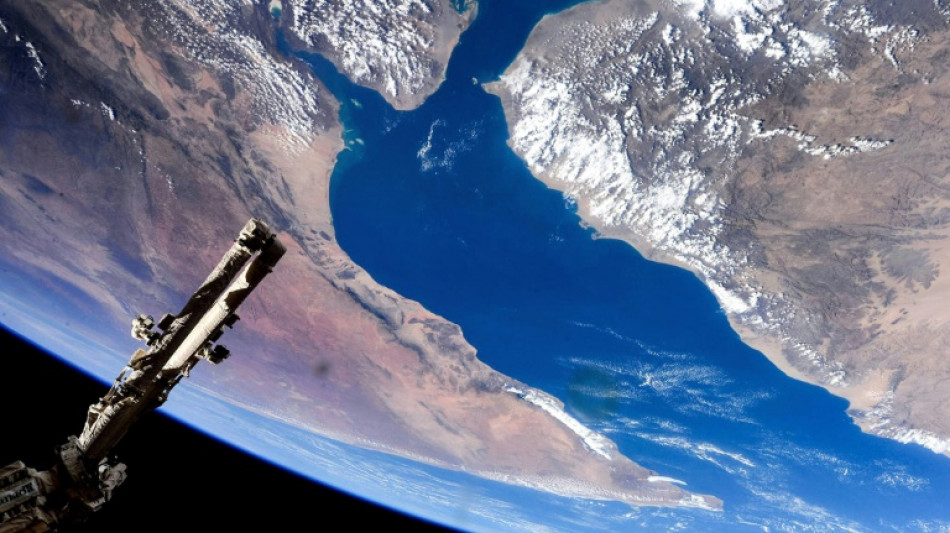
Space junk, not meteorites, remains biggest threat to spacecraft / Photo: © NASA/ESA/AFP/File

 Rams bounce back as Giants reel from Dart injury

 In Bangladesh, Pakistan's Jinnah photo stirs anger

 Two New Zealand naval ships transit Taiwan Strait

 Zidane gets down to work as France start new era
 Inside the Venezuelan prison meant to 'drive you insane'
 UK king braces as memoir by Diana's brother goes on sale
 No green light to lift EU sanctions on Russian oligarchs, talks to resume

 UK agrees support for Saudi in struggle with Houthis: reports

 EU foreign policy chief calls for continued sanctions on Russia

 Flights scrapped, evacuations urged as Typhoon Dujuan wallops Japan

 Fonseca to take break from tennis

 A Cuban zoo, and its animals, in epic battle for survival

 Infantino proposes consulting federations to reform FIFA

 El Nino weather pattern enters record territory: scientist

 OpenAI calls for US to lead global effort on AI standards
 South African ostriches plucked alive for luxury fashion: report

 US networks halt Trump coverage in revolt over White House ban

 Paramount settles with US states to clear Warner Bros. mega-merger

 Climate crisis a job for world leaders, not just activists: UK FM
 US networks halt Trump coverage over White House ban
 French singer accuses Miley Cyrus of plagiarism
 EU fines Google 403 mn euros for location data breach

 'Best is yet to come,' says De la Fuente after Spain extension

 Why diesel prices are rising more than crude oil

 COP31 host says AI's climate footprint to be a summit priority

Dodging the kind of meteorite strike that forced Russia to plan a space station rescue mission is nearly impossible, yet the greater threat to spacecraft is actually the man-made debris in orbit, experts say.
Russian announced on Wednesday a February mission to the International Space Station to pick up crew members left stranded after a strike damaged the capsule that was to take them home.
Didier Schmitt, the European Space Agency's head of human and robotic exploration, said it was not rare for tiny meteorites to hit the space station.
The micrometeorites can be travelling at speeds from 10 to 30 kilometres (6-18 miles) a second -- "much faster than a shotgun bullet," Schmitt said.
That is why, when the space station's large observation window is not in use, it is shuttered with "very, very thick layers of protective materials," he said.
The small meteorites come from so far away in the distant universe and at such high speeds that they cannot realistically be tracked, he said.
But space agencies do monitor known meteor showers, such as one expected in early August.
NASA has previously said that the Geminid meteor shower in December was unlikely to have hit the Soyuz capsule, as the hull was penetrated from a different direction.
- What about space junk? -
While meteorites might sound scary, the biggest threat to spacecraft is believed to be from orbital debris -- disused satellites and other human-made objects spinning around Earth known as "space junk".
That is because colliding space junk creates even more debris, leading to a "runaway chain reaction" of cascading collisions littering orbit with tiny, dangerous objects, NASA says.
There are half a million pieces of debris the size of a marble and 100 million pieces measuring around one millimetre in orbit, the UN Office for Outer Space Affairs said last month.
Stefania Soldini, a space engineering lecturer at the UK's Liverpool University, said that "millimetre-sized orbital debris represents the highest mission-ending risk to most robotic spacecraft operating in low Earth orbit".
The ISS is "the most heavily shielded spacecraft" against such debris, Soldini said.
The space station has orbital shields to protect it from debris of less than 1.5 centimetres in size.
But space is only becoming more crowded.
Around 35 percent of the 14,000 satellites ever launched into space entered orbit in just the last three years -- and 100,000 more satellites could potentially be added over the next decade, said the UN office.
- Missiles in space? -
Countries using missiles to shoot down their satellites for weapons tests has also significantly added to the pile of space junk.
Russia provoked criticism from NASA in 2021 when Moscow destroyed one of its own satellites during a missile test, creating more than 1,500 pieces of debris and forcing those onboard the ISS to take shelter.
China created more than 3,500 pieces of large, trackable debris when it shot down one of its weather satellites in 2007, according to NASA.
Accidental clashes have also increased in recent decades. More than 2,300 pieces of new debris were also shot into orbit when a disused Russian military satellite smacked into a US Iridium communications satellite in 2009.
The US Department of Defense tracks objects orbiting Earth, mostly those larger than 10 centimetres (about four inches).
If a larger piece of debris is seen heading towards the ISS, its thrusters move the football pitch-sized space station out of the way.
In 2021, the ISS adjusted to avoid debris known to have originated from China's 2007 anti-satellite test.
- Biggest threat to astronauts? -
For now, the "big problem" is that without Soyuz capsule MS-22 capsule, around half of the seven crew on board have no ride home, Schmitt said.
Normally if a critical event occurred on the station, the crew would hypothetically be able to return to Earth within three hours.
But now "there is a risky period where we cannot get everybody back if there is a major threat," Schmitt said.
Russia's space agency Roscosmos said that a new spaceship would be sent to the ISS on February 20 to retrieve two cosmonauts and an astronaut who initially planned to take the Soyuz MS-22 capsule home.
In normal times, the biggest threat to the astronauts on the ISS was probably fire breaking out, Schmitt said, adding: "You cannot open the windows".
He named solar flares as another danger -- not to mention the myriad dangers that await those planning to jet off on upcoming missions to the Moon and Mars.
"Human space exploration is risky," he said.
O.Bulka--BTB