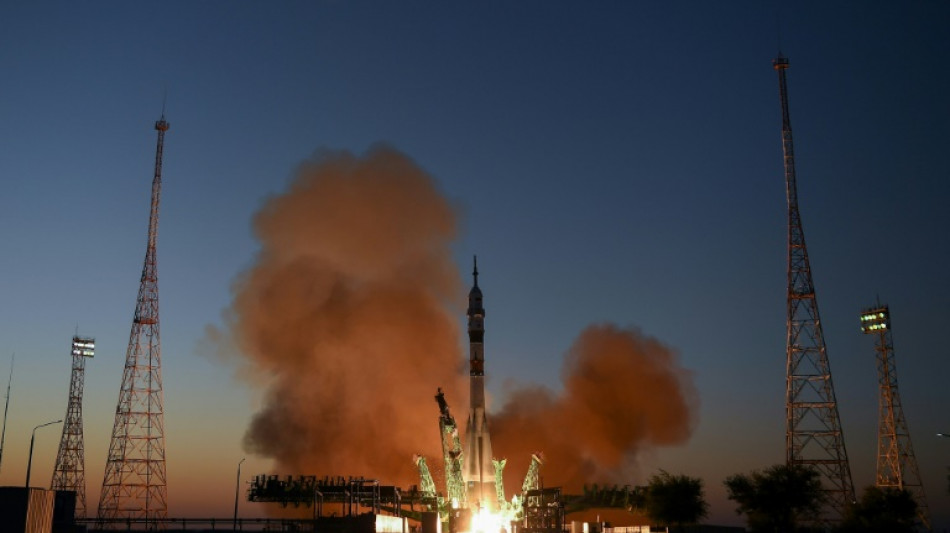
Russia to send spacecraft to ISS to bring home crew of damaged capsule / Photo: © AFP/File

 Rams bounce back as Giants reel from Dart injury

 In Bangladesh, Pakistan's Jinnah photo stirs anger

 Two New Zealand naval ships transit Taiwan Strait

 Zidane gets down to work as France start new era

 Inside the Venezuelan prison meant to 'drive you insane'

 UK king braces as memoir by Diana's brother goes on sale

 No green light to lift EU sanctions on Russian oligarchs, talks to resume

 UK agrees support for Saudi in struggle with Houthis: reports

 EU foreign policy chief calls for continued sanctions on Russia

 Flights scrapped, evacuations urged as Typhoon Dujuan wallops Japan

 Fonseca to take break from tennis

 A Cuban zoo, and its animals, in epic battle for survival

 Infantino proposes consulting federations to reform FIFA

 El Nino weather pattern enters record territory: scientist

 OpenAI calls for US to lead global effort on AI standards

 South African ostriches plucked alive for luxury fashion: report

 US networks halt Trump coverage in revolt over White House ban

 Paramount settles with US states to clear Warner Bros. mega-merger

 Climate crisis a job for world leaders, not just activists: UK FM

 US networks halt Trump coverage over White House ban
 French singer accuses Miley Cyrus of plagiarism

 EU fines Google 403 mn euros for location data breach

 'Best is yet to come,' says De la Fuente after Spain extension

 Why diesel prices are rising more than crude oil

 COP31 host says AI's climate footprint to be a summit priority

Russia said Wednesday that it will send an empty spacecraft to the International Space Station (ISS) next month to bring home three astronauts whose planned return vehicle was damaged by a strike from a tiny meteorite.
The Russian space agency, Roscosmos, made the announcement after examining the flight worthiness of the Soyuz MS-22 crew capsule docked with the ISS that sprang a radiator coolant leak in December.
Roscosmos and NASA officials said at a joint press briefing that an uncrewed Soyuz spacecraft, MS-23, would be sent to the ISS on February 20 to bring Russian cosmonauts Dmitry Petelin and Sergei Prokopyev and NASA astronaut Frank Rubio back to Earth.
"We're not calling it a rescue Soyuz," said Joel Montalbano, the ISS program manager at NASA's Johnson Space Center in Houston. "I'm calling it a replacement Soyuz.
"Right now the crew is safe onboard the space station."
MS-22 flew Petelin, Prokopyev and Rubio to the ISS in September. They were scheduled to return home in the same spacecraft in mid-March.
But MS-22 began leaking coolant on December 14 after being hit by what US and Russian space officials said they believe was a micrometeorite.
"Everything does point to a micrometeorite," Montalbano said.
Sergei Krikalev, executive director of Human Space Flight Programs at Roscosmos, said the "current theory is that this damage was caused by a small particle about one millimetre in diameter".
Krikalev said the decision to use MS-23 to fly the crew home was made because of concern over high temperatures in MS-22 during re-entry.
"The main problem to land the current Soyuz with crew would be thermal conditions because we lost heat rejection capability," he said.
"We may have a high temperature situation on Soyuz in the equipment compartment and in the crew compartment."
- SpaceX Crew Dragon -
Montalbano said discussions were also underway with SpaceX officials about potentially returning one or more crew members on the SpaceX Crew Dragon capsule currently docked with the ISS.
Four astronauts were flown to the ISS by a SpaceX rocket in October for a mission expected to last about six months.
"We could safely secure the crew members in the area that the cargo normally returns on the Dragon," Montalbano said.
"All that is only for an emergency, only if we have to evacuate ISS," he stressed. "That's not the nominal plan or anything like that."
Krikalev said MS-22 would return to Earth after the two cosmonauts and the NASA astronaut leave on MS-23. It would bring back equipment and experiments that are not "temperature sensitive", he said.
Soyuz MS-23 had been initially scheduled to fly Russian cosmonauts Oleg Kononenko and Nikolai Chub and NASA's Loral O'Hara to the ISS on March 16.
Space has remained a rare venue of cooperation between Moscow and Washington since the start of the Russian offensive in Ukraine and ensuing Western sanctions on Russia.
The ISS was launched in 1998 at a time of increased US-Russia cooperation following the Cold War "Space Race".
Russia has been using the ageing but reliable Soyuz capsules to ferry astronauts into space since the 1960s.
W.Lapointe--BTB