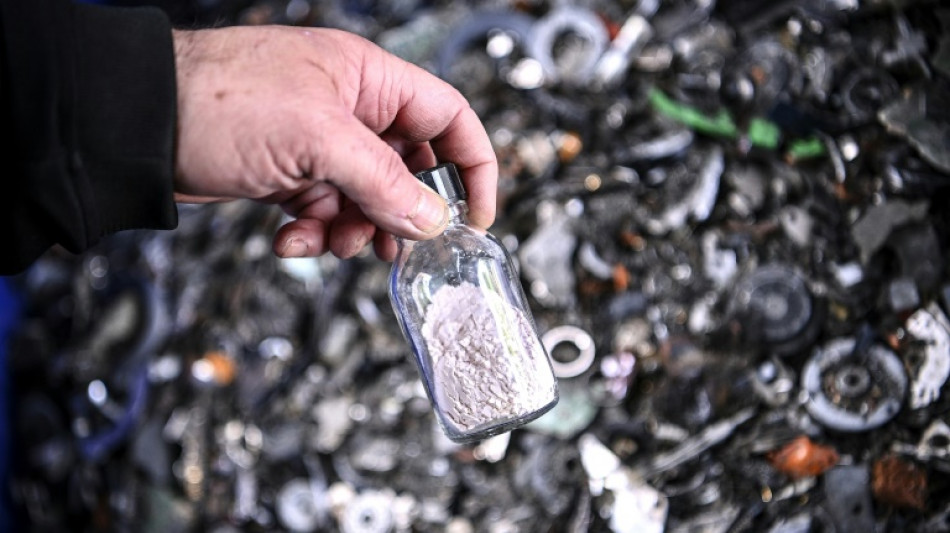
Europe's largest rare earths deposit discovered in Sweden / Photo: © AFP/File

 Rams bounce back as Giants reel from Dart injury

 In Bangladesh, Pakistan's Jinnah photo stirs anger

 Two New Zealand naval ships transit Taiwan Strait

 Zidane gets down to work as France start new era

 Inside the Venezuelan prison meant to 'drive you insane'

 UK king braces as memoir by Diana's brother goes on sale

 No green light to lift EU sanctions on Russian oligarchs, talks to resume

 UK agrees support for Saudi in struggle with Houthis: reports

 EU foreign policy chief calls for continued sanctions on Russia

 Flights scrapped, evacuations urged as Typhoon Dujuan wallops Japan

 Fonseca to take break from tennis

 A Cuban zoo, and its animals, in epic battle for survival

 Infantino proposes consulting federations to reform FIFA

 El Nino weather pattern enters record territory: scientist

 OpenAI calls for US to lead global effort on AI standards

 South African ostriches plucked alive for luxury fashion: report

 US networks halt Trump coverage in revolt over White House ban

 Paramount settles with US states to clear Warner Bros. mega-merger

 Climate crisis a job for world leaders, not just activists: UK FM
 US networks halt Trump coverage over White House ban
 French singer accuses Miley Cyrus of plagiarism
 EU fines Google 403 mn euros for location data breach

 'Best is yet to come,' says De la Fuente after Spain extension

 Why diesel prices are rising more than crude oil

 COP31 host says AI's climate footprint to be a summit priority
Europe's largest known deposit of rare earth elements, essential for the manufacturing of electric vehicles, has been discovered in Sweden's far north, boosting Europe's hopes of cutting its dependence on China.
Swedish mining group LKAB said Thursday the newly-explored deposit, found right next to its iron ore mine, contained more than one million tonnes of rare earth oxides.
"This is the largest known deposit of rare earth elements in our part of the world, and it could become a significant building block for producing the critical raw materials that are absolutely crucial to enable the green transition," LKAB's chief executive Jan Mostrom said in a statement.
"We face a supply problem. Without mines, there can be no electric vehicles," Mostrom added.
While the find is believed to be the biggest in Europe, it remains small on a global scale, representing less than one percent of the 120 million tonnes estimated worldwide by the US Geological Survey.
In 2021, the European Commission said that 98 percent of the rare earths used in the EU were imported from China, prompting Brussels to urge member states to develop their own extraction capacities.
LKAB's find was presented as a delegation from the European Commission visited Sweden, which took over the rotating EU presidency at the start of the year.
"Today, the EU is way too dependent on other countries for these materials," Swedish Energy Minister Ebba Busch told a press conference, pointing specifically to Russia and China.
"This must change. We must take responsibility for the raw material supply needed for the (green) transition," she added.
- Trade not enough -
The European Union has agreed to phase out new CO2-emitting vehicles by 2035, effectively banning combustion engine cars, meaning the need for rare earth materials will only increase.
In the short term, Busch said the EU needed to "diversify" its trade.
"But in the long run, we cannot rely on trade agreements only," she said.
Mostrom said the full extent of the deposit had yet to be established.
"We are continuing to conduct exploration to see how big this is," Mostrom told AFP, adding that LKAB was also still in the process of figuring out how the new deposit could be mined.
Mostrom said it was difficult to accurately gauge the impact of the discovery on reducing Europe's dependence on Chinese imports.
But he said he was confident "it will have a huge impact."
Asked during a press conference when the deposit could actually be mined and deliver raw materials to the market, Mostrom said it would largely depend on how quickly permits could be secured.
But based on experience, it would likely be "10 to 15 years", he said.
According to LKAB, the rare earth elements found in the Per Geijer deposit occurred "in what is mainly an iron ore deposit and which may therefore be produced as by-products," creating new opportunities for potentially "competitive mining."
- From magnets to lenses -
Rare earth minerals with names like neodymium, praseodymium and dysprosium are crucial to the manufacture of magnets used in industries of the future, like wind turbines and electric cars.
They are also present in consumer goods such as smartphones, computer screens and telescopic lenses.
Others have more traditional uses, like cerium for glass polishing and lanthanum for car catalysts or optical lenses.
Sweden is one of the EU's biggest mining countries.
More than 90 percent of the EU's iron ore production comes from the Scandinavian country, which also has the bloc's largest lead and zinc production, the second largest silver production, and among the highest gold and copper production, according to the Geological Survey of Sweden.
M.Furrer--BTB