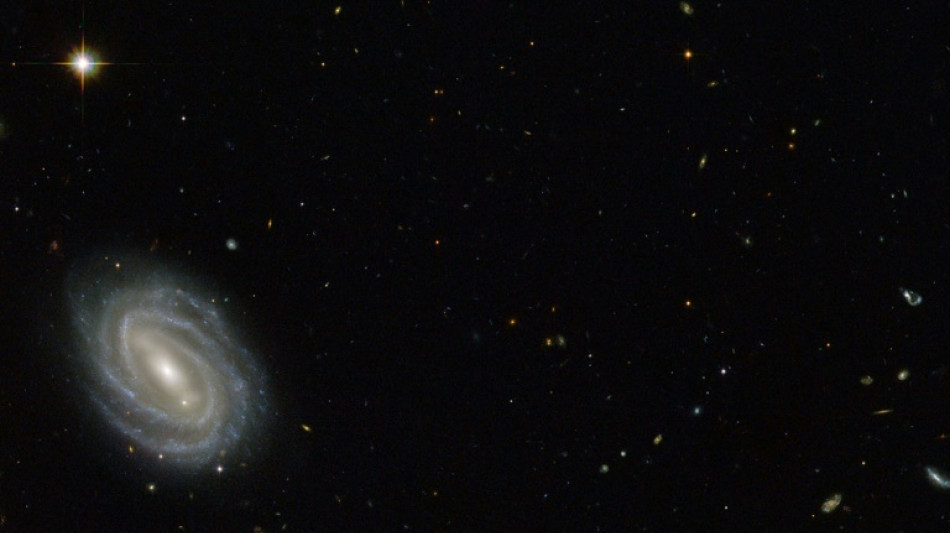
Nuclear reactor experiment rules out one dark matter hope / Photo: © NASA/ESA/HUBBLE/AFP/File

 Rams bounce back as Giants reel from Dart injury

 In Bangladesh, Pakistan's Jinnah photo stirs anger

 Two New Zealand naval ships transit Taiwan Strait

 Zidane gets down to work as France start new era

 Inside the Venezuelan prison meant to 'drive you insane'

 UK king braces as memoir by Diana's brother goes on sale

 No green light to lift EU sanctions on Russian oligarchs, talks to resume

 UK agrees support for Saudi in struggle with Houthis: reports

 EU foreign policy chief calls for continued sanctions on Russia

 Flights scrapped, evacuations urged as Typhoon Dujuan wallops Japan

 Fonseca to take break from tennis

 A Cuban zoo, and its animals, in epic battle for survival

 Infantino proposes consulting federations to reform FIFA

 El Nino weather pattern enters record territory: scientist

 OpenAI calls for US to lead global effort on AI standards

 South African ostriches plucked alive for luxury fashion: report

 US networks halt Trump coverage in revolt over White House ban

 Paramount settles with US states to clear Warner Bros. mega-merger

 Climate crisis a job for world leaders, not just activists: UK FM

 US networks halt Trump coverage over White House ban

 French singer accuses Miley Cyrus of plagiarism

 EU fines Google 403 mn euros for location data breach

 'Best is yet to come,' says De la Fuente after Spain extension

 Why diesel prices are rising more than crude oil

 COP31 host says AI's climate footprint to be a summit priority

It was an anomaly detected in the storm of a nuclear reactor so puzzling that physicists hoped it would shine a light on dark matter, one of the universe's greatest mysteries.
However new research has definitively ruled out that this strange measurement signalled the existence of a "sterile neutrino", a hypothetical particle that has long eluded scientists.
Neutrinos are sometimes called "ghost particles" because they barely interact with other matter -- around 100 trillion are estimated to pass through our bodies every second.
Since neutrinos were first theorised in 1930, scientists have been trying to nail down the properties of these shape-shifters, which are one of the most common particles in the universe.
They appear "when the nature of the nucleus of an atom has been changed", physicist David Lhuillier of France's Atomic Energy Commission told AFP.
That could happen when they come together in the furious fusion in the heart of stars like our Sun, or are broken apart in nuclear reactors, he said.
There are three confirmed flavours of neutrino: electron, muon and tau.
However physicists suspect there could be a fourth neutrino, dubbed "sterile" because it does not interact with ordinary matter at all.
In theory, it would only answer to gravity and not the fundamental force of weak interactions, which still hold sway over the other neutrinos.
The sterile neutrino has a place ready for it in theoretical physics, "but there has not yet been a clear demonstration that is exists," he added.
- Dark matter candidate -
So Lhuillier and the rest of the STEREO collaboration, which brings together French and German scientists, set out to find it.
Previous nuclear reactor measurements had found fewer neutrinos than the amount expected by theoretical models, a phenomenon dubbed the "reactor antineutrino anomaly".
It was suggested that the missing neutrinos had changed into the sterile kind, offering a rare chance to prove their existence.
To find out, the STEREO collaboration installed a dedicated detector a few metres away from a nuclear reactor used for research at the Laue–Langevin institute in Grenoble, France.
After four years of observing more than 100,000 neutrinos and two years analysing the data, the verdict was published in the journal Nature on Wednesday.
The anomaly "cannot be explained by sterile neutrinos," Lhuillier said.
But that "does not mean there are none in the universe", he added.
The experiment found that previous predictions of the amount of neutrinos being produced were incorrect.
But it was not a total loss, offering a much clearer picture of neutrinos emitted by nuclear reactors.
This could help not just with future research, but also for monitoring nuclear reactors.
Meanwhile, the search for the sterile neutrino continues. Particle accelerators, which smash atoms, could offer up new leads.
Despite the setback, interest could remain high because sterile neutrinos have been considered a suspect for dark matter, which makes up more than quarter of the universe but remains shrouded in mystery.
Like dark matter, the sterile neutrino does not interact with ordinary matter, making it incredibly difficult to observe.
"It would be a candidate which would explain why we see the effects of dark matter -- and why we cannot see dark matter," Lhuillier said.
G.Schulte--BTB