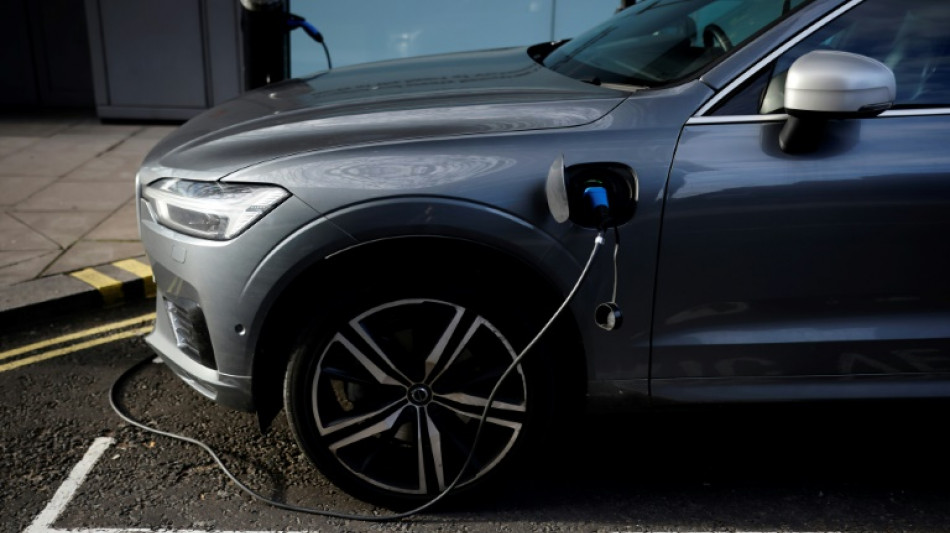
Electric car batteries could be key to boosting energy storage: study / Photo: © AFP/File

 Rams bounce back as Giants reel from Dart injury

 In Bangladesh, Pakistan's Jinnah photo stirs anger

 Two New Zealand naval ships transit Taiwan Strait

 Zidane gets down to work as France start new era

 Inside the Venezuelan prison meant to 'drive you insane'

 UK king braces as memoir by Diana's brother goes on sale

 No green light to lift EU sanctions on Russian oligarchs, talks to resume

 UK agrees support for Saudi in struggle with Houthis: reports

 EU foreign policy chief calls for continued sanctions on Russia

 Flights scrapped, evacuations urged as Typhoon Dujuan wallops Japan

 Fonseca to take break from tennis

 A Cuban zoo, and its animals, in epic battle for survival

 Infantino proposes consulting federations to reform FIFA

 El Nino weather pattern enters record territory: scientist

 OpenAI calls for US to lead global effort on AI standards

 South African ostriches plucked alive for luxury fashion: report

 US networks halt Trump coverage in revolt over White House ban

 Paramount settles with US states to clear Warner Bros. mega-merger

 Climate crisis a job for world leaders, not just activists: UK FM

 US networks halt Trump coverage over White House ban

 French singer accuses Miley Cyrus of plagiarism

 EU fines Google 403 mn euros for location data breach

 'Best is yet to come,' says De la Fuente after Spain extension

 Why diesel prices are rising more than crude oil

 COP31 host says AI's climate footprint to be a summit priority

Electric car batteries could be used to boost power storage in the future, injecting electricity into the grid during times of scarcity or storing electricity during periods of excess, a new study found Tuesday.
Renewable energy is essential for the Paris Agreement goal of limiting global warming to well below two degrees Celsius, but the need to scale up quickly and the intermittency of wind and solar have raised concerns about meeting electricity demand.
One way to help solve this problem is boosting the storage capacity of electricity grids, so that even when there is no sun or wind energy supply won't be interrupted.
New research published Tuesday found that electric car batteries could help boost short-term grid storage in times of increased demand or lower supply, either by setting up "vehicle-to-grid" or "second use" schemes.
"Harnessing this potential will have critical implications for the energy transition," said the study published in Nature Communications.
A "vehicle-to-grid" approach would allow drivers to connect car batteries to the grid for short term-storage when needed, the authors said.
For example, commercial fleets could inject power into the grid when at a depot.
"Second-use" schemes would allow drivers to sell or donate car batteries once they can no longer be used to power vehicles, which is generally when their capacity falls below 70 to 80 percent.
- Micro-payments -
Even a low level of participation from drivers could make a big difference, the researchers said.
"Low participation rates of 12 to 43 percent are needed to provide short-term grid storage demand globally," study co-author Chengjian Xu, of Leiden University in The Netherlands, told AFP.
"Short-term grid storage demand could be met as early as 2030 across most regions", he added, saying this was a conservative estimate.
By 2050, it would exceed the storage capacity required to help limit global warming to well below 2C, as outlined by the International Renewable Energy Agency.
The work examined global data -- including from the main electric car battery markets in China, India, the European Union and the United States -- taking into consideration average driving distances, driver behaviour and temperature, all of which can affect car battery health.
The authors said governments should introduce incentives and regulations to ensure vehicle-to-grid and second use schemes can take off.
"This can include market-based efforts such as micro-payments for services to the grid," Chengjian said, adding that vehicle-to-grid use would have little harm on battery life.
Some car firms such as Hyundai and Renault are already testing vehicles equipped with vehicle-to-grid technology, while some Teslas are already compatible.
The International Energy Agency (IEA) estimates that there will be some 200 million electric vehicles sold in 2030 -- about 20 percent of all cars sold -- an 11-fold increase from today's numbers.
IEA analyst Luis Lopez told AFP using car batteries as short-term storage was "quite promising but it's not a silver bullet", since it would provide less than one percent of storage needed under a net zero by 2050 scenario.
It would also require proper "communication" between the power system and the electric cars.
"If the power system, EVs (electric vehicles) and charging infrastructure all speak the same language, it is easier to aggregate more vehicles for power system needs".
L.Dubois--BTB