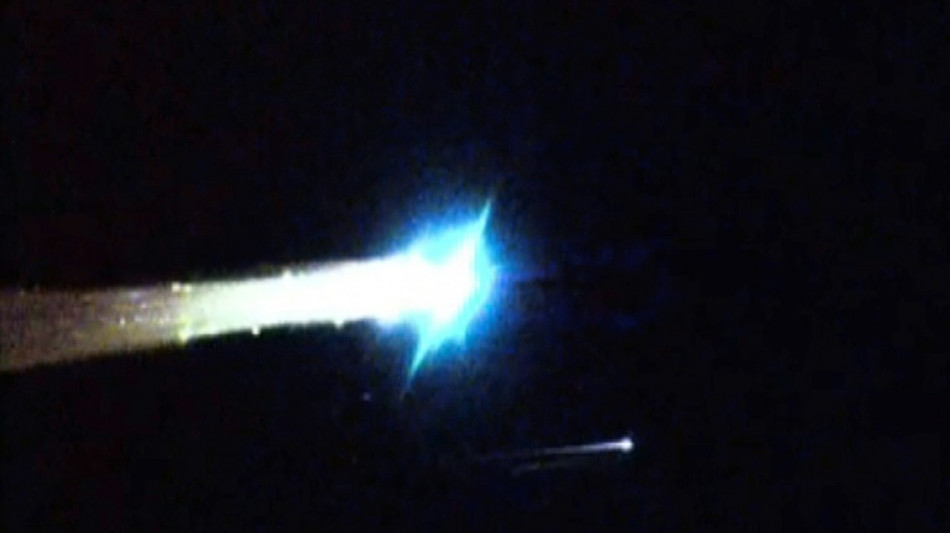
How three dust specks reveal an asteroid's secrets / Photo: © NASA/AFP/File

 Typhoon Dujuan leaves four dead in Japan, 45,000 houses without power

 G7 leaders condemn Houthi strikes on Saudi Arabia

 Google data centre sparks protests in Austria

 Shin Ohashi: Junk food-loving teen and Japan's next big swimming hope

 Stocks rise on AI buzz, drop in oil prices

 China's robot dancers limber up for America's Got Talent final

 Despite military might, Saudi struggles to crush the Houthis

 Trump to tout deals, defend Iran war in UN speech

 Sri Lanka to issue verdict in landmark Easter attack trial

 No green light to lift EU sanctions on Russian oligarchs, talks to resume

 UK agrees support for Saudi in struggle with Houthis: reports

 EU foreign policy chief calls for continued sanctions on Russia

 Flights scrapped, evacuations urged as Typhoon Dujuan wallops Japan

 Fonseca to take break from tennis

 A Cuban zoo, and its animals, in epic battle for survival

 Infantino proposes consulting federations to reform FIFA

 El Nino weather pattern enters record territory: scientist

 OpenAI calls for US to lead global effort on AI standards

 South African ostriches plucked alive for luxury fashion: report

 US networks halt Trump coverage in revolt over White House ban

 Paramount settles with US states to clear Warner Bros. mega-merger

 Climate crisis a job for world leaders, not just activists: UK FM
 US networks halt Trump coverage over White House ban
 French singer accuses Miley Cyrus of plagiarism

 EU fines Google 403 mn euros for location data breach

The specks are tiny. No, really tiny. Smaller than the diameter of a hair. But they hold billions of years of history that reveal some of the secrets of asteroids.
The three minute particles from an asteroid called Itokawa show some of these space rocks are vastly older than was thought, and are much tougher.
And that could mean we need bolder ways to prevent catastrophic collisions with Earth, according to research published Tuesday.
The three samples were collected in 2005 from the peanut-shaped Itokawa, some 300 million kilometres (186 million miles) from Earth.
It took the Japanese spacecraft Hayabusa five years to return them to Earth, along with hundreds of other particles from Itokawa, and scientists have been analysing them for clues ever since.
Fred Jourdan, professor at Curtin University's School of Earth and Planetary Sciences, wanted to see what the specks could reveal about the age of rubble-pile asteroids like Itokawa.
These form when solid asteroids collide and the resulting fragments assemble into new structures.
Solid asteroids are thought to have a lifespan of several hundred million years, and are gradually ground down by constant collisions.
But rubble-pile asteroids have a very different structure, composed of rocks, dust, pebbles and a void, and held together by the gravitational pull of their various components.
"It's like a giant space cushion, and cushions are good at absorbing shock," Jourdan said.
To find out just how good, the team analysed crystal structures in the samples, looking for deformations caused by the impact that created Itokawa.
And they dated the samples by measuring the decay of potassium into argon.
The methods suggest Itokawa was formed by an asteroid collision at least 4.2 billion years ago, ten times older than solid asteroids of similar size are predicted to be.
"We were really surprised," said Jourdan.
"I mean that's really, really old, and I'm sure some of my colleagues are not even going to believe it."
Rubble-pile asteroids are so resilient to the constant battering they face that they are likely to be much more abundant than previously assumed, the research published in the journal Proceedings of the National Academy of Sciences concludes.
That might mean we need new ways to tackle such asteroids on a collision course with Earth, Jourdan said.
NASA's recent DART test showed asteroids like Itokawa can be nudged off course, but that would likely require a lead time of several years.
An asteroid just weeks from colliding with Earth would require a different approach, and Jourdan argues a nuclear blast might be needed.
"It's not 'Armageddon'-style," blowing it up, he hastens to add, referring to the 1998 sci-fi movie.
"The shockwave should push the asteroid out of the way."
It is a far-reaching conclusion to draw from such tiny specks of dust, but each particle is analysed at the atomic level.
"We can get big stories like that out of (something) very, very small, because those machines, what they're doing, is the measuring and counting of atoms," Jourdan said.
"Every grain has its own story to tell."
J.Fankhauser--BTB