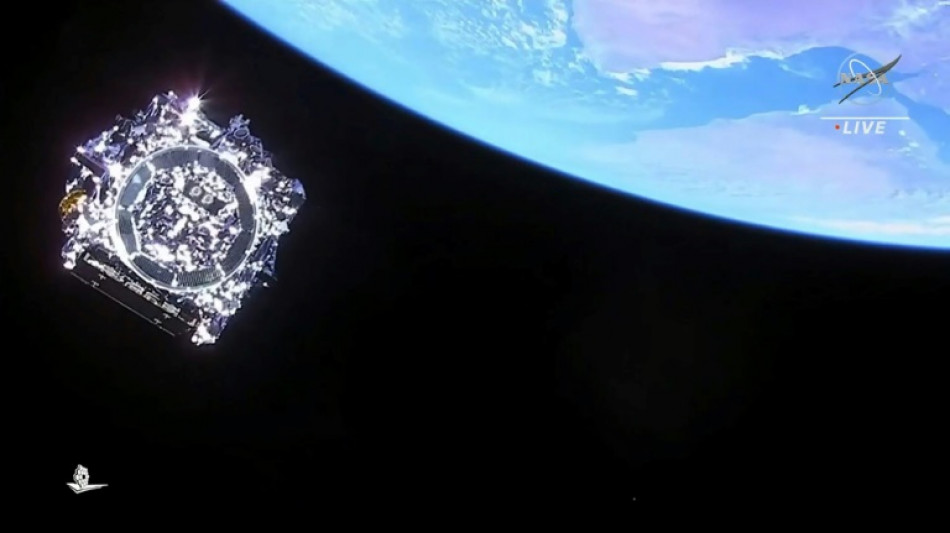
Small asteroid 'serendipitously' detected using James Webb telescope / Photo: © NASA TV/AFP/File

 Typhoon Dujuan leaves four dead in Japan, 45,000 houses without power

 G7 leaders condemn Houthi strikes on Saudi Arabia

 Google data centre sparks protests in Austria

 Shin Ohashi: Junk food-loving teen and Japan's next big swimming hope

 Stocks rise on AI buzz, drop in oil prices

 China's robot dancers limber up for America's Got Talent final

 Despite military might, Saudi struggles to crush the Houthis

 Trump to tout deals, defend Iran war in UN speech

 Sri Lanka to issue verdict in landmark Easter attack trial

 No green light to lift EU sanctions on Russian oligarchs, talks to resume

 UK agrees support for Saudi in struggle with Houthis: reports

 EU foreign policy chief calls for continued sanctions on Russia

 Flights scrapped, evacuations urged as Typhoon Dujuan wallops Japan

 Fonseca to take break from tennis

 A Cuban zoo, and its animals, in epic battle for survival

 Infantino proposes consulting federations to reform FIFA

 El Nino weather pattern enters record territory: scientist

 OpenAI calls for US to lead global effort on AI standards

 South African ostriches plucked alive for luxury fashion: report

 US networks halt Trump coverage in revolt over White House ban

 Paramount settles with US states to clear Warner Bros. mega-merger

 Climate crisis a job for world leaders, not just activists: UK FM
 US networks halt Trump coverage over White House ban

 French singer accuses Miley Cyrus of plagiarism

 EU fines Google 403 mn euros for location data breach

European astronomers using the James Webb Space Telescope have detected a previously unknown asteroid about the size of Rome's Colosseum in the main asteroid belt between Mars and Jupiter.
The asteroid measuring between 300 and 650 feet (100 to 200 meters) in length is the smallest object observed to date using the telescope, the US space agency NASA said Monday.
The European astronomers "serendipitously detected" the asteroid, NASA said in a statement, adding that more observations would be needed to better characterize its nature and properties.
"We -– completely unexpectedly -– detected a small asteroid," said Thomas Muller, an astronomer at the Max Planck Institute for Extraterrestrial Physics in Germany.
It was detected during calibration of the telescope's Mid-InfraRed Instrument (MIRI), which operates in mid-infrared wavelengths.
"Webb's incredible sensitivity made it possible to see this roughly 100-meter object at a distance of more than 100 million kilometers," Muller said.
Webb, which has been operational since July, is the most powerful space telescope ever built and has unleashed a raft of unprecedented data as well as stunning images.
One of the main goals for the $10 billion telescope is to study the life cycle of stars. Another main research focus is on exoplanets, planets outside Earth's solar system.
Webb was not designed to look for small objects such as the newly-discovered asteroid, but Muller said its discovery "suggests that many new objects will be detected with this instrument."
G.Schulte--BTB