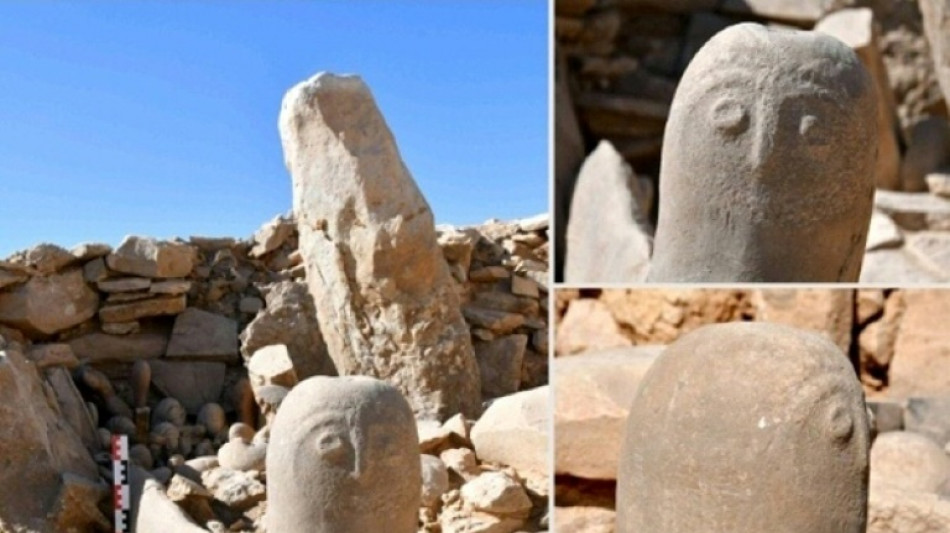
9,000-year-old ritual complex found in Jordan desert / Photo: ©

 Ed Sheeran returns to stage after Palestinian controversy

 Asian Games to open in Japan after troubled build-up

 Drone owners rush to offload devices ahead of Beijing ban

 Trump's beef policies irk Texas ranchers, testing their loyalty

 Nvidia, OpenAI CEOs to attend Xi dinner at White House

 Anthropic picks Accenture for in-house AI safety evaluation
 Balogun returns as Monaco beat Lens to continue strong Ligue 1 start

 'Pause' on overt repression in Venezuela, but reforms still needed: HRW

 Global stocks mixed as yen falls despite Bank of Japan rate hike

 Cuba hit with seventh major blackout of the year

 Murray out with concussion so Wentz will start for Vikings

 UN chief 'deeply regrets' US visa refusal to Abbas for annual meeting

 England quick Carse to face no charges over alleged nightclub assault

 Mancini brings nine newcomers into the first squad of his Italy comeback

 Czechs level Davis Cup tie against USA as South Korea eye Finals

 New France boss Zidane confirms Mbappe as captain after naming first squad

 California governor signs order to explore AI 'kill switch'

 Head leads run spree as Australia win Zimbabwe ODI series

 In-form Raphinha wants to finish career at Barcelona

 Warren Buffett steps down as Berkshire Hathaway chairman

 Carrick confident Man Utd can 'work through' tough time

 Mbappe ends Nike partnership to join Swiss brand On

 Liverpool boss Iraola puts Bournemouth love affair on hold

 'A disaster' if Man City do not win says Maresca after flawless start

 Kerry James Marshall: American 'blackness' painter celebrated in Europe

Archaeologists deep in the Jordanian desert have discovered a 9,000-year-old ritualistic complex near what is thought to be the earliest known large human-built structure worldwide.
The Stone Age shrine site, excavated last year, was used by gazelle hunters and features carved stone figures, an altar and a miniature model of a large-scale hunting trap.
The giant game traps the model represents -- so-called "desert kites" -- were made of long walls that converge to corral running gazelles into enclosures or holes for slaughter.
Similar structures of two or more stone walls, some several kilometres (miles) long, have been found in deserts across Saudi Arabia, Syria, Turkey and Kazakhstan.
The Neolithic-era ritual site was discovered inside a larger campsite last October by a joint French-Jordanian team called the South Eastern Badia Archaeological Project.
The nearby desert kites in Jibal al-Khashabiyeh are "the earliest large-scale human built structures worldwide known to date," said a statement by the SEBA Project.
It hailed the "spectacular and unprecedented discovery" of the ritualistic site, believed to date to about 7000 BC.
It featured two steles with anthropomorphic features, the taller one 1.12 metres high, other artefacts including animal figurines, flints, and some 150 arranged marine fossils.
The wider, decade-old research project aims to study "the first pastoral nomadic societies, as well as the evolution of specialised subsistence strategies".
The desert kites suggest "extremely sophisticated mass hunting strategies, unexpected in such an early timeframe," said the project's statement.
The sacral symbolism was most likely meant "to invoke the supranatural forces for successful hunts and abundance of prey to capture," it said.
The teams of researchers have also found campsites with circular dwellings and large numbers of gazelle bones.
The project is a collaboration of Jordan's Al Hussein Bin Talal University and the French Institute of the Near East.
French ambassador Veronique Vouland-Aneini hailed the "outcome for both the scientific world and Jordan", saying "it provides us with a priceless testimony of the historical life in the Middle East, its traditions and rituals".
D.Schneider--BTB