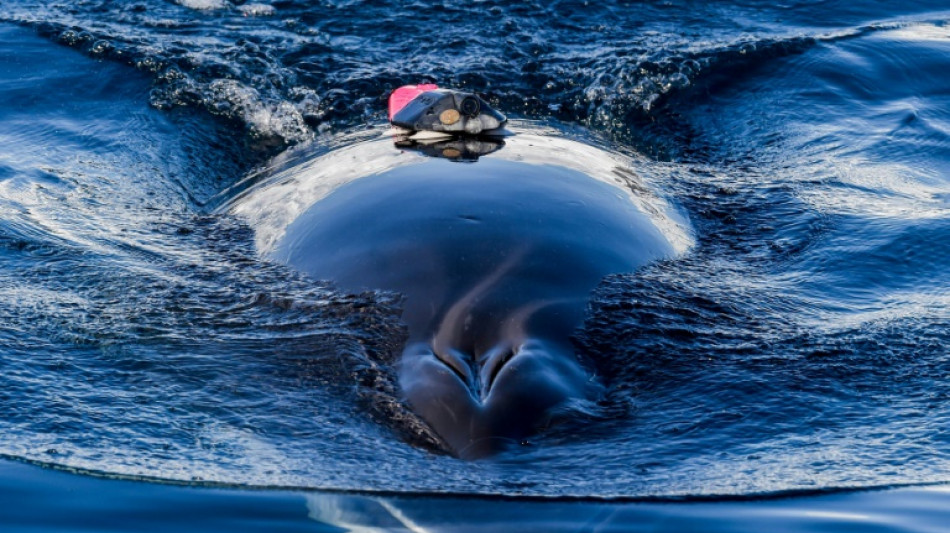
Norway study highlights whale excrement's role in ecosystem / Photo: © Stanford University/Goldbogen Laboratory/AFP/File

 Typhoon Dujuan leaves four dead in Japan, 45,000 houses without power

 G7 leaders condemn Houthi strikes on Saudi Arabia

 Google data centre sparks protests in Austria

 Shin Ohashi: Junk food-loving teen and Japan's next big swimming hope

 Stocks rise on AI buzz, drop in oil prices

 China's robot dancers limber up for America's Got Talent final

 Despite military might, Saudi struggles to crush the Houthis

 Trump to tout deals, defend Iran war in UN speech

 Sri Lanka to issue verdict in landmark Easter attack trial

 No green light to lift EU sanctions on Russian oligarchs, talks to resume

 UK agrees support for Saudi in struggle with Houthis: reports

 EU foreign policy chief calls for continued sanctions on Russia

 Flights scrapped, evacuations urged as Typhoon Dujuan wallops Japan

 Fonseca to take break from tennis

 A Cuban zoo, and its animals, in epic battle for survival

 Infantino proposes consulting federations to reform FIFA

 El Nino weather pattern enters record territory: scientist

 OpenAI calls for US to lead global effort on AI standards

 South African ostriches plucked alive for luxury fashion: report

 US networks halt Trump coverage in revolt over White House ban

 Paramount settles with US states to clear Warner Bros. mega-merger

 Climate crisis a job for world leaders, not just activists: UK FM

 US networks halt Trump coverage over White House ban

 French singer accuses Miley Cyrus of plagiarism

 EU fines Google 403 mn euros for location data breach

Minke whale excrement is "worth its weight in gold" as it plays an important role in fertilizing phytoplankton and thereby reducing the cetacean's carbon footprint, according to a Norwegian study.
For the first time, researchers from the Norwegian Institute for Marine Research have studied the concentration of nutrients in whale excrement before it is dissolved in seawater.
"It can sound disgusting, but for the ecosystem it's worth its weight in gold," researchers said in a statement Thursday.
"The idea is simply that the faeces fertilize the sea in the same way that cows and sheep do on land," they continued.
The researchers analysed the excrement of minke whales harpooned by whalers -- as Norway is one of few countries allowing the commercial hunting of these cetaceans.
The some 15,000 whales that migrate each summer to the Norwegian archipelago of Svalbard in the Arctic release some 600 tonnes of excrement on the surface of the water each day, at a rate of about 40 kilograms (88 pounds) per animal.
According to the study, the daily excrement releases about 10 tonnes of phosphorus and 7 tonnes of nitrogen into the oceans, nutrients that are essential for the growth of phytoplankton -- microscopic algae that absorb carbon dioxide through photosynthesis and convert it into oxygen.
The scientists concluded that the minke whale excrement contributed to between 0.2 and 4 percent of daily phytoplankton production in the Arctic Svalbard region.
"The real contribution of whales is probably higher because these estimates do not include urine, which is very rich in nitrogen," research leader Kjell Gundersen told AFP.
Each minke whale -- an animal weighing 40-50 tonnes as an adult that feeds by filtering large quantities of water -- releases "several hundred litres of urine" per day.
"If there are fewer whales, there is a risk that there will be less fertilisation of the ocean," Gundersen said.
"More phytoplankton production also means more CO2 is absorbed," he added.
"This is positive for the climate," he noted, "but we don't know the net balance of whales in terms of greenhouse gases" because cetaceans also emit methane when they breathe.
This question, which is still largely unexplored, will be the subject of a European study that will start in June and last four years.
E.Schubert--BTB