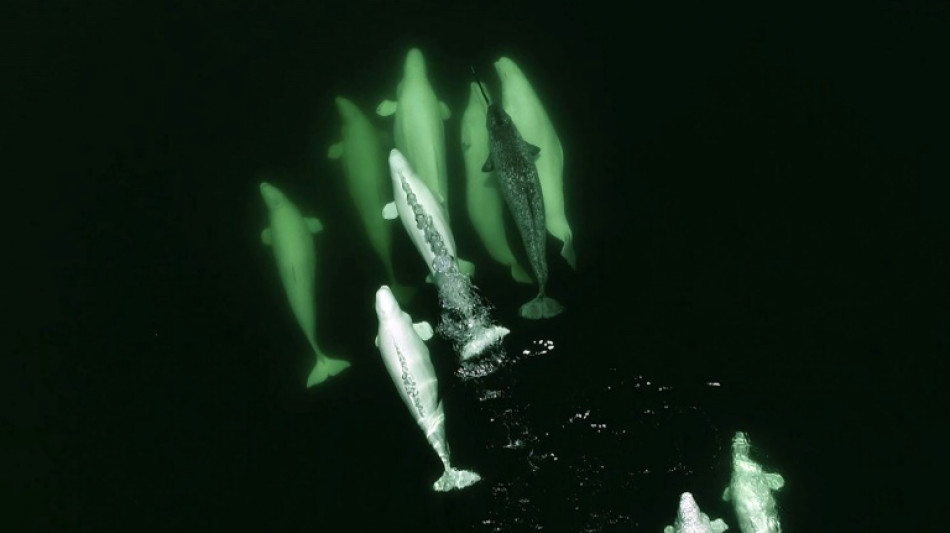
Narwhals' climate-vulnerable winter feeding crucial for survival: study / Photo: © GREMM/AFP

 Typhoon Dujuan leaves four dead in Japan, 45,000 houses without power

 G7 leaders condemn Houthi strikes on Saudi Arabia

 Google data centre sparks protests in Austria

 Shin Ohashi: Junk food-loving teen and Japan's next big swimming hope

 Stocks rise on AI buzz, drop in oil prices

 China's robot dancers limber up for America's Got Talent final

 Despite military might, Saudi struggles to crush the Houthis

 Trump to tout deals, defend Iran war in UN speech

 Sri Lanka to issue verdict in landmark Easter attack trial

 No green light to lift EU sanctions on Russian oligarchs, talks to resume

 UK agrees support for Saudi in struggle with Houthis: reports

 EU foreign policy chief calls for continued sanctions on Russia

 Flights scrapped, evacuations urged as Typhoon Dujuan wallops Japan

 Fonseca to take break from tennis

 A Cuban zoo, and its animals, in epic battle for survival

 Infantino proposes consulting federations to reform FIFA

 El Nino weather pattern enters record territory: scientist

 OpenAI calls for US to lead global effort on AI standards

 South African ostriches plucked alive for luxury fashion: report

 US networks halt Trump coverage in revolt over White House ban

 Paramount settles with US states to clear Warner Bros. mega-merger

 Climate crisis a job for world leaders, not just activists: UK FM

 US networks halt Trump coverage over White House ban

 French singer accuses Miley Cyrus of plagiarism

 EU fines Google 403 mn euros for location data breach

Narwhals are likely more dependent on fat reserves and abundant prey in climate-threatened winter habitats than previously thought, researchers said Wednesday, warning of severe risks posed by global warming.
Scientists studying the long-horned marine mammals in the fjords off the eastern coast of Greenland during the summer found narwhals were largely unsuccessful in capturing prey.
"(This) suggests that they could actually rely on the wintering grounds to build up sufficient body reserves and energy stores to sustain year-round activities," said Philippine Chambault of the University of California Santa Cruz, co-author of the study published in the journal Biology Letters.
Researchers believe most narwhals spend their winters feasting off fish and squid under sea ice off the coast of Greenland, but Chambault said this cold-water habitat may essentially "disappear" because of climate change, with expected increases in ocean temperatures driving ice melt and potentially causing prey to relocate.
While the exact causes of the low summer feeding rate are not yet clear, researchers said it could be due to a decline or relocation of squid and cod, lower energy needs, or even because they are picky eaters.
Normally narwhal eating habits are hard to track because they dive deep, up to one kilometre (3,000 feet) and stay in the open water.
The researchers were able to study the foraging behaviours of 14 narwhals using so-called stomach temperature pills that could detect when the whales swallowed cold prey and icy water.
They also used acoustic tags tuned to the sound waves or "buzzes" emitted when narwhals narrow-in on their prey.
- 'Little flexibility' -
More than two-thirds of the hunting dives recorded over roughly 1,000 hours were deemed unsuccessful due to the presence of buzzes without an accompanying stomach temperature drop, said the study.
The researchers said the small sample size and limits to the detection capabilities of the equipment meant the feeding rates could be underestimated.
But they also worked with local indigenous Inuit communities to test their findings.
Inuit hunters examined the stomach contents of the narwhals caught during summer hunting season, confirming that the whales' stomachs were in fact "pretty empty", Chambault told AFP.
Diet limitation is just one factor complicating the species' survival.
Their preference for cold water and a strong tendency to remain within or near where they were born mean they are particularly sensitive to climate change.
This means they might "show very little flexibility to changing habitats," Chambault said.
N.Fournier--BTB