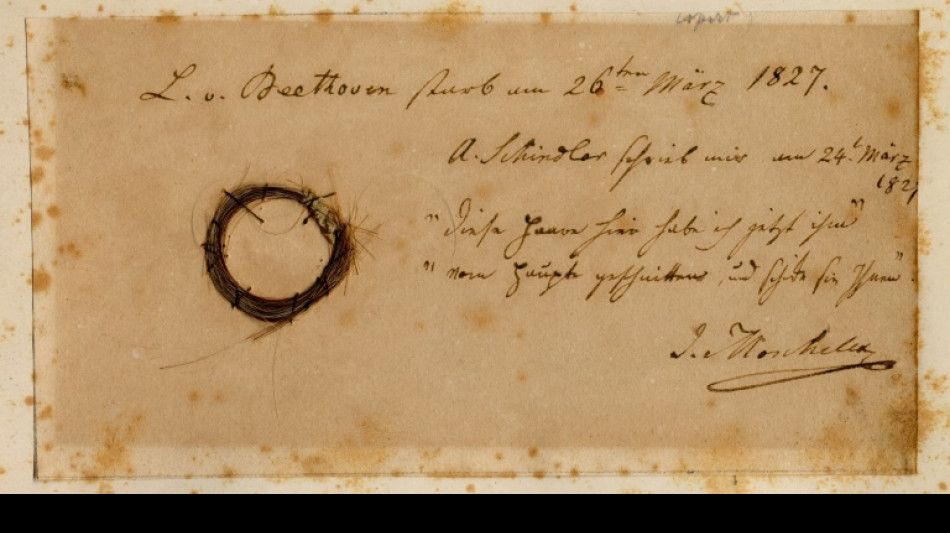
DNA analysis of Beethoven's hair provides clues to his death / Photo: © Center for Beethoven Studies, San Jose State University/AFP

 Marchand 'stressed' about racing Japanese rivals at LA Olympics

 Mobile boat clinics bring healthcare to India's remote islands

 Former India paceman Zaheer Khan named Chennai coach in IPL

 Six-year-old Chinese girl sets world record with Rubik's Cube

 Swimming prodigy Yu, 13, says 'interviews way harder than racing'

 Star coaches make their bows as Nations League returns

 Rams bounce back as Giants reel from Dart injury

 In Bangladesh, Pakistan's Jinnah photo stirs anger

 Two New Zealand naval ships transit Taiwan Strait

 Zidane gets down to work as France start new era

 Inside the Venezuelan prison meant to 'drive you insane'

 UK king braces as memoir by Diana's brother goes on sale

 Akkodis and Hamburg Public Transport Association Showcase hvv mia at InnoTrans 2026, Demonstrating the Future of AI-Powered Mobility

 Macron says talks with Trump on Red Sea, Ukraine 'constructive'

 Green policies just good politics, says UK minister

 Bardot auction in Paris fetches nearly one million euros

 No timeline on Daniels injury return, says Commanders coach

 British Columbia sues OpenAI in US court over Canada school shooting

 French star Batum retires after 18-year NBA career

 Zidane leads first France training session

 Man shot by ICE agent in Texas detained with bullet inside him: lawyer

 California declares state of emergency ahead of El Nino

 South Africa arrests three more suspects, after nine women murdered

 Carse needs time away from England, says captain Brook

 NOWPayments Releases Cross-Chain Payout Data Revealing Key Performance Benchmarks Across TRON, BNB Chain, and Solana

Ludwig van Beethoven died in Vienna nearly 200 years ago after a lifetime of composing some of the most influential works in classical music.
Ever since, biographers have sought to explain the causes of the German composer's death at the age of 56, his progressive hearing loss and his well-documented struggles with chronic illness.
A team of researchers who sequenced Beethoven's genome using locks of the German composer's hair may now have some answers.
Liver failure, or cirrhosis, was the likely cause of Beethoven's death brought about by a number of factors, including his alcohol consumption, they said.
"We looked at possible genetic causes of his three main symptom complexes -- the progressive hearing loss, the gastrointestinal symptoms and the liver disease ultimately leading to his death due to liver failure," said Markus Nothen of the Institute of Human Genetics at the University Hospital of Bonn, one of the co-authors.
Beethoven, Nothen said, had "a strong genetic disposition to liver disease" and sequences of the hepatitis B virus were detected in his hair.
"We believe the disease arose from an interplay of genetic disposition, well documented chronic alcohol consumption and hepatitis B infection," Nothen said.
Johannes Krause of the Max Planck Institute for Evolutionary Anthropology said hepatitis B "was probably quite common at that time in the early 19th century."
"At least in the last few months before his death he was infected with hepatitis B virus," Krause said.
The authors of the study, published in the Cell Press journal Current Biology on Wednesday, were unable to determine the cause of the hearing loss that eventually left Beethoven profoundly deaf.
The researchers analyzed eight locks of hair said to be from Beethoven and determined that five of them were "almost certainly authentic," said Tristan Begg, a PhD student at the University of Cambridge and the lead author of the study.
"Because we reconstructed the genome from ultra-short DNA fragments, we only confidently mapped about two-thirds of it," he said.
- 'Acute illness' -
Beethoven, who was born in Bonn in 1770 and died in 1827, battled gastrointestinal problems at various times of his life as well as jaundice.
"There were periods of acute illness where he was unable to work, for example, his month-long period of acute illness in the spring of 1825," Begg said.
The researchers, by studying Beethoven's DNA data and archival documents, also uncovered a discrepancy in his legal and biological genealogy.
They found an "extra-pair paternity event" -- a child resulting from an extramarital relationship -- in Beethoven's direct paternal line, said Toomas Kivisild of the Institute of Genomics at the University of Tartu.
Kivisild said it occurred some time within seven generations that separate a common ancestor, Aert van Beethoven, at the end of the 16th century and Beethoven's birth in 1770.
Begg said it was no surprise it was not recorded.
"You wouldn't necessarily expect an extra-pair paternity event to be documented," he said, being "probably clandestine in nature."
"You cannot rule out that Beethoven himself may have been illegitimate," Begg said.
"I'm not advocating that," he stressed. "I'm simply saying that's a possibility and you have to consider it."
Beethoven had asked in an 1802 letter that his health problems, particularly his hearing loss, be described after his death.
"He had the wish to be studied post-mortem," Krause said.
"And it is kind of, basically, his wish that we are fulfilling to some degree with this project."
W.Lapointe--BTB