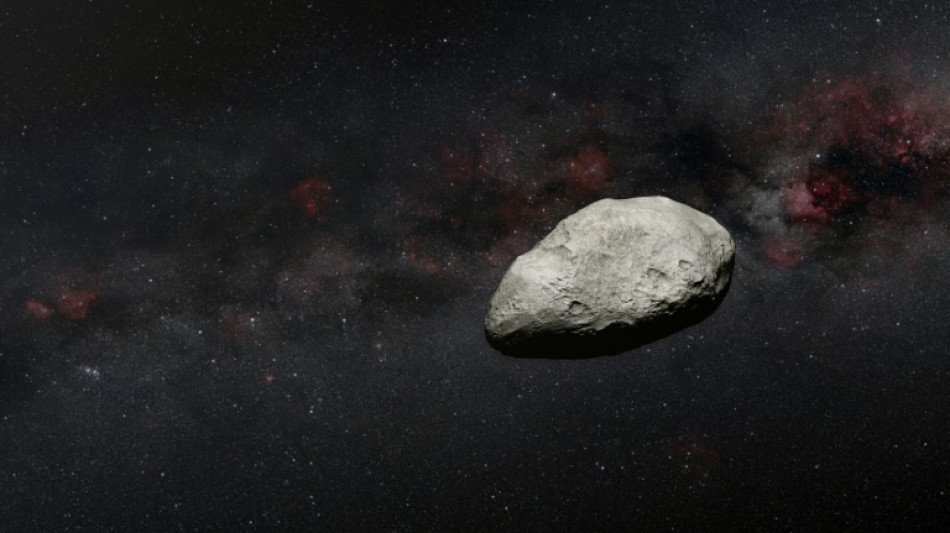
Large asteroid to zoom between Earth and Moon / Photo: © EUROPEAN SPACE AGENCY/AFP

 Marchand 'stressed' about racing Japanese rivals at LA Olympics

 Mobile boat clinics bring healthcare to India's remote islands

 Former India paceman Zaheer Khan named Chennai coach in IPL

 Six-year-old Chinese girl sets world record with Rubik's Cube

 Swimming prodigy Yu, 13, says 'interviews way harder than racing'

 Star coaches make their bows as Nations League returns

 Rams bounce back as Giants reel from Dart injury

 In Bangladesh, Pakistan's Jinnah photo stirs anger

 Two New Zealand naval ships transit Taiwan Strait

 Zidane gets down to work as France start new era

 Inside the Venezuelan prison meant to 'drive you insane'

 UK king braces as memoir by Diana's brother goes on sale

 Akkodis and Hamburg Public Transport Association Showcase hvv mia at InnoTrans 2026, Demonstrating the Future of AI-Powered Mobility

 Macron says talks with Trump on Red Sea, Ukraine 'constructive'

 Green policies just good politics, says UK minister

 Bardot auction in Paris fetches nearly one million euros

 No timeline on Daniels injury return, says Commanders coach

 British Columbia sues OpenAI in US court over Canada school shooting

 French star Batum retires after 18-year NBA career

 Zidane leads first France training session

 Man shot by ICE agent in Texas detained with bullet inside him: lawyer

 California declares state of emergency ahead of El Nino

 South Africa arrests three more suspects, after nine women murdered

 Carse needs time away from England, says captain Brook

 NOWPayments Releases Cross-Chain Payout Data Revealing Key Performance Benchmarks Across TRON, BNB Chain, and Solana

A large asteroid will safely zoom between Earth and the Moon on Saturday, a once-in-a-decade event that will be used as a training exercise for planetary defence efforts, according to the European Space Agency.
The asteroid, named 2023 DZ2, is estimated to be 40 to 70 metres (130 to 230 feet) wide, roughly the size of the Parthenon, and big enough to wipe out a large city if it hit our planet.
At 19:49 GMT on Saturday it will come within a third of the distance from the Earth to the Moon, said Richard Moissl, the head of the ESA's planetary defence office.
Though that is "very close", there is nothing to worry about, he told AFP.
Small asteroids fly past every day, but one of this size coming so close to Earth only happens around once every 10 years, he added.
The asteroid will pass 175,000 kilometres (109,000 miles) from Earth at a speed of 28,000 kilometres per hour (17,400 miles per hour). The moon is roughly 385,000 kilometres away.
An observatory in La Palma, one of Spain's Canary Islands, first spotted the asteroid on February 27.
Last week, the UN-endorsed International Asteroid Warning Network decided it would take advantage of the close look, carrying out a "rapid characterisation" of 2023 DZ2, Moissl said.
That means astronomers around the world will analyse the asteroid with a range of instruments such as spectrometers and radars.
The goal is to find out just how much we can learn about such an asteroid in only a week, Moissl said.
It will also serve as training for how the network "would react to a threat" possibly heading our way in the future, he added.
- 'Scientifically interesting' -
Moissl said preliminary data suggests 2023 DZ2 is "a scientifically interesting object", indicating it could be a somewhat unusual type of asteroid. But he added that more data was needed to determine the asteroid's composition.
The asteroid will again swing past Earth in 2026, but poses no threat of impact for at least the next 100 years -- which is how far out its trajectory has been calculated.
Earlier this month a similarly sized asteroid, 2023 DW, was briefly given a one-in-432 chance of hitting Earth on Valentine's Day 2046.
But further calculations ruled out any chance of an impact, which is what normally happens with newly discovered asteroids. Moissl said 2023 DW was now expected to miss Earth by some 4.3 million kilometres.
Even if such an asteroid was determined to be heading our way, Earth is no longer defenceless.
Last year, NASA's DART spacecraft deliberately slammed into the pyramid-sized asteroid Dimorphos, significantly knocking it off course in the first such test of our planetary defences.
L.Dubois--BTB