Webb measures temperature of rocky exoplanet for first time / Photo: © European Southern Observatory/AFP/File

 Marchand 'stressed' about racing Japanese rivals at LA Olympics

 Mobile boat clinics bring healthcare to India's remote islands

 Former India paceman Zaheer Khan named Chennai coach in IPL

 Six-year-old Chinese girl sets world record with Rubik's Cube
 Swimming prodigy Yu, 13, says 'interviews way harder than racing'

 Star coaches make their bows as Nations League returns

 Rams bounce back as Giants reel from Dart injury

 In Bangladesh, Pakistan's Jinnah photo stirs anger

 Two New Zealand naval ships transit Taiwan Strait

 Zidane gets down to work as France start new era

 Inside the Venezuelan prison meant to 'drive you insane'

 UK king braces as memoir by Diana's brother goes on sale

 Akkodis and Hamburg Public Transport Association Showcase hvv mia at InnoTrans 2026, Demonstrating the Future of AI-Powered Mobility

 Macron says talks with Trump on Red Sea, Ukraine 'constructive'

 Green policies just good politics, says UK minister

 Bardot auction in Paris fetches nearly one million euros
 No timeline on Daniels injury return, says Commanders coach

 British Columbia sues OpenAI in US court over Canada school shooting

 French star Batum retires after 18-year NBA career

 Zidane leads first France training session

 Man shot by ICE agent in Texas detained with bullet inside him: lawyer

 California declares state of emergency ahead of El Nino

 South Africa arrests three more suspects, after nine women murdered

 Carse needs time away from England, says captain Brook

 NOWPayments Releases Cross-Chain Payout Data Revealing Key Performance Benchmarks Across TRON, BNB Chain, and Solana

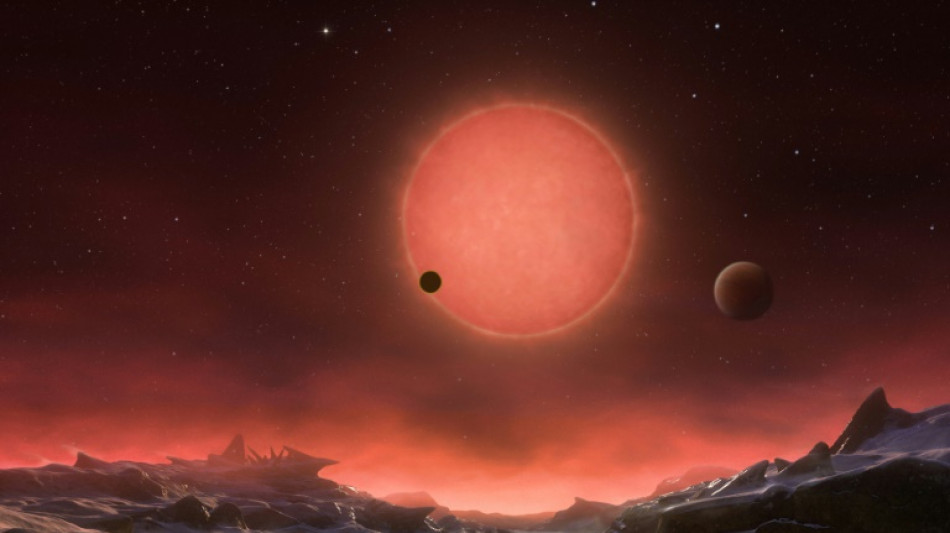
The James Webb Space Telescope has measured the temperature of a rocky exoplanet for the first time, finding that a "cousin" of Earth most likely lacks an atmosphere, researchers said Monday.
When the Trappist-1 system was discovered in 2017, astronomers were excited at the prospect that some of its seven rocky planets -- which are roughly similar to Earth in size and mass -- could be habitable.
Just 40 light years from Earth, the planets orbit much closer to their ultracool red dwarf star than the rocky planets in our Solar System. But their star gives off far less energy than our Sun.
The system made an obvious target for the piercing gaze of the Webb telescope, which has unleashed a torrent of scientific discovery since releasing its first observations in July last year.
Astronomers focused on Trappist-1b, the closest planet to the red dwarf, because it was the easiest to spot.
Webb's Mid-Infrared Instrument (MIRI) measured the change in brightness when the planet moved behind its star, in what is known as a secondary eclipse.
"Just before disappearing behind the star, the planet gives off the most light because it almost exclusively shows its 'day' side," Elsa Ducrot, a co-author of a new study published in the journal Nature, told AFP.
By subtracting the brightness of the star, the researchers calculated how much infrared light the planet was giving off.
The MIRI instrument was therefore able to act like "a giant touch-free thermometer," NASA said in a statement.
- 'Perfect for baking pizza' -
The planet's dayside temperature was determined to be 230 degrees Celsius (450 Fahrenheit) -- "just about perfect for baking pizza," NASA added.
France's Atomic Energy Commission (CEA) said that the heat was not redistributed throughout this "cousin" of Earth, a role normally provided by an atmosphere.
The scientists therefore concluded that Trappist-1b "has little or no atmosphere," said Ducrot, a CEA astrophysicist. She emphasised that other wavelengths would need to be analysed to confirm the result.
But it was certain that the atmosphere did not contain carbon dioxide, because that would have absorbed some of the light, she added.
The Spitzer Space Telescope was not able to rule out an atmosphere on Trappist-1b despite observing 28 secondary eclipses, Ducrot said.
"The James Webb saw it in a single eclipse!"
The ability to analyse the potential atmospheres of such rocky exoplanets opens "a new era" in the study of planets outside our Solar System, she added.
It was already known that Trappist-1b was uninhabitable, as it is too close to its star.
But Trappist-1e, Trappist-1f and Trappist-1g are all thought to be in what is called the "goldilocks zone".
Planets in this zone have a moderate temperature which could support liquid water -- considered essential for life anywhere.
S.Keller--BTB