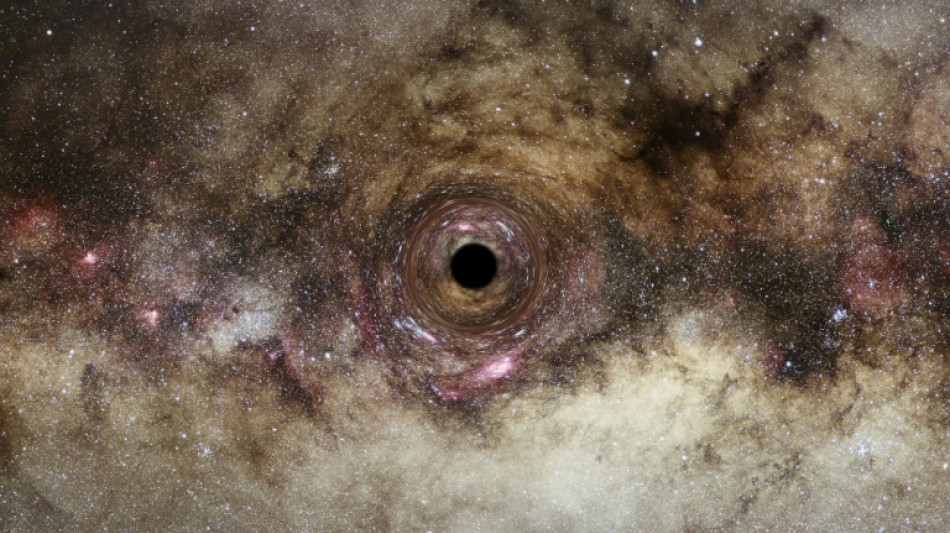
Astronomers discover one of biggest black holes ever recorded / Photo: © ESA/HUBBLE/AFP

 Marchand 'stressed' about racing Japanese rivals at LA Olympics

 Mobile boat clinics bring healthcare to India's remote islands

 Former India paceman Zaheer Khan named Chennai coach in IPL

 Six-year-old Chinese girl sets world record with Rubik's Cube
 Swimming prodigy Yu, 13, says 'interviews way harder than racing'

 Star coaches make their bows as Nations League returns

 Rams bounce back as Giants reel from Dart injury

 In Bangladesh, Pakistan's Jinnah photo stirs anger

 Two New Zealand naval ships transit Taiwan Strait

 Zidane gets down to work as France start new era

 Inside the Venezuelan prison meant to 'drive you insane'

 UK king braces as memoir by Diana's brother goes on sale

 Akkodis and Hamburg Public Transport Association Showcase hvv mia at InnoTrans 2026, Demonstrating the Future of AI-Powered Mobility

 Macron says talks with Trump on Red Sea, Ukraine 'constructive'

 Green policies just good politics, says UK minister

 Bardot auction in Paris fetches nearly one million euros

 No timeline on Daniels injury return, says Commanders coach

 British Columbia sues OpenAI in US court over Canada school shooting

 French star Batum retires after 18-year NBA career

 Zidane leads first France training session

 Man shot by ICE agent in Texas detained with bullet inside him: lawyer

 California declares state of emergency ahead of El Nino

 South Africa arrests three more suspects, after nine women murdered

 Carse needs time away from England, says captain Brook

 NOWPayments Releases Cross-Chain Payout Data Revealing Key Performance Benchmarks Across TRON, BNB Chain, and Solana

One of the largest black holes ever recorded has been discovered using a new technique that could spot thousands more of the insatiable celestial monsters in the coming years, according to astronomers.
The ultramassive black hole, one of just four ever observed, is more than 30 billion times the mass of the Sun, a new study said.
It is the first black hole ever observed using a phenomenon called gravitational lensing, in which light travelling towards us from a distant galaxy appears to magnify and bend inwards, giving away the presence of a dark giant.
James Nightingale, an astronomer at the UK's Durham University and the study's lead author, told AFP the process was "similar to shining light through the base of a wine glass".
He said it was "very fortuitous" that the light of a galaxy in the distant universe travelled extremely close to this black hole, which is roughly two billion light years from Earth.
It could even be the biggest black hole ever recorded, but it was difficult to say for sure given the varying techniques and uncertainties involved, he added.
Supermassive black holes sit at the centre of galaxies using their vast gravitational pull to gobble up stars like specks of dust, not even allowing light to escape.
Previous black holes of this size have been observed when their voracious devouring gives off huge amounts light at the margins -- or by measuring the orbit of stars that speed up as they pass by.
But these techniques only work for galaxies relatively close to Earth.
- Landscape to 'dramatically change' -
Gravitational lensing allows astronomers to "discover black holes in the other 99 percent of galaxies that are currently inaccessible," Nightingale said.
There are currently around 500 known gravitational lenses -- at least one of which we now know is a supermassive black hole.
But "the landscape is about to dramatically change," Nightingale said.
The European Space Agency's Euclid mission, planned to launch into space in July, will open a "big data era" for black hole hunters by creating a huge high resolution map of the universe, he said.
In the next six years Euclid could find 100,000 new gravitational lenses, which would potentially point towards thousands of previously hidden black holes, Nightingale added.
For the latest discovery, the researchers used computer simulations and images from the Hubble Space Telescope to confirm their findings, as well as eliminating other possibilities such as an overconcentration of dark matter.
The huge size is also consistent with what would be expected for a black hole at the centre of its giant host galaxy, Nightingale said.
The mass of all the stars in the galaxy, dubbed Abell 1201, is more than a trillion times that of our Sun, meaning it would be expected to have a particularly large black hole at its centre.
The study was published in the journal Monthly Notices of the Royal Astronomical Society on Tuesday.
K.Thomson--BTB