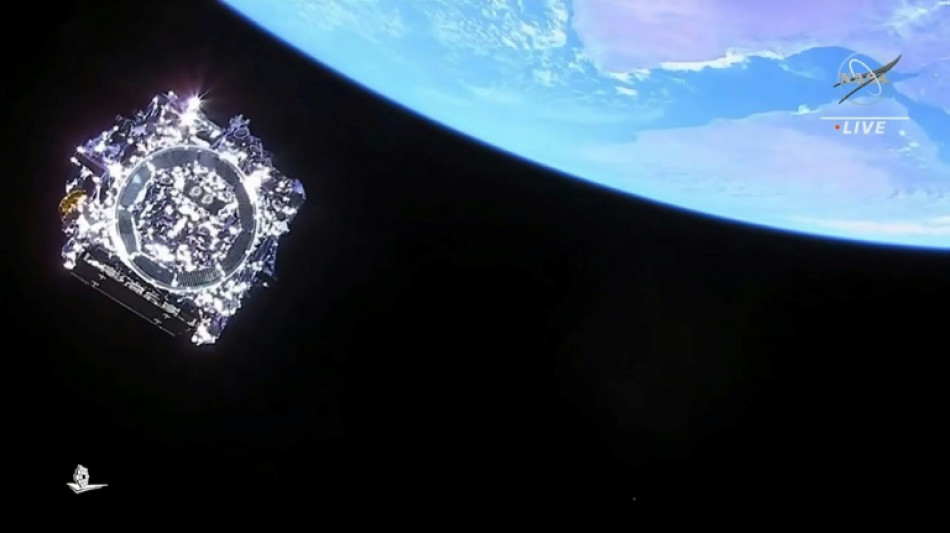
Webb telescope discovers oldest galaxies ever observed / Photo: © NASA TV/AFP/File

 Marchand 'stressed' about racing Japanese rivals at LA Olympics

 Mobile boat clinics bring healthcare to India's remote islands

 Former India paceman Zaheer Khan named Chennai coach in IPL

 Six-year-old Chinese girl sets world record with Rubik's Cube
 Swimming prodigy Yu, 13, says 'interviews way harder than racing'

 Star coaches make their bows as Nations League returns

 Rams bounce back as Giants reel from Dart injury

 In Bangladesh, Pakistan's Jinnah photo stirs anger

 Two New Zealand naval ships transit Taiwan Strait

 Zidane gets down to work as France start new era

 Inside the Venezuelan prison meant to 'drive you insane'

 UK king braces as memoir by Diana's brother goes on sale

 Akkodis and Hamburg Public Transport Association Showcase hvv mia at InnoTrans 2026, Demonstrating the Future of AI-Powered Mobility

 Macron says talks with Trump on Red Sea, Ukraine 'constructive'

 Green policies just good politics, says UK minister

 Bardot auction in Paris fetches nearly one million euros

 No timeline on Daniels injury return, says Commanders coach

 British Columbia sues OpenAI in US court over Canada school shooting

 French star Batum retires after 18-year NBA career

 Zidane leads first France training session

 Man shot by ICE agent in Texas detained with bullet inside him: lawyer

 California declares state of emergency ahead of El Nino

 South Africa arrests three more suspects, after nine women murdered

 Carse needs time away from England, says captain Brook

 NOWPayments Releases Cross-Chain Payout Data Revealing Key Performance Benchmarks Across TRON, BNB Chain, and Solana

The James Webb Space Telescope has discovered the four most distant galaxies ever observed, one of which formed just 320 million years after the Big Bang when the universe was still in its infancy, new research said on Tuesday.
The Webb telescope has unleashed a torrent of scientific discovery since becoming operational last year, peering farther than ever before into the universe's distant reaches -- which also means it is looking back in time.
By the time light from the most distant galaxies reaches Earth, it has been stretched by the expansion of the universe and shifted to the infrared region of the light spectrum.
The Webb telescope's NIRCam instrument has an unprecedented ability to detect this infrared light, allowing it to quickly spot a range of never-before-seen galaxies -- some of which could reshape astronomers' understanding of the early universe.
In two studies published in the Nature Astronomy journal, astronomers revealed they have "unambiguously detected" the four most distant galaxies ever observed.
The galaxies date from 300 to 500 million years after the Big Bang more than 13 billion years ago, when the universe was just two percent of its current age.
That means the galaxies are from what is called "the epoch of reionisation," a period when the first stars are believed to have emerged. The epoch came directly after the cosmic dark ages brought about by the Big Bang.
- 'Surprising' -
Stephane Charlot, a researcher at the Astrophysics Institute of Paris and co-author of the two new studies, told AFP that the farthest galaxy -- called JADES-GS-z13-0 -- formed 320 million years after the Big Bang.
That is the greatest distance ever observed by astronomers, he said.
The Webb telescope also confirmed the existence of JADES-GS-z10-0, which dates from 450 million years after the Big Bang and had previously been spotted by the Hubble Space Telescope.
All four galaxies are "very low in mass," weighing roughly a hundred million solar masses, Charlot said. The Milky Way, in comparison, weighs 1.5 trillion solar masses by some estimations.
But the galaxies are "very active in star formation in proportion to their mass," Charlot said.
Those stars were forming "at around the same rate as the Milky Way," a speed that was "surprising so early in the Universe," he added.
The galaxies were also "very poor in metals," he added.
This is consistent with the standard model of cosmology, science's best understanding of how the universe works, which says that the closer to the Big Bang, the less time there is for such metals to form.
- Technical tour de force' -
However in February, the discovery of six massive galaxies from 500-700 million years after the Big Bang led some astronomers to question the standard model.
Those galaxies, also observed by the Webb telescope, were bigger than thought possible so soon after the birth of the universe -- if confirmed, the standard model could need updating.
Pieter van Dokkum, an astronomer at Yale University not involved in the latest research, hailed the confirmation of the four newly-discovered distant galaxies as a "technical tour de force".
"The frontier is moving almost every month," van Dokkum commented in Nature, adding that there was now "only 300 million years of unexplored history of the universe between these galaxies and the Big Bang".
The Webb telescope has observed possible galaxies even closer to the Big Bang, but they have yet to be confirmed, he said.
J.Fankhauser--BTB