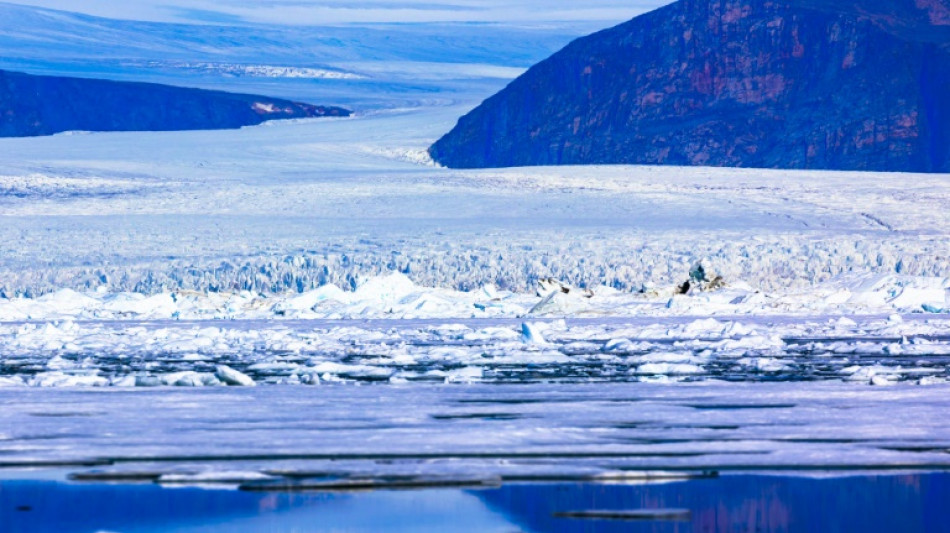
'Snowball Earth' might have been rather slushy: study / Photo: © AFP/File

 Marchand 'stressed' about racing Japanese rivals at LA Olympics

 Mobile boat clinics bring healthcare to India's remote islands

 Former India paceman Zaheer Khan named Chennai coach in IPL

 Six-year-old Chinese girl sets world record with Rubik's Cube
 Swimming prodigy Yu, 13, says 'interviews way harder than racing'

 Star coaches make their bows as Nations League returns

 Rams bounce back as Giants reel from Dart injury

 In Bangladesh, Pakistan's Jinnah photo stirs anger

 Two New Zealand naval ships transit Taiwan Strait

 Zidane gets down to work as France start new era

 Inside the Venezuelan prison meant to 'drive you insane'

 UK king braces as memoir by Diana's brother goes on sale

 Akkodis and Hamburg Public Transport Association Showcase hvv mia at InnoTrans 2026, Demonstrating the Future of AI-Powered Mobility

 Macron says talks with Trump on Red Sea, Ukraine 'constructive'

 Green policies just good politics, says UK minister

 Bardot auction in Paris fetches nearly one million euros

 No timeline on Daniels injury return, says Commanders coach

 British Columbia sues OpenAI in US court over Canada school shooting

 French star Batum retires after 18-year NBA career

 Zidane leads first France training session

 Man shot by ICE agent in Texas detained with bullet inside him: lawyer

 California declares state of emergency ahead of El Nino

 South Africa arrests three more suspects, after nine women murdered

 Carse needs time away from England, says captain Brook

 NOWPayments Releases Cross-Chain Payout Data Revealing Key Performance Benchmarks Across TRON, BNB Chain, and Solana

Millions of years ago, the Earth was so cold that most of its surface was covered in ice. But that hard freeze might have been slushier than once thought.
The longstanding "Snowball Earth" theory imagines our world as seen from space, a perfect sphere with ice covering land and sea alike.
It draws on clues including deposits made by glaciers near the Equator. For ice to have extended that far from the poles suggests much of our planet was once frozen.
But there has long been speculation about just how complete the cover was, with some convinced that areas of slush or open ocean remained, allowing oxygen to penetrate and creating incubators for life.
New research published Tuesday in the journal Nature Communications adds weight to that theory, and suggests these oases in the tundra might have existed much further north than previously suspected.
The evidence comes from a thin layer of black shale that would have been under the sea during the Marinoan ice age, which began around 650 million years ago.
The shale in the Nantuo Formation in southern China acts as a sort of archive for the conditions in oceans at the time.
By analysing levels of elements such as iron, and the presence of nitrogen, scientists can infer whether oxygen was penetrating the ocean and nitrogen was being produced by lifeforms.
"We found evidence of ice-free conditions at mid-northern paleolatitudes (locations before continental drift)," Huyue Song, who helped lead the research, told AFP.
"Until now, ice-free areas had been identified only in peri-equatorial regions."
Instead of a "narrow ice-free belt" across the middle of the Earth, "patchy ice-free areas may have existed much more widely," added Song, a professor at the China University of Geosciences, Wuhan.
The findings build on other research at sites ranging from Australia to Brazil that suggest life was able to cling on in pockets while most of Earth was in deep freeze.
These incubators may even have helped spur "a rapid rebound of the biosphere" at the end of the ice age, the research published Tuesday argues.
The work took four years in total, and involved collecting samples at a remote site in the Shennongjia region of Hubei province, some 500 kilometres from Song's base in Wuhan.
Song believes the findings will help scientists better understand both how our planet's climate works, and how life evolved and survived on Earth through the ages.
And while Earth's ice ages might seem like ancient history, Song argues they could have useful lessons for a planet now experiencing new severe climate change.
"It provides insight into how life survived extreme climate events -- a topic that will become of increasing relevance as modern climate change intensifies," he said.
O.Bulka--BTB