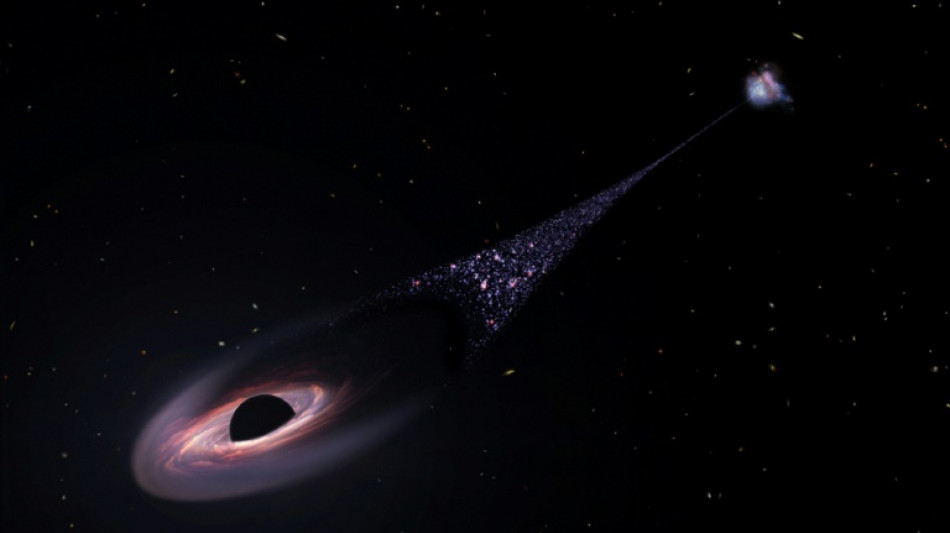
Runaway black hole creating trail of new stars: scientists / Photo: © NASA/ESA/AFP

 Marchand 'stressed' about racing Japanese rivals at LA Olympics
 Mobile boat clinics bring healthcare to India's remote islands

 Former India paceman Zaheer Khan named Chennai coach in IPL

 Six-year-old Chinese girl sets world record with Rubik's Cube
 Swimming prodigy Yu, 13, says 'interviews way harder than racing'

 Star coaches make their bows as Nations League returns

 Rams bounce back as Giants reel from Dart injury

 In Bangladesh, Pakistan's Jinnah photo stirs anger

 Two New Zealand naval ships transit Taiwan Strait

 Zidane gets down to work as France start new era

 Inside the Venezuelan prison meant to 'drive you insane'

 UK king braces as memoir by Diana's brother goes on sale

 Akkodis and Hamburg Public Transport Association Showcase hvv mia at InnoTrans 2026, Demonstrating the Future of AI-Powered Mobility

 Macron says talks with Trump on Red Sea, Ukraine 'constructive'

 Green policies just good politics, says UK minister

 Bardot auction in Paris fetches nearly one million euros
 No timeline on Daniels injury return, says Commanders coach

 British Columbia sues OpenAI in US court over Canada school shooting

 French star Batum retires after 18-year NBA career

 Zidane leads first France training session
 Man shot by ICE agent in Texas detained with bullet inside him: lawyer

 California declares state of emergency ahead of El Nino
 South Africa arrests three more suspects, after nine women murdered

 Carse needs time away from England, says captain Brook

 NOWPayments Releases Cross-Chain Payout Data Revealing Key Performance Benchmarks Across TRON, BNB Chain, and Solana

A huge black hole is tearing through space, leaving behind a 200,000-light-year-long trail of newborn stars, space scientists say.
The supermassive monster -- likely born of a bizarre game of intergalactic billiards -- is rampaging through the blackness and plowing into gas clouds in its path.
The incredible forces at play mean this gas is being forged into a contrail of new stars, which have been captured on camera by NASA's powerful Hubble Space Telescope.
"We think we're seeing a wake behind the black hole where the gas cools and is able to form stars," said Pieter van Dokkum of Yale University.
"What we're seeing is the aftermath. Like the wake behind a ship, we're seeing the wake behind the black hole."
Researchers believe gas is probably being blasted and warmed by the motion of the black hole.
"Gas in front of it gets shocked because of this supersonic, very high-velocity impact of the black hole moving through the gas," said van Dokkum.
The black hole weighs about the same as 20 million of our Suns.
Scientists believe it began its rampage after being ejected from a celestial menage-a-trois.
The working theory is that two galaxies probably merged about 50 million years earlier, bringing together two supermassive black holes, which whirled around each other harmoniously.
But a third galaxy butted in with its own black hole, creating an unstable and chaotic scene that eventually saw one of them ejected at high speed -- fast enough to travel between the Earth and the Moon in just 14 minutes.
Stargazers say there is no cause for earthly concern because this is all very far away.
It's also a long time ago -- back when the universe was half of its current age. We are seeing it now because of the time it has taken for light to arrive here.
The runaway black hole, which has never been seen before, was discovered by accident, says van Dokkum.
"I was just scanning through the Hubble image and then I noticed that we have a little streak.
"It didn't look like anything we've seen before," he said, adding the star trail is "quite astonishing, very, very bright and very unusual."
While this is the first tearaway black hole ever spotted, it might not be the only one, says NASA.
Their Nancy Grace Roman Space Telescope, which is expected to launch some time this decade, should give astronomers a much wider view of the universe -- and could lead to the discovery of more of these star-forming runaways.
M.Furrer--BTB