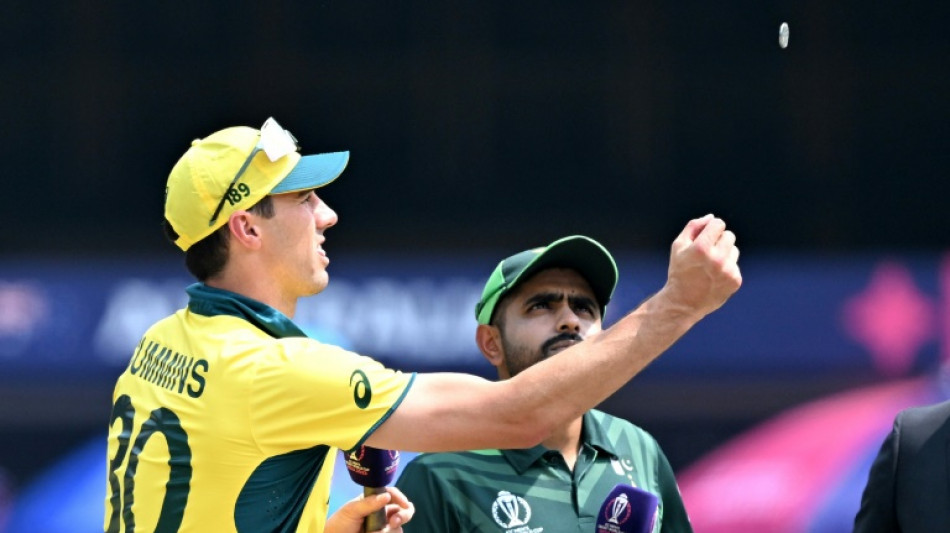
Coin tosses are not 50/50: researchers find a slight bias / Photo: © AFP/File

 Trump renames AI "super intelligence," rejects international oversight

 Trump rejects international regulation of AI
 How is the EU approaching record fuel prices?

 Sri Lanka's Colombage strikes on debut as England dismissed for 265 in first ODI

 Hurricane Polo strengthens to top category 5 off Mexico

 11 hurt as teen opens fire outside school in western Turkey

 UN chief says 'Big Oil' treats atmosphere as open sewer
 Tunisia says 2026 summer hottest on record

 England's Rashid out of Sri Lanka ODIs with hand injury
 Houthis accuse Saudi Arabia of deadly strikes as thousands flee

 Stocks climb as oil slides, AI buzz returns
 India cricketers win in style as Afghan savours 'special' Games silver

 La Liga president hits out at Real Madrid refereeing 'conspiracy' claims

 MEXC Launches “Real Stocks, Real Friends” with Rewards for Bringing Friends to Wall Street

 Mbappe continues media push for Ballon d'Or recognition
 Stocks rise on AI buzz, oil prices cool

 India narrowly survive huge scare against minnows Japan

 Missing F-35 fighter parts 'not sensitive', says Australia minister

 Cambodia showcases scams crackdown with global conference
 Afghan cyclist who disguised herself as man wins Asian Games silver
 Typhoon Dujuan leaves four dead in Japan, 45,000 houses without power

 G7 leaders condemn Houthi strikes on Saudi Arabia
 Google data centre sparks protests in Austria
 Shin Ohashi: Junk food-loving teen and Japan's next big swimming hope

 Stocks rise on AI buzz, drop in oil prices

Want to get a slight edge during a coin toss? Check out which side is facing upwards before the coin is flipped –- then call that same side.
This tactic will win 50.8 percent of the time, according to researchers who conducted 350,757 coin flips.
For the preprint study, which was published on the arXiv database last week and has not yet been peer-reviewed, 48 people tossed coins of 46 different currencies.
They were told to flip the coins with their thumb and catch it in their hand -- if the coins fell on a flat surface that could introduce other factors such as bouncing or spinning.
Frantisek Bartos, of the University of Amsterdam in the Netherlands, told AFP that the work was inspired by 2007 research led by Stanford University mathematician Persi Diaconis -- who is also a former magician.
Diaconis' model proposed that there was a "wobble" and a slight off-axis tilt that occurs when humans flip coins with their thumb, Bartos said.
Because of this bias, they proposed it would land on the side facing upwards when it was flipped 51 percent of the time -- almost exactly the same figure borne out by Bartos' research.
While that may not seem like a significant advantage, Bartos said it was more of an edge that casinos have against "optimal" blackjack players.
It does depend on the technique of the flipper. Some people had almost no bias while others had much more than 50.8 percent, Bartos said.
For people committed to choosing either heads or tails before every toss, there was no bias for either side, the researchers found.
None of the many different coins showed any sign of bias either.
Happily, achieving a fair coin flip is simple: just make sure the person calling heads or tails cannot see which side is facing up before the toss.
- 'It's fun to do stupid stuff' -
Bartos first heard of the bias theory while studying Bayesian statistics during his master's degree, and decided to test it on a massive scale.
But there was a problem: he needed people willing to toss a lot of coins.
At first he tried to persuade his friends to flip coins over the weekend while watching "Lord of the Rings".
"But nobody was really down for that," he said.
Eventually Bartos managed to convince some colleagues and students to flip coins whenever possible, during lunch breaks, even while on holiday.
"It will be terrible," he told them. "But it's fun to do some stupid stuff from time to time."
The flippers even held weekend-long events where they tossed coins from 9am to 9pm. A massage gun was deployed to soothe sore shoulders.
Countless decisions have been made by coin tosses throughout human history.
While writing his paper, Bartos visited the British Museum and learned that the Wright brothers used one to determine who would attempt the first plane flight.
Coin tosses have also decided numerous political races, including a tied 2013 mayoral election in the Philippines.
But they are probably most common in the field of sport. During the current Cricket World Cup, coin tosses decide which side gets to choose whether to bat or field first.
G.Schulte--BTB