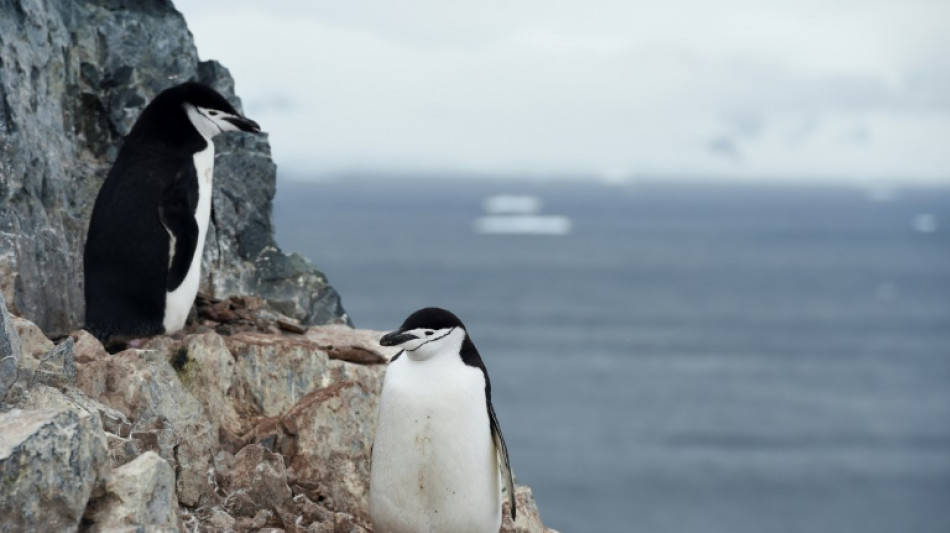
Penguins snatch 11 hours of sleep through seconds-long micronaps / Photo: © AFP/File

 Macron urges world to choose UN over 'law of the jungle'

 All-rounder Jacks stars as England beat Sri Lanka in 1st ODI

 Man City peg back Bayern to start Women's Champions League

 Trump beats 'America first' drum at UN as allies tread carefully

 Snedeker backs Spaun for Ryder Cup after Presidents snub

 French prosecutors probe secret filming of women with smart glasses

 Trump renames AI "super intelligence," rejects international oversight

 Trump rejects international regulation of AI

 How is the EU approaching record fuel prices?

 Sri Lanka's Colombage strikes on debut as England dismissed for 265 in first ODI

 Hurricane Polo strengthens to top category 5 off Mexico

 11 hurt as teen opens fire outside school in western Turkey

 UN chief says 'Big Oil' treats atmosphere as open sewer

 Tunisia says 2026 summer hottest on record

 England's Rashid out of Sri Lanka ODIs with hand injury

 Houthis accuse Saudi Arabia of deadly strikes as thousands flee

 Stocks climb as oil slides, AI buzz returns

 India cricketers win in style as Afghan savours 'special' Games silver

 La Liga president hits out at Real Madrid refereeing 'conspiracy' claims

 MEXC Launches “Real Stocks, Real Friends” with Rewards for Bringing Friends to Wall Street

 Mbappe continues media push for Ballon d'Or recognition

 Stocks rise on AI buzz, oil prices cool

 India narrowly survive huge scare against minnows Japan

 Missing F-35 fighter parts 'not sensitive', says Australia minister

 Cambodia showcases scams crackdown with global conference

In humans, nodding off for a few seconds is a clear sign of insufficient sleep -- and can be dangerous in some situations, such as when driving a car.
But a new study published on Thursday finds chinstrap penguins snooze thousands of times per day, accumulating their daily sleep requirement of more than 11 hours in short bursts averaging just four seconds.
The flightless birds might have evolved this trait because of their need to remain constantly vigilant, according to the authors of the paper in Science.
The researchers argued that the findings show, contrary to prior assumptions, the benefits of sleep can accrue incrementally, at least in some species.
Chinstrap penguins (Pygoscelis antarcticus), named for the thin black band of plumage that extends from ear to ear, may be the most abundant species of penguin. Their current population is estimated at nearly eight million breeding pairs that are found mainly on the Antarctic Peninsula and South Atlantic Ocean islands.
When nesting, single parent penguins have to keep watch over their egg, guarding them from predatory birds called skuas while their partners are away on foraging trips that last several days.
They also have to defend their nests from other penguins that might try to steal nest material. Once a penguin partner finally returns, the couple switch roles.
A team led by Paul-Antoine Libourel of Lyon Neuroscience Research Centre implanted electrodes on 14 birds at a colony on King George Island in December 2019. They recorded electrical activity in the brain and neck muscles, and they used accelerometers and GPS to study body movement and location.
Combined with video recordings and direct observation over multiple days, they were able to identify numerous peculiarities.
The penguins' sleep occurred while standing or while lying to incubate their eggs, with the average bout lasting 3.91 seconds. In total they slept more than 10,000 times a day.
Penguins on the periphery got longer and deeper bouts of sleep than those in the center -- which can be explained by the excess noise and physical bumping that occurs in the middle of a colony, or the heightened risk of nest material theft.
Although the scientists did not directly measure whether the birds were gaining the restorative benefits of sleep, the fact the penguins were successful at breeding led them to believe this was indeed the case, with the moments of neuronal silence providing windows for rest and recovery.
In humans, however, conditions that fragment sleep such as sleep apnea have impacts on cognitive function and might even precipitate neurodegenerative disease, such as Alzheimer's.
"Thus, what is abnormal in humans could be perfectly normal in birds or other animals, at least under certain conditions," wrote scientists Christian Harding and Vladyslav Vyazovskiy in a related commentary piece.
M.Ouellet--BTB