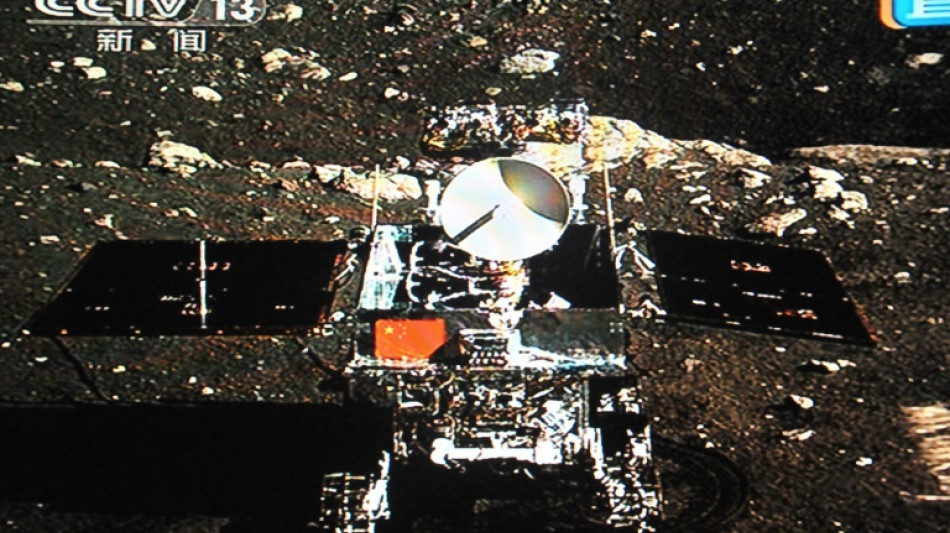
China's space programme: Five things to know / Photo: © CCTV/AFP/File

 Macron urges world to choose UN over 'law of the jungle'

 All-rounder Jacks stars as England beat Sri Lanka in 1st ODI

 Man City peg back Bayern to start Women's Champions League

 Trump beats 'America first' drum at UN as allies tread carefully

 Snedeker backs Spaun for Ryder Cup after Presidents snub

 French prosecutors probe secret filming of women with smart glasses

 Trump renames AI "super intelligence," rejects international oversight

 Trump rejects international regulation of AI

 How is the EU approaching record fuel prices?

 Sri Lanka's Colombage strikes on debut as England dismissed for 265 in first ODI

 Hurricane Polo strengthens to top category 5 off Mexico

 11 hurt as teen opens fire outside school in western Turkey

 UN chief says 'Big Oil' treats atmosphere as open sewer

 Tunisia says 2026 summer hottest on record

 England's Rashid out of Sri Lanka ODIs with hand injury

 Houthis accuse Saudi Arabia of deadly strikes as thousands flee

 Stocks climb as oil slides, AI buzz returns

 India cricketers win in style as Afghan savours 'special' Games silver

 La Liga president hits out at Real Madrid refereeing 'conspiracy' claims

 MEXC Launches “Real Stocks, Real Friends” with Rewards for Bringing Friends to Wall Street

 Mbappe continues media push for Ballon d'Or recognition

 Stocks rise on AI buzz, oil prices cool

 India narrowly survive huge scare against minnows Japan

 Missing F-35 fighter parts 'not sensitive', says Australia minister

 Cambodia showcases scams crackdown with global conference

When Chang'e-3 became the first Chinese craft to land on the Moon 10 years ago, it kicked off nationwide celebrations -- and a decade of major successes for a rapidly accelerating space programme.
Since the December 14, 2013 landing, China has built a crewed space station, sent a robotic rover to Mars and become the first nation to make a controlled landing on the far side of the Moon.
Here are five things to know about China's space programme:
- A slow start -
Chinese leader Mao Zedong declared his nation's space ambitions soon after the Soviet Union launched the world's first satellite, Sputnik 1, in 1957.
It took 13 years for China to launch its first satellite Dong Fang Hong, or "The East is Red" -- named after the famous Communist revolutionary song it broadcast from orbit.
It was not until the late 1980s that the programme began to pick up pace, alongside China's ascent into the world's richest and most powerful nations.
Overseen by the military, its secretive space programme's goals became more ambitious. In 1992, it formally began a project to send humans into space.
- 'Taikonauts' -
More than three decades after its first satellite launch, on October 15, 2003, Yang Liwei became the first Chinese to travel into space, and an instant national hero.
With the success of his Shenzhou 5 mission, China became only the third nation after the United States and Russia to demonstrate the ability to launch humans into space.
In total, 20 Chinese astronauts have made the journey into space, including two women. State media have used the term "taikonaut" to describe China's spacefarers.
Many of them have journeyed to Tiangong, China's first long-term space station whose construction was completed last year.
Though much smaller than the International Space Station, it contains living quarters for a rotating crew, robotic arms and airlocks for conducting spacewalks.
- To the Moon -
China has also sent exploration missions to the Moon.
Named after the Moon goddess in Chinese folklore, Chang'e-3 touched down on the surface in 2013, making China only the third nation to successfully land there.
Two other milestones followed. In 2019, China became the first nation to make a controlled landing on the far side of the Moon with Chang'e-4.
A year later, Chang'e-5 brought the first lunar samples to Earth in more than 40 years.
Chinese space authorities have said they plan to land humans on the Moon by 2030, as well as build a lunar base.
- Mars and deep space -
One of the most spectacular successes of the Chinese space programme came in 2021 when its Tianwen-1 mission landed a rover named Zhurong on the surface of Mars.
China is only the second nation after the United States to put a robotic rover on the Red Planet.
Officials have said they aim to send a crewed mission there by 2033.
Aside from landers and orbiters, China is soon expected to launch a space telescope named Xuntian.
Orbiting close to the Tiangong space station, with which it can dock, Xuntian is expected to have a field of view far greater than NASA's Hubble telescope.
- Defence and prestige -
While China says it opposes the weaponisation of space, its policy makers have also identified space as critical to national defence and security.
Its military is a core player in the national space programme, and China is developing spy satellites, anti-satellite missiles and electronic warfare capabilities, according to the US military.
China "sees counterspace operations as a means to deter and counter a US intervention during a regional military conflict", the Pentagon said in a report to Congress this year.
And beyond the direct applications of these technologies, China considers success in space as a major driver of its image as a global power at home and abroad.
"National prestige is perhaps one of the most important, if not the most important, motives driving Chinese space ambitions," said Robert Hines, an assistant professor at the Georgia Institute of Technology in the United States.
"These symbols of increasing international status provide a powerful form of domestic propaganda."
D.Schneider--BTB