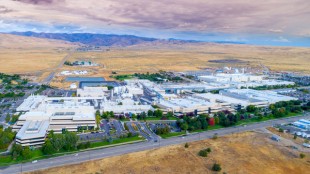
Blue Origin returns to space after year-long hiatus / Photo: © BLUE ORIGIN/AFP

 Macron urges world to choose UN over 'law of the jungle'

 All-rounder Jacks stars as England beat Sri Lanka in 1st ODI

 Man City peg back Bayern to start Women's Champions League

 Trump beats 'America first' drum at UN as allies tread carefully

 Snedeker backs Spaun for Ryder Cup after Presidents snub

 French prosecutors probe secret filming of women with smart glasses

 Trump renames AI "super intelligence," rejects international oversight

 Trump rejects international regulation of AI

 How is the EU approaching record fuel prices?

 Sri Lanka's Colombage strikes on debut as England dismissed for 265 in first ODI

 Hurricane Polo strengthens to top category 5 off Mexico

 11 hurt as teen opens fire outside school in western Turkey

 UN chief says 'Big Oil' treats atmosphere as open sewer

 Tunisia says 2026 summer hottest on record

 England's Rashid out of Sri Lanka ODIs with hand injury

 Houthis accuse Saudi Arabia of deadly strikes as thousands flee

 Stocks climb as oil slides, AI buzz returns

 India cricketers win in style as Afghan savours 'special' Games silver

 La Liga president hits out at Real Madrid refereeing 'conspiracy' claims

 MEXC Launches “Real Stocks, Real Friends” with Rewards for Bringing Friends to Wall Street

 Mbappe continues media push for Ballon d'Or recognition

 Stocks rise on AI buzz, oil prices cool

 India narrowly survive huge scare against minnows Japan

 Missing F-35 fighter parts 'not sensitive', says Australia minister

 Cambodia showcases scams crackdown with global conference

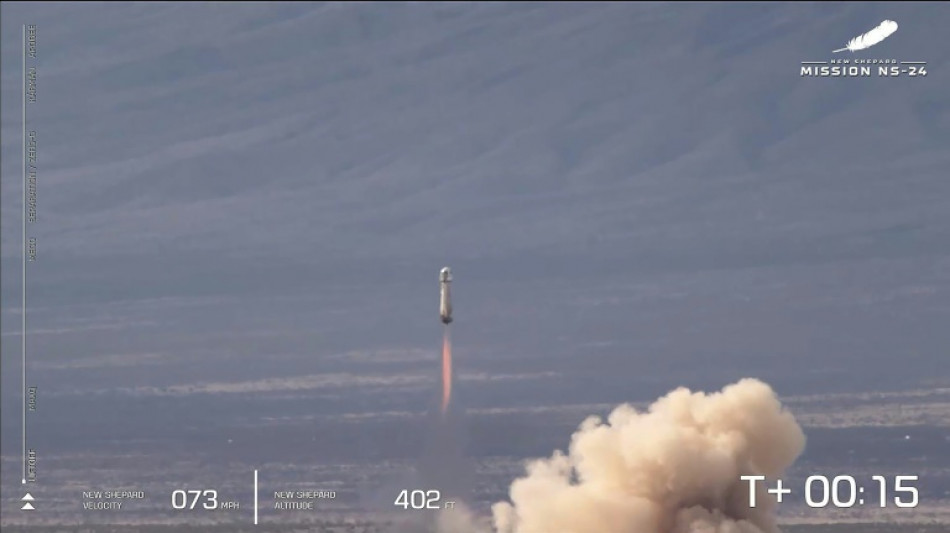
Blue Origin launched its first rocket in more than a year on Tuesday, reviving the US company's fortunes with a successful return to space following an uncrewed crash in 2022.
Though mission NS-24 carried a payload of science experiments, not people, it paves the way for Jeff Bezos' aerospace enterprise to resume taking wealthy thrill-seekers to the final frontier.
The New Shepard suborbital rocket blasted off from the pad at Launch Site One, near Van Horn, Texas, at 10:42 am (1642 GMT).
After separating from the booster, the gumdrop-shaped capsule attained a peak altitude of 66.5 miles (107 kilometers) above sea level, well above the internationally recognized boundary of space known as the Karman line, which is 62 miles high.
The booster then successfully landed vertically on the launchpad, against the majestic backdrop of the Sierra Diablo mountains, followed a few minutes later by the capsule floating to the desert floor on three giant parachutes.
All in all, the mission lasted 10 minutes and 13 seconds.
"Demand for New Shepard flights continues to grow and we're looking forward to increasing our flight cadence in 2024," said Phil Joyce, the company's senior vice president.
The science experiments onboard included one to demonstrate the operation of hydrogen fuel cell technology in microgravity, and another showing how water and gas move in a weightless environment.
Future applications could include monitoring water quality for astronauts in space.
- Long break -
On September 12, 2022, a Blue Origin rocket became engulfed in flames shortly after launch. The capsule, fixed to the top of the rocket, successfully initiated an emergency separation sequence and floated safely to the ground on parachutes.
The accident prompted a year-long probe by the Federal Aviation Administration (FAA), which found it was caused by the failure of an engine nozzle that experienced higher-than-expected operating temperatures.
The regulator issued a set of corrective actions for Blue Origin to undertake before it could resume flying, including the redesign of certain engine parts. It confirmed Sunday that it had approved Blue Origin's application to fly again.
In all, Blue Origin has carried out six crewed flights -- some passengers were paying customers and others were guests -- since July 2021, when Bezos himself took part in the first.
While Blue Origin has been grounded, rival Virgin Galactic -- the company founded by British billionaire Richard Branson -- has pressed on, with five commercial flights this year.
The two companies compete in the emerging space tourism sector, operating in suborbital space.
- Reusable rocket, no carbon emissions -
While Blue Origin launches a small rocket vertically, Virgin Galactic uses a large carrier plane to gain altitude and then drop off a smaller, rocket-powered spaceplane that completes the journey to space.
In both cases, passengers enjoy a few minutes of weightlessness and can view the curvature of the Earth through large windows.
Virgin Galactic tickets were sold for between $200,000-$450,000; Blue Origin does not publicly disclose its ticket prices.
Blue Origin can boast of the fact that nearly all of its rocket platform is re-used, including the booster, capsule, engine, landing gear and parachutes.
Its engine meanwhile is fueled by liquid oxygen and hydrogen, meaning the only byproduct during flight is water vapor, with no carbon emissions.
Blue Origin is also developing a heavy rocket for commercial purposes called New Glenn, with the maiden flight planned for next year.
This rocket, which measures 98 meters (320 feet) high, is designed to carry payloads of as much as 45 metric tons into low Earth orbit.
O.Bulka--BTB