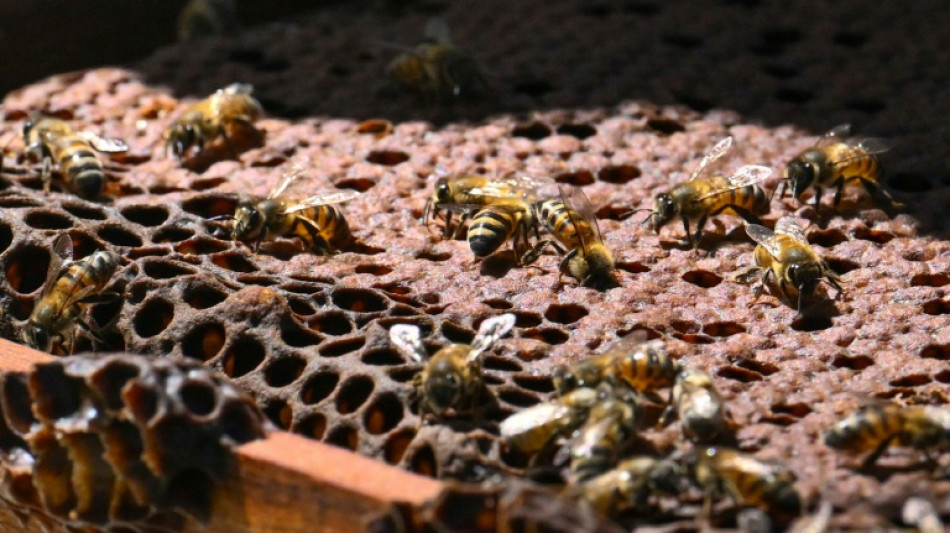
In Colombia, illegally felled timber repurposed to help bees / Photo: © AFP

 Macron urges world to choose UN over 'law of the jungle'

 All-rounder Jacks stars as England beat Sri Lanka in 1st ODI

 Man City peg back Bayern to start Women's Champions League

 Trump beats 'America first' drum at UN as allies tread carefully

 Snedeker backs Spaun for Ryder Cup after Presidents snub

 French prosecutors probe secret filming of women with smart glasses

 Trump renames AI "super intelligence," rejects international oversight

 Trump rejects international regulation of AI

 How is the EU approaching record fuel prices?

 Sri Lanka's Colombage strikes on debut as England dismissed for 265 in first ODI

 Hurricane Polo strengthens to top category 5 off Mexico

 11 hurt as teen opens fire outside school in western Turkey

 UN chief says 'Big Oil' treats atmosphere as open sewer

 Tunisia says 2026 summer hottest on record

 England's Rashid out of Sri Lanka ODIs with hand injury

 Houthis accuse Saudi Arabia of deadly strikes as thousands flee

 Stocks climb as oil slides, AI buzz returns

 India cricketers win in style as Afghan savours 'special' Games silver

 La Liga president hits out at Real Madrid refereeing 'conspiracy' claims

 MEXC Launches “Real Stocks, Real Friends” with Rewards for Bringing Friends to Wall Street

 Mbappe continues media push for Ballon d'Or recognition

 Stocks rise on AI buzz, oil prices cool

 India narrowly survive huge scare against minnows Japan

 Missing F-35 fighter parts 'not sensitive', says Australia minister

 Cambodia showcases scams crackdown with global conference

In northeast Colombia, police guard warehouses stacked high with confiscated timber with a noble new destiny: transformation into homes for bees beleaguered by pesticides and climate change.
The illegally harvested wood is used in the Santander department's "Timber Returns Home" initiative, building hives since 2021 to house the little pollinators so critical to human survival.
So far, the project has seen about 200 cubic meters (7,060 cubic feet) of wood transformed into 1,000 bee hives, with another 10,000 planned for the next phase, according to the Santander environmental authority.
Previously, confiscated timber was turned into sawdust, donated to municipalities for projects... and sometimes just left to rot.
Now it is being repurposed to help address the "extremely serious problem" of possible bee extinction, said biologist German Perilla, director of the Honey Bee Impact Foundation.
About three quarters of crops producing fruits or seeds for human consumption depend on pollination, but the UN has warned that 40 percent of invertebrate pollinators -- particularly bees and butterflies -- risk global extinction.
"The main threat is that we will run out of trees and there will be no flowers, because without flowers there are no bees, without bees there are no humans, and we will run out of food," said beekeeper Maria Acevedo, one of the beneficiaries of the project.
In 2023 alone, she told AFP, she lost more than half of her hives. She blames pesticides used in nearby production of crops such as coffee.
- Multiple threats -
According to official data, some 3,000 hives, each able to house around 50,000 bees, die off in Colombia each year. Laboratory tests found traces of the insecticide fipronil in most of the dead insects.
Colombia has issued a ban on fipronil -- already banned in Europe and restricted in the United States and China -- starting February 2024.
According to the UN's Food and Agriculture Organization, higher temperatures, droughts, floods and other extreme events caused by climate change reduces nectar-bearing flowers that bees feed on, and studies have also linked bee infertility to heat stress.
The Santander environmental authority seizes some 1,000 cubic meters of illegally felled timber in anti-trafficking operations in Santander every year.
The country lost 123,517 hectares (305,200 acres) of trees in 2022, mainly in the Amazon -- the world's largest rainforest.
Nearly half of all timber traded in Colombia is of illegal origin, according to the environment ministry.
L.Dubois--BTB