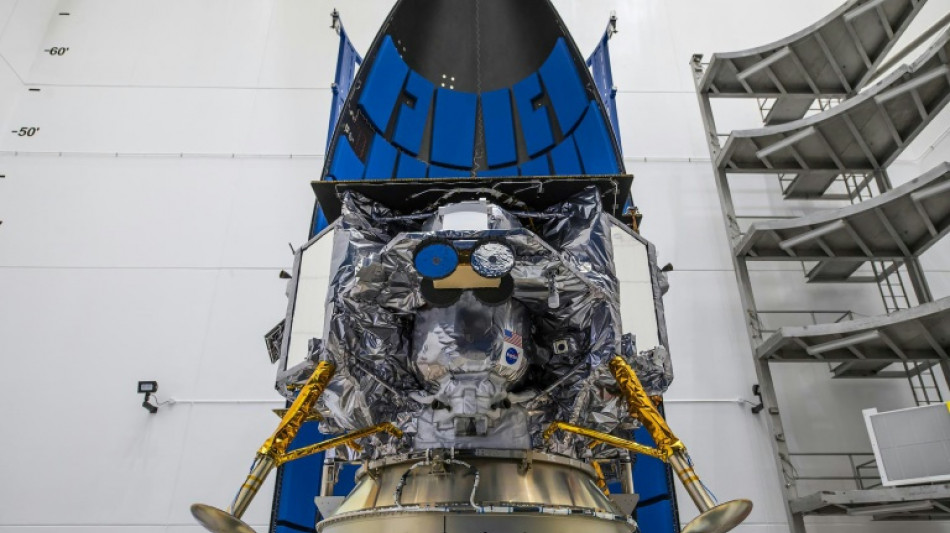
New US lunar lander runs into technical problem: company / Photo: © NASA/AFP/File

 Trump renames AI 'super intelligence' as leaders jostle over dangers

 Oil prices retreat as markets welcome US-Iran talks

 US refusing to give Sudan's de facto leader visa for UN: diplomatic sources, UN

 Macron urges world to choose UN over 'law of the jungle'

 All-rounder Jacks stars as England beat Sri Lanka in 1st ODI

 Man City peg back Bayern to start Women's Champions League

 Trump beats 'America first' drum at UN as allies tread carefully

 Snedeker backs Spaun for Ryder Cup after Presidents snub

 French prosecutors probe secret filming of women with smart glasses

 Trump renames AI "super intelligence," rejects international oversight

 Trump rejects international regulation of AI

 How is the EU approaching record fuel prices?

 Sri Lanka's Colombage strikes on debut as England dismissed for 265 in first ODI

 Hurricane Polo strengthens to top category 5 off Mexico

 11 hurt as teen opens fire outside school in western Turkey

 UN chief says 'Big Oil' treats atmosphere as open sewer

 Tunisia says 2026 summer hottest on record

 England's Rashid out of Sri Lanka ODIs with hand injury

 Houthis accuse Saudi Arabia of deadly strikes as thousands flee

 Stocks climb as oil slides, AI buzz returns

 India cricketers win in style as Afghan savours 'special' Games silver

 La Liga president hits out at Real Madrid refereeing 'conspiracy' claims

 MEXC Launches “Real Stocks, Real Friends” with Rewards for Bringing Friends to Wall Street

 Mbappe continues media push for Ballon d'Or recognition

 Stocks rise on AI buzz, oil prices cool

The first US lunar lander launched in more than five decades has experienced an anomaly preventing it from pointing its solar panels towards the Sun, the company that built the robot said Monday.
Astrobotic's Peregrine lunar lander separated successfully from United Launch Alliance's new Vulcan rocket overnight from the Cape Canaveral Space Force Base, and quickly established communications with NASA's Deep Space Network of ground-based radio antennas.
All its systems powered on as expected, and it "entered a fully operational state," Astrobotic said in a tweet.
But "unfortunately, an anomaly occurred which prevented Astrobotic from achieving a stable sun-pointing orientation.
"The team is responding in real time as the situation unfolds and will be providing updates as data is obtained and analyzed."
The lander's documentation, available online, says that while in orbit, Peregrine's top mounted solar panel stays pointed at the Sun to enable maximum power generation.
"The solar panel is utilized to provide battery charge and maintain lander and payload operations. After descent to the lunar surface the power system continues to provide reliable power services to payloads through the end of mission," it says.
Peregrine is on its way to the Moon and is supposed to hold its orbit before finally landing on a mid-latitude region called Sinus Viscositatis, or Bay of Stickiness, on February 23.
Until now, a soft landing on Earth's nearest celestial neighbor has only been accomplished by a handful of nations. But the United States and others are increasingly turning to the commercial sector to carry out routine missions and ship hardware at a fraction of the cost.
K.Brown--BTB