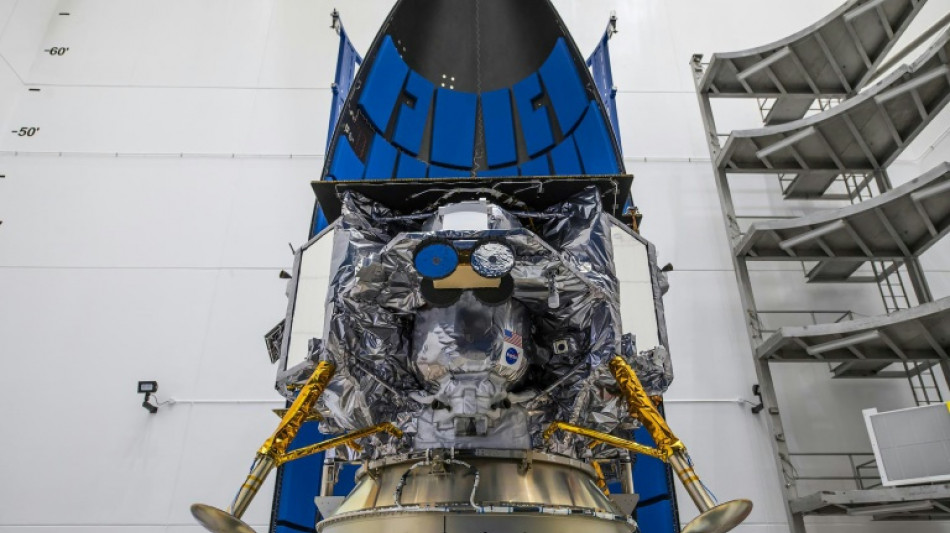
Private US lunar lander hits technical problems on way to Moon / Photo: © NASA/AFP/File

 Trump renames AI 'super intelligence' as leaders jostle over dangers

 Oil prices retreat as markets welcome US-Iran talks

 US refusing to give Sudan's de facto leader visa for UN: diplomatic sources, UN

 Macron urges world to choose UN over 'law of the jungle'

 All-rounder Jacks stars as England beat Sri Lanka in 1st ODI

 Man City peg back Bayern to start Women's Champions League

 Trump beats 'America first' drum at UN as allies tread carefully

 Snedeker backs Spaun for Ryder Cup after Presidents snub

 French prosecutors probe secret filming of women with smart glasses

 Trump renames AI "super intelligence," rejects international oversight

 Trump rejects international regulation of AI

 How is the EU approaching record fuel prices?

 Sri Lanka's Colombage strikes on debut as England dismissed for 265 in first ODI

 Hurricane Polo strengthens to top category 5 off Mexico

 11 hurt as teen opens fire outside school in western Turkey

 UN chief says 'Big Oil' treats atmosphere as open sewer

 Tunisia says 2026 summer hottest on record

 England's Rashid out of Sri Lanka ODIs with hand injury

 Houthis accuse Saudi Arabia of deadly strikes as thousands flee

 Stocks climb as oil slides, AI buzz returns

 India cricketers win in style as Afghan savours 'special' Games silver

 La Liga president hits out at Real Madrid refereeing 'conspiracy' claims

 MEXC Launches “Real Stocks, Real Friends” with Rewards for Bringing Friends to Wall Street

 Mbappe continues media push for Ballon d'Or recognition

 Stocks rise on AI buzz, oil prices cool

For the first time in five decades, an American lander is bound for the Moon following a successful launch -- but the historic mission led by private industry is experiencing a technical issue that could derail it.
A brand new rocket, United Launch Alliance's Vulcan Centaur, lifted off from Florida's Cape Canaveral Space Force Station at 2:18 am (0718 GMT) for its maiden voyage, carrying Astrobotic's Peregrine Lunar Lander.
Peregrine separated as expected, powered up its systems and made contact with ground control.
But "unfortunately, an anomaly occurred which prevented Astrobotic from achieving a stable sun-pointing orientation," Astrobotic tweeted, adding teams are working on the problem and would provide updates.
While in orbit, Peregrine's top mounted solar panel stays pointed at the Sun to enable maximum power generation.
"The solar panel is utilized to provide battery charge and maintain lander and payload operations," the robot's documentation says. Power is needed to run the onboard computer, as well as its communications and flight control systems.
Peregrine is supposed to reach the Moon, then maintain an orbit for several weeks before touching down on a mid-latitude region of the Moon called Sinus Viscositatis, or Bay of Stickiness, on February 23.
Until now, a soft landing on Earth's nearest celestial neighbor has only been accomplished by a handful of national space agencies: the Soviet Union was first, in 1966, followed by the United States, which is still the only country to put people on the Moon.
China has successfully landed three times over the past decade, while India was the most recent to achieve the feat on its second attempt, last year.
Now, the United States is turning to the commercial sector to stimulate a broader lunar economy and ship its own hardware at a fraction of the cost, under the Commercial Lunar Payload Services (CLPS) program.
- Treacherous terrain -
NASA paid Astrobotic more than $100 million for the task, while another contracted company, Houston-based Intuitive Machines, is looking to launch in February and land near the Moon's south pole.
NASA says they will help pave the way for its Artemis program to return astronauts to the Moon later this decade, in preparation for future missions to Mars.
Controlled touchdown on the Moon is a challenging undertaking, with roughly half of all attempts failing.
In the absence of an atmosphere that would allow the use of parachutes, a spacecraft must navigate treacherous terrain using only its thrusters to slow descent.
Private missions by Israel and Japan, as well as a recent attempt by the Russian space agency, have all ended in failure -- though the Japanese Space Agency is targeting mid-January for the touchdown of its SLIM lander launched last September.
It was the first launch for ULA's Vulcan rocket, maintaining the company's 100 percent success rate in more than 150 prior launches.
Vulcan is planned to have reusable first stage booster engines, which the company, a joint venture between Lockheed Martin and Boeing, expects will save costs.
- Human remains -
On board Peregrine is a suite of scientific instruments that will probe radiation and surface composition, helping to pave the way for the return of astronauts.
But it also contains more colorful cargo, including a shoebox-sized rover built by Carnegie Mellon University, a physical Bitcoin and cremated remains and DNA, including those of Star Trek creator Gene Roddenberry, legendary sci-fi author and scientist Arthur C. Clarke and a dog.
The Navajo Nation, America's largest Indigenous tribe, has objected to sending human remains, calling it a desecration of a sacred space. Though they were granted a last-ditch meeting with White House and NASA officials, their objections failed to remove the cargo.
The Vulcan rocket's upper stage, which will circle the Sun after it deploys the lander, is meanwhile carrying remains of more late cast members of Star Trek, as well as hair samples of presidents George Washington, Dwight D. Eisenhower and John F. Kennedy.
G.Schulte--BTB