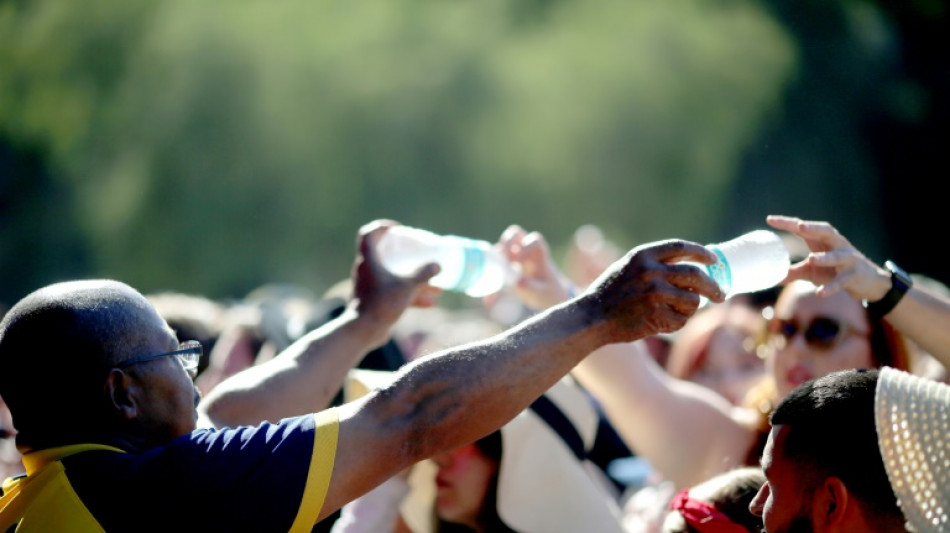
Bottled water contains hundreds of thousands of plastic bits: study / Photo: © GETTY IMAGES NORTH AMERICA/AFP/File

 Trump renames AI 'super intelligence' as leaders jostle over dangers

 Oil prices retreat as markets welcome US-Iran talks

 US refusing to give Sudan's de facto leader visa for UN: diplomatic sources, UN

 Macron urges world to choose UN over 'law of the jungle'

 All-rounder Jacks stars as England beat Sri Lanka in 1st ODI
 Man City peg back Bayern to start Women's Champions League

 Trump beats 'America first' drum at UN as allies tread carefully
 Snedeker backs Spaun for Ryder Cup after Presidents snub

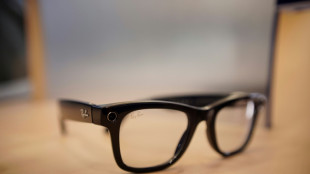 French prosecutors probe secret filming of women with smart glasses

 Trump renames AI "super intelligence," rejects international oversight

 Trump rejects international regulation of AI

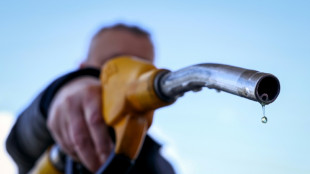 How is the EU approaching record fuel prices?

 Sri Lanka's Colombage strikes on debut as England dismissed for 265 in first ODI

 Hurricane Polo strengthens to top category 5 off Mexico

 11 hurt as teen opens fire outside school in western Turkey

 UN chief says 'Big Oil' treats atmosphere as open sewer

 Tunisia says 2026 summer hottest on record

 England's Rashid out of Sri Lanka ODIs with hand injury

 Houthis accuse Saudi Arabia of deadly strikes as thousands flee

 Stocks climb as oil slides, AI buzz returns

 India cricketers win in style as Afghan savours 'special' Games silver

 La Liga president hits out at Real Madrid refereeing 'conspiracy' claims

 MEXC Launches “Real Stocks, Real Friends” with Rewards for Bringing Friends to Wall Street

 Mbappe continues media push for Ballon d'Or recognition

 Stocks rise on AI buzz, oil prices cool

Bottled water is up to a hundred times worse than previously thought when it comes to the number of tiny plastic bits it contains, a new study in the Proceedings of the National Academy of Sciences said Monday.
Using a recently invented technique, scientists counted on average 240,000 detectable fragments of plastic per liter of water in popular brands -- between 10-100 times higher than prior estimates -- raising potential health concerns that require further study.
"If people are concerned about nanoplastics in bottled water, it's reasonable to consider alternatives like tap water," Beizhan Yan, an associate research professor of geochemistry at Columbia University and a co-author of the paper told AFP.
But he added: "We do not advise against drinking bottled water when necessary, as the risk of dehydration can outweigh the potential impacts of nanoplastics exposure."
There has been rising global attention in recent years on microplastics, which break off from bigger sources of plastic and are now found everywhere from the polar ice caps to mountain peaks, rippling through ecosystems and finding their way into drinking water and food.
While microplastics are anything under 5 millimeters, nanoplastics are defined as particles below 1 micrometer, or a billionth of a meter -- so small they can pass through the digestive system and lungs, entering the bloodstream directly and from there to organs, including the brain and heart. They can also cross the placenta into the bodies of unborn babies.
There is limited research on their impacts on ecosystems and human health, though some early lab studies have linked them to toxic effects, including reproductive abnormalities and gastric issues.
To study nanoparticles in bottled water, the team used a technique called Stimulated Raman Scattering (SRS) microscopy, which was recently invented by one of the paper's co-authors, and works by probing samples with two lasers tuned to make specific molecules resonate, revealing what they are to a computer algorithm.
They tested three leading brands but chose not to name them, "because we believe all bottled water contain nanoplastics, so singling out three popular brands could be considered unfair," said Yan.
The results showed between 110,000 to 370,000 particles per liter, 90 percent of which were nanoplastics while the rest were microplastics.
The most common type was nylon -- which probably comes from plastic filters used to purify the water-- followed by polyethylene terephthalate or PET, which is what bottles are themselves made from, and leaches out when the bottle is squeezed. Other types of plastic enter the water when the cap is opened and closed.
Next, the team hopes to probe tap water, which has also been found to contain microplastics, though at far lower levels.
J.Bergmann--BTB