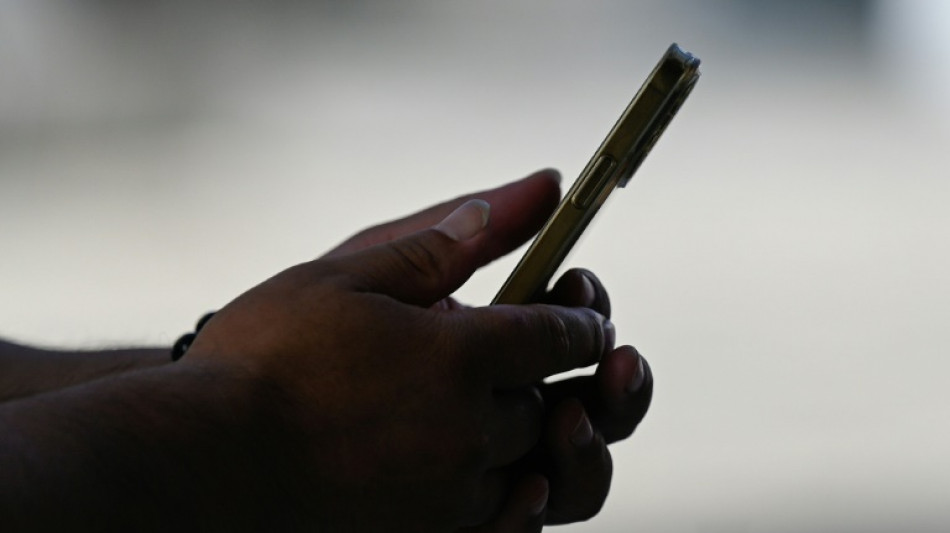
China says state-backed experts crack Apple's AirDrop / Photo: © AFP/File

 Trump renames AI 'super intelligence' as leaders jostle over dangers

 Oil prices retreat as markets welcome US-Iran talks
 US refusing to give Sudan's de facto leader visa for UN: diplomatic sources, UN

 Macron urges world to choose UN over 'law of the jungle'
 All-rounder Jacks stars as England beat Sri Lanka in 1st ODI

 Man City peg back Bayern to start Women's Champions League

 Trump beats 'America first' drum at UN as allies tread carefully

 Snedeker backs Spaun for Ryder Cup after Presidents snub

 French prosecutors probe secret filming of women with smart glasses

 Trump renames AI "super intelligence," rejects international oversight

 Trump rejects international regulation of AI

 How is the EU approaching record fuel prices?

 Sri Lanka's Colombage strikes on debut as England dismissed for 265 in first ODI

 Hurricane Polo strengthens to top category 5 off Mexico

 11 hurt as teen opens fire outside school in western Turkey

 UN chief says 'Big Oil' treats atmosphere as open sewer

 Tunisia says 2026 summer hottest on record

 England's Rashid out of Sri Lanka ODIs with hand injury

 Houthis accuse Saudi Arabia of deadly strikes as thousands flee

 Stocks climb as oil slides, AI buzz returns

 India cricketers win in style as Afghan savours 'special' Games silver

 La Liga president hits out at Real Madrid refereeing 'conspiracy' claims

 MEXC Launches “Real Stocks, Real Friends” with Rewards for Bringing Friends to Wall Street

 Mbappe continues media push for Ballon d'Or recognition

 Stocks rise on AI buzz, oil prices cool

Chinese state-backed experts have found a way to identify people who use Apple's encrypted AirDrop messaging service, according to the Beijing municipal government.
AirDrop allows users to send content to Apple devices in close proximity without an internet connection, encoded so they cannot be viewed by other people.
The service was widely used by participants in pro-democracy protests in Hong Kong in 2019 that China's central government eventually quelled.
Apple also limited file-sharing for Chinese iPhone users in 2022 following protests against the ruling Communist Party's stringent zero-Covid policy.
The Beijing municipal government's justice bureau said experts at the Beijing Wangshen Dongjian Justice Appraisal Institute in the capital had devised a way to reveal an iPhone's encrypted device log.
From there, they could identify an AirDrop user's phone number and email accounts, the Monday statement on the bureau's website said.
It said the technique "cracked the tough technological problem of the transmission of inappropriate information with anonymous traceability via AirDrop".
The method also "raised the efficacy and accuracy of case detection and resolution, and has effectively helped police ascertain several case suspects".
The statement did not mention whether the technique had led to any arrests or convictions.
Apple did not immediately respond to a request for comment from AFP.
There were widespread reports in late 2022 that people in China were using AirDrop to spread digital leaflets critical of the government.
The transmissions were believed to be partly inspired by a protest in Beijing in which a man hung banners calling for the removal of President Xi Jinping.
In November of that year, Apple released an AirDrop update that meant users of Apple smartphones in China could only opt-in to receive files from unknown contacts during a 10-minute window before it automatically shuts off. The feature did not previously have a time limit.
The update made it virtually impossible to receive unexpected files from strangers.
Apple has long faced criticism for making perceived concessions to Xi's increasingly repressive China.
Beijing imposed a sweeping national security law in Hong Kong in 2020 that has all but quashed public dissent in the former British colony.
F.Müller--BTB