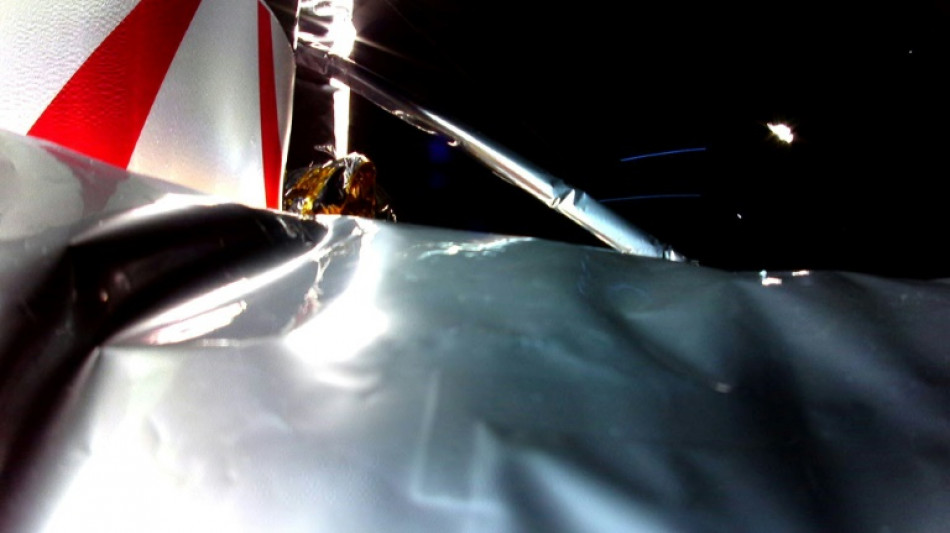
Doomed US lunar lander's space odyssey continues...for now / Photo: © Astrobotic/AFP/File

 Trump renames AI 'super intelligence' as leaders jostle over dangers

 Oil prices retreat as markets welcome US-Iran talks

 US refusing to give Sudan's de facto leader visa for UN: diplomatic sources, UN

 Macron urges world to choose UN over 'law of the jungle'

 All-rounder Jacks stars as England beat Sri Lanka in 1st ODI

 Man City peg back Bayern to start Women's Champions League

 Trump beats 'America first' drum at UN as allies tread carefully

 Snedeker backs Spaun for Ryder Cup after Presidents snub

 French prosecutors probe secret filming of women with smart glasses

 Trump renames AI "super intelligence," rejects international oversight

 Trump rejects international regulation of AI

 How is the EU approaching record fuel prices?

 Sri Lanka's Colombage strikes on debut as England dismissed for 265 in first ODI

 Hurricane Polo strengthens to top category 5 off Mexico

 11 hurt as teen opens fire outside school in western Turkey

 UN chief says 'Big Oil' treats atmosphere as open sewer

 Tunisia says 2026 summer hottest on record

 England's Rashid out of Sri Lanka ODIs with hand injury

 Houthis accuse Saudi Arabia of deadly strikes as thousands flee

 Stocks climb as oil slides, AI buzz returns

 India cricketers win in style as Afghan savours 'special' Games silver

 La Liga president hits out at Real Madrid refereeing 'conspiracy' claims

 MEXC Launches “Real Stocks, Real Friends” with Rewards for Bringing Friends to Wall Street

 Mbappe continues media push for Ballon d'Or recognition

 Stocks rise on AI buzz, oil prices cool

Is it the little spaceship that could?
A private US lunar lander that's been hemorrhaging fuel since an onboard explosion at the start of its journey is somehow still chugging along, snapping selfies and running science instruments as it continues its journey through space.
Though Astrobotic, the company that built the Peregrine robot, has said a controlled touchdown on the Moon is no longer possible, it hasn't ruled out a so-called "hard landing" or crash -- a prospect that has space watchers gripped.
"Peregrine has now been operating in space for more than 4 days," Astrobotic said in its latest update posted on X on Friday, adding it remained "stable and operational."
The rate of fuel loss has steadily diminished as the pressure inside its tank drops, meaning the company has been able to extend the spacecraft's life far longer than it initially thought possible.
Meanwhile, the US, German and Mexican space agencies have been able to power on the scientific instruments they wanted to run on the Moon.
"Measurements and operations of the NASA-provided science instruments on board will provide valuable experience, technical knowledge, and scientific data to future CLPS lunar deliveries," said Joel Kearns, deputy associate administrator for exploration for NASA.
Commercial Lunar Payload Services is the experimental NASA program under which the space agency paid Astrobotic more than $100 million to ship its hardware of Peregrine, as part of a strategy to seed a commercial lunar economy and reduce its own overheads.
Astrobotic is the third private entity to have failed in a soft landing, following an Israeli nonprofit and a Japanese company.
- 'Shots on goal' -
Though it hasn't worked out this time, NASA officials have made clear their strategy of "more shots on goal" means more chances to score, and the next attempt, by Houston-based Intuitive Machines, launches in February.
Astrobotic itself will get another chance in November with its Griffin lander transporting NASA's VIPER rover to the lunar south pole.
For now, the Pittsburgh-based company is staying tight-lipped on Peregrine's intended destination, leaving enthusiasts to make their own calculations.
Amateur astronomer Tony Dunn used publicly available data provided by NASA's Jet Propulsion Laboratory (JPL) to plot out the spaceship's current course, posting a graphic on social media platform X showing it would collide with the Moon on January 23.
But "it's really anybody's guess as to what is actually going to happen because of the leaking fuel," which could easily push it off course, he told AFP.
Or, Astrobotic could intentionally point Peregrine another way, such as flying by the Moon and shooting for interplanetary space.
While a hard lunar landing might satisfy some of Astrobotic's clients, such as those flying human ashes and DNA to the Moon, it could anger others like the Navajo Nation, which had called that cargo a "desecration" of the celestial body.
"I think it would be a shame if they completed their failed mission by littering the surface of the Moon with debris," Justin Walsh, a professor of art history, archaeology, and space studies at USC told AFP, adding that humanity had left some 180 tons of material on the surface since the first Soviet impactor crashed in 1959.
A.Gasser--BTB