Taiwan's TSMC to launch Japan chipmaking plant in February / Photo: © AFP

 Trump renames AI 'super intelligence' as leaders jostle over dangers

 Oil prices retreat as markets welcome US-Iran talks
 US refusing to give Sudan's de facto leader visa for UN: diplomatic sources, UN
 Macron urges world to choose UN over 'law of the jungle'
 All-rounder Jacks stars as England beat Sri Lanka in 1st ODI

 Man City peg back Bayern to start Women's Champions League

 Trump beats 'America first' drum at UN as allies tread carefully

 Snedeker backs Spaun for Ryder Cup after Presidents snub

 French prosecutors probe secret filming of women with smart glasses

 Trump renames AI "super intelligence," rejects international oversight

 Trump rejects international regulation of AI

 How is the EU approaching record fuel prices?

 Sri Lanka's Colombage strikes on debut as England dismissed for 265 in first ODI

 Hurricane Polo strengthens to top category 5 off Mexico

 11 hurt as teen opens fire outside school in western Turkey

 UN chief says 'Big Oil' treats atmosphere as open sewer

 Tunisia says 2026 summer hottest on record

 England's Rashid out of Sri Lanka ODIs with hand injury

 Houthis accuse Saudi Arabia of deadly strikes as thousands flee

 Stocks climb as oil slides, AI buzz returns

 India cricketers win in style as Afghan savours 'special' Games silver

 La Liga president hits out at Real Madrid refereeing 'conspiracy' claims
 MEXC Launches “Real Stocks, Real Friends” with Rewards for Bringing Friends to Wall Street

 Mbappe continues media push for Ballon d'Or recognition

 Stocks rise on AI buzz, oil prices cool

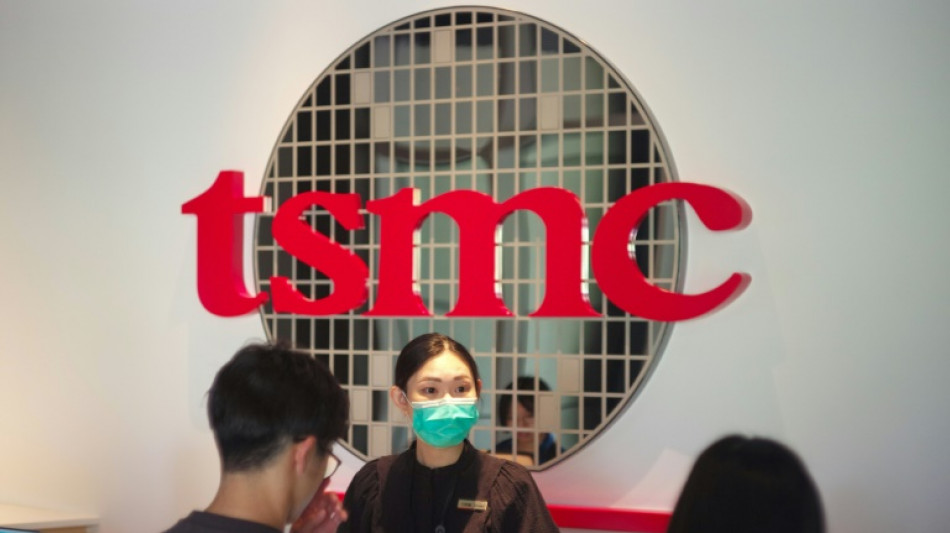
Taiwan's TSMC will open its latest chipmaking foundry on Japan's Kyushu island on February 24, its chairman said Thursday, part of the semiconductor giant's plan to expand its global manufacturing footprint.
Taiwan Semiconductor Manufacturing Company -- which counts Apple and Nvidia as clients -- controls more than half the world's output of silicon wafers, used in everything from smartphones to cars and missiles.
In recent years, the company has had to navigate geopolitical tussles between the United States and China as the two face off over technology import restrictions, trade and Taiwan -- the primary manufacturing base for TSMC.
On Thursday, during an investors' call over fourth-quarter earnings, chairman Mark Liu announced the official date of the long-awaited Japan foundry's opening ceremony would be February 24.
"In Japan, we are building a special technology fab(rication plant) in Kumamoto which will utilise 12- and 16-nanometre and 28- and 22-nanometre process technology," Liu said.
"We will hold an opening ceremony for this fab on February 24 next month and volume production is on track for fourth quarter of 2024."
He added that TSMC's expansion overseas is "based on our customers' needs and a necessary level of government subsidies for support".
"In today's fractured globalisation environment, our strategy is to expand our global manufacturing footprint to increase our customers' trust, expand our future growth potential, and reach for more global talents," Liu said.
Japan's government said last year it plans to spend $13 billion to boost domestic production of strategically important semiconductors and generative AI technology.
Part of that spending would be to support the construction of a second TSMC plant in Kumamoto, a Japanese trade ministry official had said in November.
But Liu said Thursday that the second plant is still in the "serious evaluation stage".
"We are still discussing with the Japanese government, they are very cooperative," he said. "Nothing is definitive."
- 'Challenging year' -
Besides a plant in Japan, TSMC also has a planned fab in Germany, which would be its first in Europe.
Liu said Thursday the fab construction in Germany, in Saxony's capital Dresden, "is scheduled to begin in Q4 (the fourth quarter) this year".
The company also reported a 19.3 percent drop in net profits in the October-December period to Tw$238.7 billion ($7.6 billion), while its revenues were "essentially flat".
CEO C.C. Wei said that while 2023 was a "challenging year" for the global semiconductor industry, the rising demand for generative AI technology also means "we expect 2024 to be a healthy growth year for TSMC".
The chip industry has seen sluggish performance, which companies attribute to high inflation and slowing global economic growth caused in part by geopolitical tensions.
TSMC had sought to quell investor fears in the past by pointing to the increasing demand for AI-related products, like ChatGPT, which needs high-performing silicon wafers to function.
T.Bondarenko--BTB


