Astronomers in Chile to scour universe with car-sized mega camera / Photo: © AFP

 Trump renames AI 'super intelligence' as leaders jostle over dangers

 Oil prices retreat as markets welcome US-Iran talks

 US refusing to give Sudan's de facto leader visa for UN: diplomatic sources, UN

 Macron urges world to choose UN over 'law of the jungle'

 All-rounder Jacks stars as England beat Sri Lanka in 1st ODI

 Man City peg back Bayern to start Women's Champions League

 Trump beats 'America first' drum at UN as allies tread carefully

 Snedeker backs Spaun for Ryder Cup after Presidents snub

 French prosecutors probe secret filming of women with smart glasses

 Trump renames AI "super intelligence," rejects international oversight

 Trump rejects international regulation of AI

 How is the EU approaching record fuel prices?

 Sri Lanka's Colombage strikes on debut as England dismissed for 265 in first ODI

 Hurricane Polo strengthens to top category 5 off Mexico

 11 hurt as teen opens fire outside school in western Turkey

 UN chief says 'Big Oil' treats atmosphere as open sewer

 Tunisia says 2026 summer hottest on record

 England's Rashid out of Sri Lanka ODIs with hand injury

 Houthis accuse Saudi Arabia of deadly strikes as thousands flee

 Stocks climb as oil slides, AI buzz returns

 India cricketers win in style as Afghan savours 'special' Games silver

 La Liga president hits out at Real Madrid refereeing 'conspiracy' claims

 MEXC Launches “Real Stocks, Real Friends” with Rewards for Bringing Friends to Wall Street

 Mbappe continues media push for Ballon d'Or recognition

 Stocks rise on AI buzz, oil prices cool

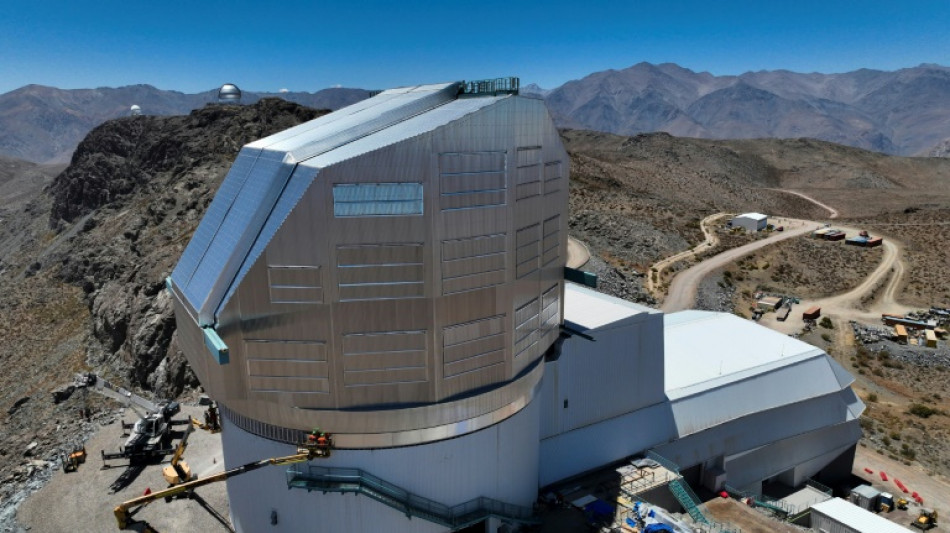
Surrounded by the desert mountains and clear blue sky of northern Chile, astronomers from the Vera C. Rubin Observatory hope to revolutionize the study of the universe by affixing the world's largest-ever digital camera to a telescope.
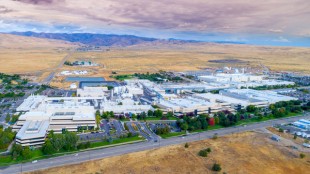
The size of a small car and weighing 2.8 metric tons, the sophisticated piece of equipment will reveal views of the cosmos as never before, officials from the US-funded project told AFP.
Beginning in early 2025, when the $800 million camera will snap its first photos, the machine will sweep the sky every three days, allowing scientists to reach new heights in their galactic analyses.
Researchers will be able to go from "studying one star and knowing everything in-depth about that one star, to studying thousands of stars at a time," said Bruno Dias, president of the Chilean Society of Astronomy (Sochias).
According to Stuartt Corder, deputy director of NOIRLab, the US research center running the observatory located 2,500 meters (8,200 feet) up the Cerro Pachon mountain, 560 kilometers (350 miles) north of Santiago, the new facility will usher in "a paradigm shift in astronomy."
The project solidifies Chile's dominant position in astronomical observation, as the South American country is home to a third of the globe's most powerful telescopes, according to Sochias, and boasts among the clearest skies on the planet.
The Rubin Observatory camera's first task will be to complete a 10-year review of the sky, called the Legacy Survey of Space and Time (LSST), which researchers hope will reveal information about 20 million galaxies, 17 billion stars and six million space objects.
The survey will give scientists an up-to-date inventory of images of the solar system, allow them to map our own galaxy, the Milky Way, and delve deeper into the study of energy and dark matter.
- 300 TVs for one picture -
The new camera will be able to capture 3,200-megapixel photos -- resulting in images so large they would require more than 300 average-size high-definition televisions, lined up together, to view just one.
The machine, built in California, will have triple the capacity of the world's current most powerful camera, the 870-megapixel Hyper Suprime-Cam in Japan, and will have six times the capacity of NOIRLab's most powerful camera.
The lab's existing top camera, on Chile's Cerro Tololo mountain, is only 520 megapixels, according to Jacques Sebag, head of construction of the Rubin telescope.
Chile's telescopes have come a long way since the 40-centimeter Cerro Tololo telescope, at the country's first international observatory, installed in the 1960s.
"That telescope arrived here on the back of a mule, because there was no road," said Stephen Heathcote, director of the Cerro Tololo Inter-American Observatory, only 20 kilometers from Cerro Pachon.
- Astronomy capital of the world -
The Vera C. Rubin Observatory, named in honor of the US astronomer who discovered dark matter, will join several other space observation research centers in northern Chile.
The natural conditions of the region's desert landscape -- tucked between the Pacific Ocean and the Andes mountain range -- creates the clearest skies on the planet, thanks to a dry climate with little cloud cover.
The area plays host to telescopes from more than 30 countries, including some of the most powerful astronomical instruments in the world, such as the radio telescope at the ALMA Observatory and the under-construction Extremely Large Telescope, which by 2027 is set to be able to view never-before-seen reaches of the universe.
Many of humanity's most important astronomical discoveries have been made at the Cerro Tololo observatory, such as the 2011 Nobel Prize-winning revelation that expansion of the universe is picking up speed, a phenomenon known as cosmic acceleration.
Though other influential observatories have been opened around the globe, including in the United States, Australia, China and Spain, "Chile is unbeatable" in the world of astronomy, said Dias, the Sochias president.
K.Brown--BTB