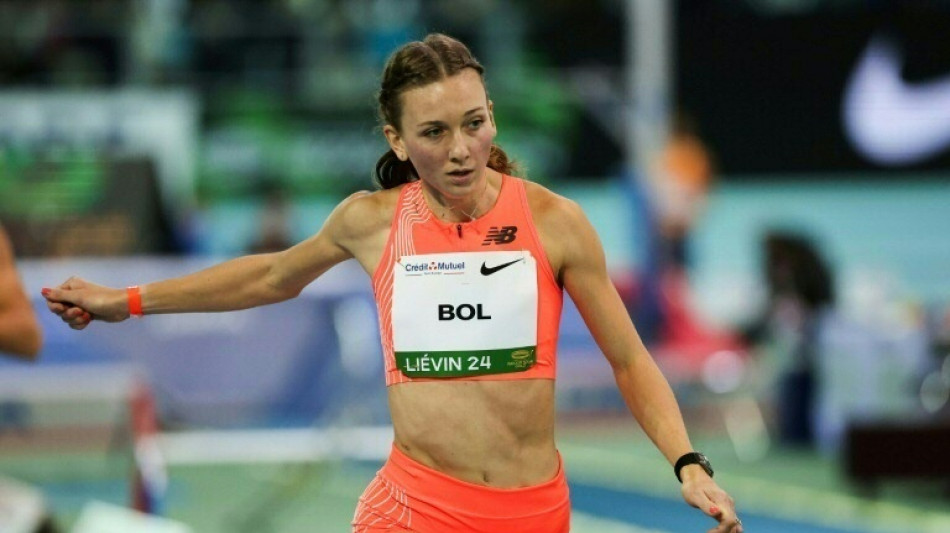
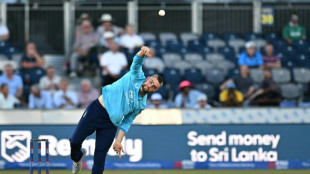
Scientists develop mathematical model to optimise elite athletes' performance / Photo: © AFP/File

 Voting opens in Alaska's annual Fat Bear Week

 MLS coach axed for telling female ref 'It's a man's game'

 US refuses to give Sudan's de facto leader visa for UN

 Man City hold Bayern to start Women's Champions League, Arsenal win late

 Trump threatens Iran with 'hell' but reveals fresh talks

 Trump signs security deal with Greenland, Denmark at UN
 Trump threatens Iran with 'hell' but unveils fresh talks
 Chile's Atacama Desert blossoms with life after El Nino rains

 Sri Lanka hands 220-year jail terms to 15 convicted of Easter bombings

 Typhoon Dujuan leaves 7 dead in Japan from landslides, flooding: media
 Ganna and Borghini lead Italy to mixed relay gold at cycling worlds

 Drug cocktail killed former child star Hayden Panettiere: coroner

 Moldova declares energy, water emergency

 French Holocaust denier jailed for eight months
 Oil prices slide, AI stock buzz fades
 Trump threatens to 'annihilate' Iran in bombastic UN speech

 Prada's skirts take centre stage as Milan Fashion Week begins

 Quoin Pharmaceuticals Announces FDA Fast Track Designation for QRX003 for the Treatment of Peeling Skin Syndrome
 Brazil's Flavio Bolsonaro turns scandal into poll gains
 Republican senator seeks probe of Trump Jr Russian-funded wedding
 Memoir by Diana's brother goes on sale after rocking UK monarchy
 Newcomers South Korea face holders Italy in Davis Cup finals

 Japan's Kojima sounds Marchand warning with Asian Games gold

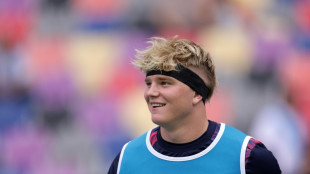 England rugby star Pollock signs new Northampton deal

 STARTRADER Expands Its Chinese Equity CFD Range with CXMT and Unitree Robotics

Scientists have developed a mathematical model that promises to optimise training for competitors in 400-metre and 1,500-metre athletics events, according to a study published Tuesday.
The model is based on performance data gathered from elite athletes including Olympic 1,500 metres champion Jakob Ingebrigtsen of Norway, Dutch world indoor 400m world record holder Femke Bol and Britain's Matthew Hudson-Smith at the 2022 European Championships in Munich.
"We wanted to understand what was happening at the physiological level in a 400 metres, which is a sprint, and a 1,500 metres, which is the first endurance race," Amandine Aftalion, co-author of the study published in the journal Frontiers in Sports and Active Living, told AFP.
Thanks to new technology of GPS sensors placed under athletes' jerseys, researchers were able to trace with precision the speeds of each athlete, with their position indicated ten times per second.
They integrated equations calculating physiological variables -- energy expenditure during exercise, maximum oxygen consumption (VO2), running economy and motor control -- in other words the role of the brain in the process of movement such as motivation, which has a role in the delay in action.
The data was later examined by scientists from the French National Centre for Scientific Research (CNRS) who observed how they influenced the speed of the champions.
"Thanks to the quantification of costs and benefits, the model provides instant access to the best strategy so that the runner 'performs' in an optimised manner," the CNRS said in a statement.
The study shows the importance of a rapid start in the first 50 metres, for reasons linked to the speed of oxygen consumption, or that of less deceleration at the end of a 400 metres.
The simulations notably explained the performance of middle distance runner Ingebrigtsen by his ability to quickly reach his maximum oxygen consumption (VO2), and to maintain it throughout the race.
A particularity which allows the Olympic champion "to run at a greater pace than his competitors throughout the race, even though we see him start less strongly," explained Aftalion.
The model could lead to performance support software so that coaches can "refine the racing strategy in relation to the physiological profile of the runner", the researcher concluded.
K.Brown--BTB