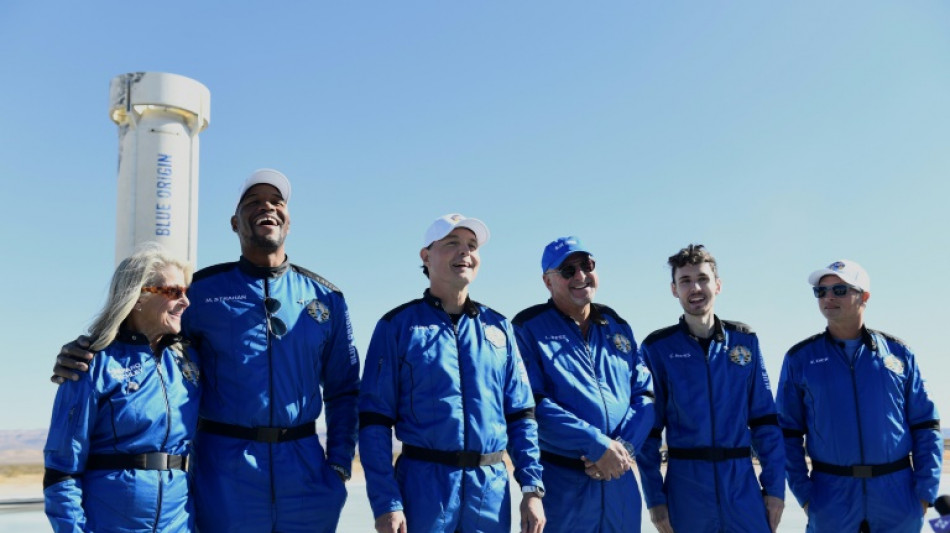
Space tourism: the arguments in favor / Photo: ©

 Ed Sheeran returns to stage after Palestinian controversy

 Asian Games to open in Japan after troubled build-up

 Drone owners rush to offload devices ahead of Beijing ban

 Trump's beef policies irk Texas ranchers, testing their loyalty

 Nvidia, OpenAI CEOs to attend Xi dinner at White House

 Anthropic picks Accenture for in-house AI safety evaluation

 Balogun returns as Monaco beat Lens to continue strong Ligue 1 start

 'Pause' on overt repression in Venezuela, but reforms still needed: HRW

 Global stocks mixed as yen falls despite Bank of Japan rate hike

 Cuba hit with seventh major blackout of the year
 Murray out with concussion so Wentz will start for Vikings

 UN chief 'deeply regrets' US visa refusal to Abbas for annual meeting

 England quick Carse to face no charges over alleged nightclub assault

 Mancini brings nine newcomers into the first squad of his Italy comeback

 Czechs level Davis Cup tie against USA as South Korea eye Finals
 New France boss Zidane confirms Mbappe as captain after naming first squad

 California governor signs order to explore AI 'kill switch'

 Head leads run spree as Australia win Zimbabwe ODI series

 In-form Raphinha wants to finish career at Barcelona

 Warren Buffett steps down as Berkshire Hathaway chairman

 Carrick confident Man Utd can 'work through' tough time

 Mbappe ends Nike partnership to join Swiss brand On

 Liverpool boss Iraola puts Bournemouth love affair on hold

 'A disaster' if Man City do not win says Maresca after flawless start

 Kerry James Marshall: American 'blackness' painter celebrated in Europe

To its many detractors, space tourism amounts to nothing more than joy-rides for the global super rich that will worsen the planet's climate crisis.
But the nascent sector also has supporters, who, while not rejecting the criticism outright, argue the industry can bring humanity benefits too.
- More research opportunities -
The first argument is that private spaceflights, in addition to their customers, can send to space scientific experiments that require microgravity environments.
In the past, national agencies "it used to take quite a long time to work within government grant channels, get approval, get the funding, get picked to be among the very select few that could go," Ariel Ekblaw, of the MIT Space Exploration Initiative told AFP.
By contrast, it took Ekblaw just six months from signing a contract to sending her research project to the International Space Station on board the private Ax-1 mission, which blasted off Friday thanks to the private entrepreneurs paying for the trip.
Her experiment, called TESSERAE, involves smart tiles that form a floating robotic swarm that can self-assemble into space architecture -- which might be how future space stations are built.
An earlier prototype was flown to space for a few minutes aboard a Blue Origin suborbital spaceflight, paving the way for the new test.
"The proliferation of these commercial launch providers does allow us to do riskier, faster and more innovative projects," said Ekblaw.
Virgin Galactic, for its part, has announced plans to take scientists on future flights.
- Better space technology -
Space tourism, and the private space sector overall, also acts as an innovation driver for getting better at doing all things related to space.
Government agencies, which operate with taxpayers' money, move cautiously and are deeply-averse to failure -- while companies like Elon Musk's SpaceX don't mind blowing up prototype rockets until they get them right, speeding up development cycles.
Where NASA focuses on grand exploration goals, private companies seek to improve the rate, profitability and sustainability of launches, with reusable vessels -- and in the case of Blue Origin, rockets that emit only water vapor.
For now, spaceflight remains a risky and expensive endeavor.
"The more we go to space, the better we become at space, the more an industry base arises to support space technology," said Mason Peck, an aeronautics professor at Cornell University who previously served as NASA's chief technologist.
A parallel can be drawn with the early era of aviation, when flying was limited to the privileged few.
"We started out with lots of accidents, and lots of different companies with different kinds of ideas for how to build airplanes," explained George Nield, former associate administrator for the Federal Aviation Administration (FAA) office of commercial space transportation.
"But gradually, we learned what works, what doesn't work." Today, commercial air travel is statistically the safest mode of transport.
But what will safer, more efficient spaceflight actually achieve?
According to experts, it is currently difficult to imagine the future impact space will have on transport.
"Just in the next 10 years, I'm pretty confident that we're going to see companies that have systems that can have people take off from one point on the Earth, and travel to the other side of the Earth, in like an hour," said Nield, who was on BlueOrigin's last flight.
Such point-to-point travel would probably eventually happen anyway, but space tourism is speeding up its advent, he added.
- Environmental benefit? -
The last argument, paradoxically, has to do with the climate.
Many of those who have observed Earth from outer space have reported feeling deeply moved by how fragile the planet appears, and overwhelmed by a desire to protect it.
The phenomenon was dubbed the "overview effect" by space philosopher Frank White.
"It gives you a sense of urgency about needing to be part of the solution," stressed Jane Poynter, co-founder of Space Perspective.
Her company plans to start flying tourists on a giant high-altitude balloon to observe the Earth's curvature from a capsule with panoramic views.
The vessel was developed precisely for its minimal environmental impact, unlike some highly-polluting rockets.
The overall contribution to climate change from rockets is currently minimal, but could become problematic if the number of launches increases.
Increased activity in space can also help the planet in more concrete, less philosophical ways, say industry advocates.
"Because of the advances in space technology, terrestrial solar cells have become more efficient over the years," said Peck.
W.Lapointe--BTB