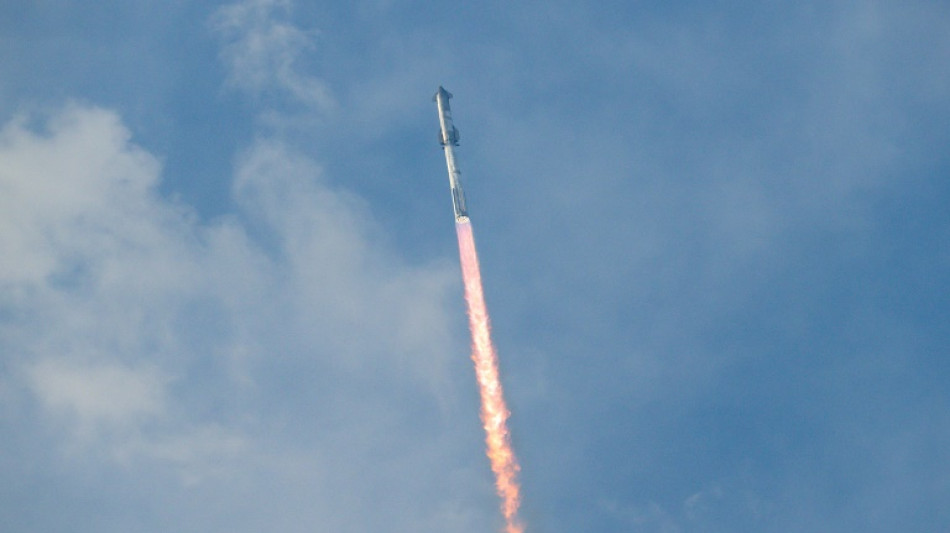
SpaceX mega rocket lost in final phase of test flight / Photo: © AFP

 Voting opens in Alaska's annual Fat Bear Week

 MLS coach axed for telling female ref 'It's a man's game'

 US refuses to give Sudan's de facto leader visa for UN

 Man City hold Bayern to start Women's Champions League, Arsenal win late

 Trump threatens Iran with 'hell' but reveals fresh talks

 Trump signs security deal with Greenland, Denmark at UN

 Trump threatens Iran with 'hell' but unveils fresh talks

 Chile's Atacama Desert blossoms with life after El Nino rains

 Sri Lanka hands 220-year jail terms to 15 convicted of Easter bombings

 Typhoon Dujuan leaves 7 dead in Japan from landslides, flooding: media

 Ganna and Borghini lead Italy to mixed relay gold at cycling worlds

 Drug cocktail killed former child star Hayden Panettiere: coroner

 Moldova declares energy, water emergency

 French Holocaust denier jailed for eight months

 Oil prices slide, AI stock buzz fades

 Trump threatens to 'annihilate' Iran in bombastic UN speech

 Prada's skirts take centre stage as Milan Fashion Week begins

 Quoin Pharmaceuticals Announces FDA Fast Track Designation for QRX003 for the Treatment of Peeling Skin Syndrome

 Brazil's Flavio Bolsonaro turns scandal into poll gains

 Republican senator seeks probe of Trump Jr Russian-funded wedding

 Memoir by Diana's brother goes on sale after rocking UK monarchy

 Newcomers South Korea face holders Italy in Davis Cup finals

 Japan's Kojima sounds Marchand warning with Asian Games gold

 England rugby star Pollock signs new Northampton deal

 STARTRADER Expands Its Chinese Equity CFD Range with CXMT and Unitree Robotics

Starship, the world's most powerful rocket, flew further and faster than ever before during its third test flight Thursday, although it was eventually lost as it re-entered the atmosphere over the Indian Ocean, SpaceX said.
Lift-off from the company's Starbase in southeast Texas came around 8:25 am local time (1325 GMT) and was carried live on a webcast that was eventually watched by more than 3.5 million people on social media platform X.
The sleek mega rocket is vital to NASA's plans for landing astronauts on the Moon later this decade -- and Elon Musk's hopes of eventually colonizing Mars.
Two prior attempts have ended in spectacular explosions, although that's not necessarily a bad thing: The company has adopted a rapid trial-and-error approach in order to accelerate development, and the strategy has brought success in the past.
When the two stages of Starship are combined, the rocket stands 397 feet (121 meters) tall -- beating the Statue of Liberty by a comfortable 90 feet.
Its Super Heavy Booster produces 16.7 million pounds (74.3 Meganewtons) of thrust, almost double that of the world's second most powerful rocket, NASA's Space Launch System (SLS) -- though the latter is now certified, while Starship is still a prototype.
Starship's third launch test in its fully stacked configuration was its most ambitious yet and the company said it was able to meet many of its objectives.
These included opening and closing Starship's payload door to test its ability to deliver satellites and other cargo into space.
High definition footage from an onboard camera showed Starship firing its engines in space, with the curve of the Earth visible in the background. It hit a top speed of more than 26,000 kilometers per hour (16,000 mph) and achieved an altitude of more than 200 kilometers.
Starship flew halfway around the globe, then began its descent phase over the Indian Ocean, with engineers cheering as the craft's heat shield composed of 18,000 hexagonal tiles glowed red hot.
But ground control stopped receiving signals when it was 65 kilometers above sea level, and announcers declared the vessel "lost" before it could achieve its final goal of splashing down in the water.
"Starship will make life multiplanetary," Musk, the company's billionaire founder, posted on X afterward, emphasizing the progress made in this test flight.
- Third time lucky? -
The first so-called "integrated" test came in April 2023. SpaceX was forced to blow up Starship within a few minutes of launch, because the two stages failed to separate.
The rocket disintegrated into a ball of fire and crashed into the Gulf of Mexico, sending a dust cloud over a town several miles (kilometers) away.
The second test in November 2023 fared slightly better: The booster separated from the spaceship, but both then exploded over the ocean, in what the company euphemistically called a "rapid unscheduled disassembly."
SpaceX's strategy of carrying out tests in the real world rather than in labs has paid off in the past.
Its Falcon 9 rockets have come to be workhorses for NASA and the commercial sector, its Dragon capsule sends astronauts and cargo to the International Space Station, and its Starlink internet satellite constellation now covers dozens of countries.
But the clock is ticking for SpaceX to be ready for NASA's planned return of astronauts to the Moon in 2026, using a modified Starship as the lander vehicle.
China is approaching in the rear view mirror, targeting 2030 to land its first crew on the Moon.
Not only does SpaceX need to prove it can launch, fly and land Starship safely -- it must eventually also show it can send multiple "Starship tankers" into orbit to refuel a main Starship for its onward journey to the Moon.
N.Fournier--BTB