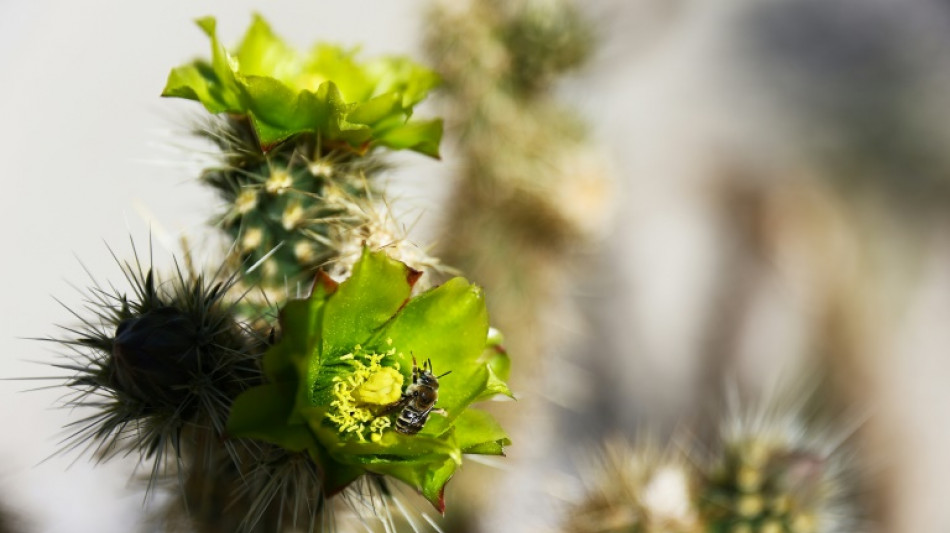
Global warming: even cacti can't take the heat / Photo: © GETTY IMAGES NORTH AMERICA/AFP/File

 Ed Sheeran returns to stage after Palestinian controversy

 Asian Games to open in Japan after troubled build-up

 Drone owners rush to offload devices ahead of Beijing ban

 Trump's beef policies irk Texas ranchers, testing their loyalty

 Nvidia, OpenAI CEOs to attend Xi dinner at White House

 Anthropic picks Accenture for in-house AI safety evaluation

 Balogun returns as Monaco beat Lens to continue strong Ligue 1 start

 'Pause' on overt repression in Venezuela, but reforms still needed: HRW

 Global stocks mixed as yen falls despite Bank of Japan rate hike

 Cuba hit with seventh major blackout of the year

 Murray out with concussion so Wentz will start for Vikings

 UN chief 'deeply regrets' US visa refusal to Abbas for annual meeting

 England quick Carse to face no charges over alleged nightclub assault

 Mancini brings nine newcomers into the first squad of his Italy comeback

 Czechs level Davis Cup tie against USA as South Korea eye Finals

 New France boss Zidane confirms Mbappe as captain after naming first squad

 California governor signs order to explore AI 'kill switch'

 Head leads run spree as Australia win Zimbabwe ODI series

 In-form Raphinha wants to finish career at Barcelona

 Warren Buffett steps down as Berkshire Hathaway chairman

 Carrick confident Man Utd can 'work through' tough time

 Mbappe ends Nike partnership to join Swiss brand On

 Liverpool boss Iraola puts Bournemouth love affair on hold

 'A disaster' if Man City do not win says Maresca after flawless start

 Kerry James Marshall: American 'blackness' painter celebrated in Europe

Sixty percent of cactus species will wind up in less hospitable climates over the coming decades as global warming sets in, according to new research challenging the long-held assumption the iconic desert plants will thrive with more heat.
By 2070, up to 90 percent could be threatened with extinction due to climate change, habitat loss and other stressors, triple the current percentage, scientists reported in Nature Plants.
Some 1,500 species of cacti spread across the Americas live in varying climes, ranging from sea-level deserts to the high Andes mountains, from bone-dry ecosystems to humid tropical forests.
Biodiversity hotspots rich in species and numbers include central Mexico and the Brazilian Atlantic Forest.
To test the notion that cacti will benefit from a warmer and more drought-prone world, researchers led by Michiel Pillet from the University of Arizona examined data on more than 400 species and ran models projecting how they would fare at mid-century and beyond under different greenhouse gas emissions scenarios.
The findings "paint a more pessimistic future," according to the study, published Thursday.
Currently, the main threat to cacti is expanding agriculture, along with land degradation, biodiversity loss and harvesting for various uses.
Even without climate change, cacti "is one of the most endangered groups of organisms on the planet," with more than 30 percent classified as at risk of extinction, the authors note.
Under a moderate emissions scenario in line with current policies, global warming will soon be a significant threat as well.
"Our results suggest that climate change will become a primary driver of cactus extinction risk, with 60 to 90 percent of species assessed negatively impacted" by global warming, the researchers reported.
Within four or five decades, some 25 percent of cacti species could experience unfamiliar climates over a quarter of their current range.
Earlier studies have shown impaired photosynthesis -- the process by which plants use sunlight to make foods from CO2 and water -- with only two degrees Celsius of global warming.
Earth's average surface temperature, including oceans, is already 1.1C warmer than preindustrial times, and about 1.7C warmer over land only.
E.Schubert--BTB